
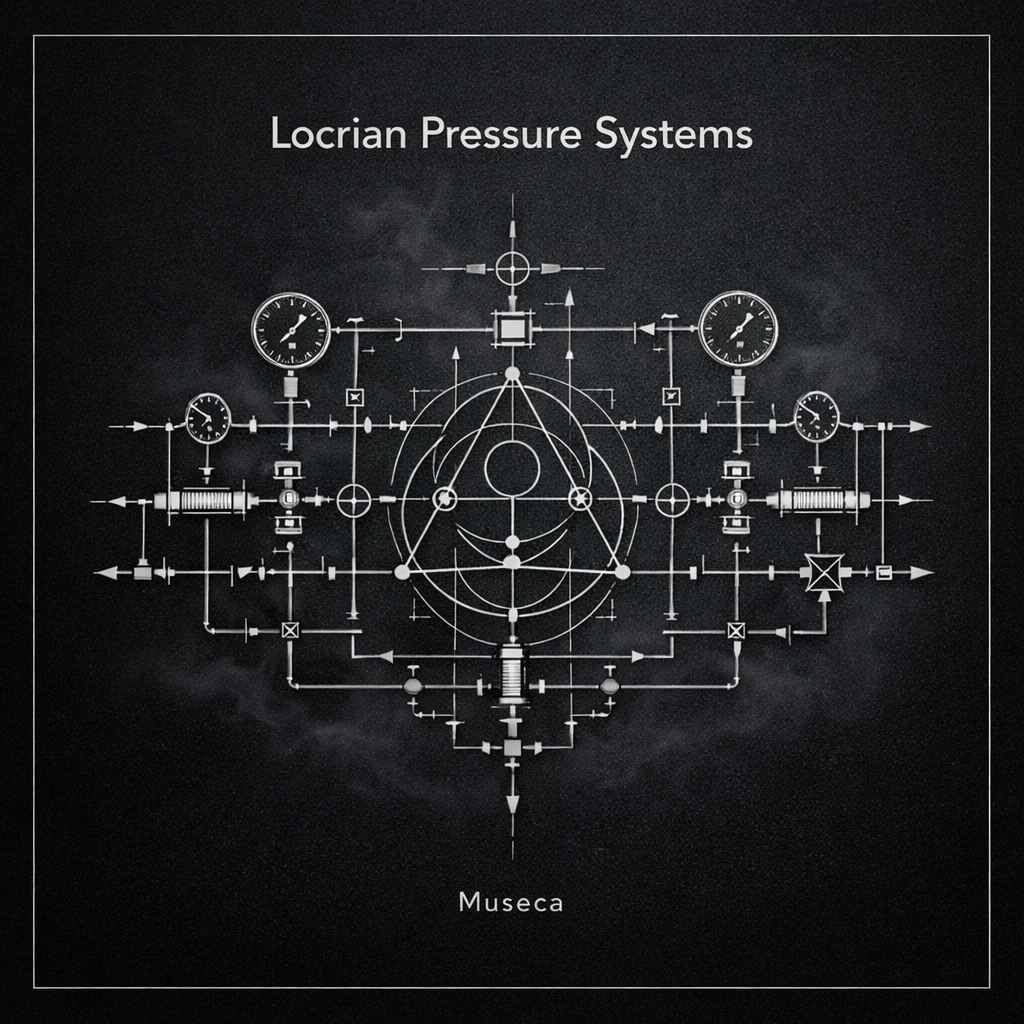
Introduction — Locrian Pressure Systems (Locrian Lounge)
Locrian Pressure Systems is an album of engineered tension. It treats harmony as infrastructure—sealed chambers, calibrated valves, and repetitive systems that accumulate force not through drama, but through persistence. These pieces do not aim for lyrical catharsis or conventional release. Instead, they create the sensation of pressure building inside a closed architecture: a pulse that will not soften, a harmonic field that refuses to resolve, and a rhythmic machine that advances by micro-adjustment rather than spectacle.
At the center of this language is the Locrian mode. In practical terms, Locrian is the seventh mode of the major scale and can be described by its interval formula:
1 – ♭2 – ♭3 – 4 – ♭5 – ♭6 – ♭7
Locrian’s defining trait is the diminished fifth (♭5) above the tonic. That single interval changes everything. In most tonal systems, the fifth is the stabilizing pillar—a structural “beam” that supports the perception of home. In Locrian, that beam is weakened. The tonic chord is diminished rather than major or minor, which means the mode naturally resists the kind of resolution listeners are trained to expect.
That “refusal” is precisely why Locrian can produce this album’s sound world so effectively.
Why Locrian works for pressure-based, system music
Locrian generates tension without needing melody.
Because the tonal center never feels fully secured, a simple repeating figure can remain gripping for long durations. This is ideal for loop-based forms where the musical narrative is created by texture, density, and gradual transformation rather than by harmonic progression.
The ♭2 and ♭5 behave like constant friction points.
In pressure-system terms, these tones function like stress concentrations in a design: small but persistent dissonances that keep the harmonic “container” slightly unstable. When you build ostinatos around these degrees—especially in low registers—the result feels dark, heavy, and unavoidable.
Locrian supports the aesthetic of controlled intensity.
This album’s “pounding” quality does not come from dramatic chord changes. It comes from a stable, repeating mechanical grid—sub-bass pulses, industrial transients, metallic ticks—held under a harmonic climate that never relaxes into comfort. Locrian provides a tonal identity that stays tense even when the rhythm is steady and the arrangement is minimal.
It pairs naturally with symmetrical systems like octatonic.
Several tracks in the album orbit the octatonic scale (whole–half / half–whole), which is built from repeating interval cycles. Octatonic symmetry and Locrian instability complement each other: octatonic creates the sense of a designed lattice, while Locrian provides gravitational dread. Together, they produce the album’s signature feeling—architecture under stress.
Ultimately, Locrian Pressure Systems reframes Locrian not as a “forbidden” mode, but as a sophisticated tool for modern composition: a way to write music that feels industrial, nocturnal, cerebral, and immersive—where the tension is structural, the rhythm is procedural, and the emotional effect is the slow, hypnotic certainty of pressure accumulating inside a perfectly sealed machine.
Liner Notes
Pressure Lattice — D Octatonic (Whole–Half)
The blueprint track: a rigid, symmetrical pitch-grid that behaves like architecture under load. The whole–half octatonic set removes ordinary tonal “comfort zones,” so repetition doesn’t relax—it tightens. The groove is built from pressure pulses and metallic micro-transients, with motion coming from incremental filter drift, density changes, and subtle re-voicings rather than harmonic travel.
Pressure Lattice — D Octatonic (Whole–Half) (Version 2)
Octatonic Pressure (Minus the 5th) — “Locri-octa”
A deliberate destabilization protocol. By deprioritizing the fifth (the interval that typically supplies structural reassurance), the harmony feels less like a scale and more like a diagnostic environment—clinical, compressed, and slightly volatile. The tension is maintained through close-interval friction and sustained midrange weight, with a sense of constant internal torque rather than melodic release.
Valve Arithmetic — D Locrian ⇄ Octatonic Pivots
A control-panel piece where harmony behaves like switching logic. Locrian’s weakened “home” is used as the pressure source, while octatonic symmetry functions as the regulating mechanism—opening, closing, and recalibrating the system in small increments. Motifs are short and computational; rests and staccato attacks operate like mechanical stops, keeping the track taut even in minimal materials.
Killbox Grid — C Octatonic (Half–Whole)
Sharper geometry, faster activation. The half–whole octatonic color brings semitone friction to the front of the spectrum, producing a heightened sense of alert containment. The grid is the narrative: repeating cells, hard edges, and an engineered inevitability, with the arrangement intensifying by layering, spectral brightening, and increasingly tight rhythmic alignment.
Manifold Drift — E Locrian (Phased / Polymetric Feel)
A distribution system under pressure—one center, many channels. The harmonic content remains disciplined, but layered pulses drift slightly out of phase, creating a slow polymetric shimmer (the sensation of 3:4 or 5:4 without overt complexity). Locrian’s gravity keeps the track dark and unresolved while texture and timing supply the forward motion.
Hydraulic Hammer — D Locrian (Pounding Pressure Mix)
The album’s heaviest subsystem: dark, relentless, and physically present. The pounding is not “drop culture”; it’s controlled compression—sub-thump as a repeating force, industrial hits as impact testing, metallic ticks as calibration. Locrian is used here as pure structural tension: a tonal center that asserts itself while refusing to stabilize, producing a hammering persistence that feels engineered rather than emotional.
Venturi Mirage — A Locrian (Turbulence Arpeggios)
Speed without spectacle. Like airflow through a narrowing channel, arpeggios create turbulence and perceived acceleration, while the underlying pulse stays restrained and precise. Locrian’s interval profile keeps the arpeggiated motion from turning bright or triumphant; the result is sleek circuitry—unstable, luminous at the edges, and always on the verge of pressure shift.
Relief Valve Ascension — D Locrian (Controlled Discharge)
Not a resolution—an intentional vent. The track widens its voicings and thins its density over time, letting the system exhale without ever turning sentimental. The final arc is structural: less cluster, more space; fewer impacts, more air; tension converted into release through orchestration and spectrum rather than harmonic cadence. The machine does not stop—it simply discharges and fades back into silence.
Playlist
- Pressure Lattice — D Octatonic (Whole–Half) Museca 3:06
- Pressure Lattice — D Octatonic (Whole–Half) (Version 2) Museca 3:06
- Octatonic pressure (minus the 5th) — “Locri-octa” Museca 3:35
- Valve Arithmetic — D Locrian ⇄ Octatonic pivots Museca 4:59
- Killbox Grid — C Octatonic (Half–Whole) Museca 4:40
- Manifold Drift — E Locrian, phased layers Museca 4:59
- Hydraulic Hammer — D Locrian (Pounding Pressure Mix) Museca 5:08
- Relief Valve Ascension — D Locrian, controlled discharge Museca 6:32