
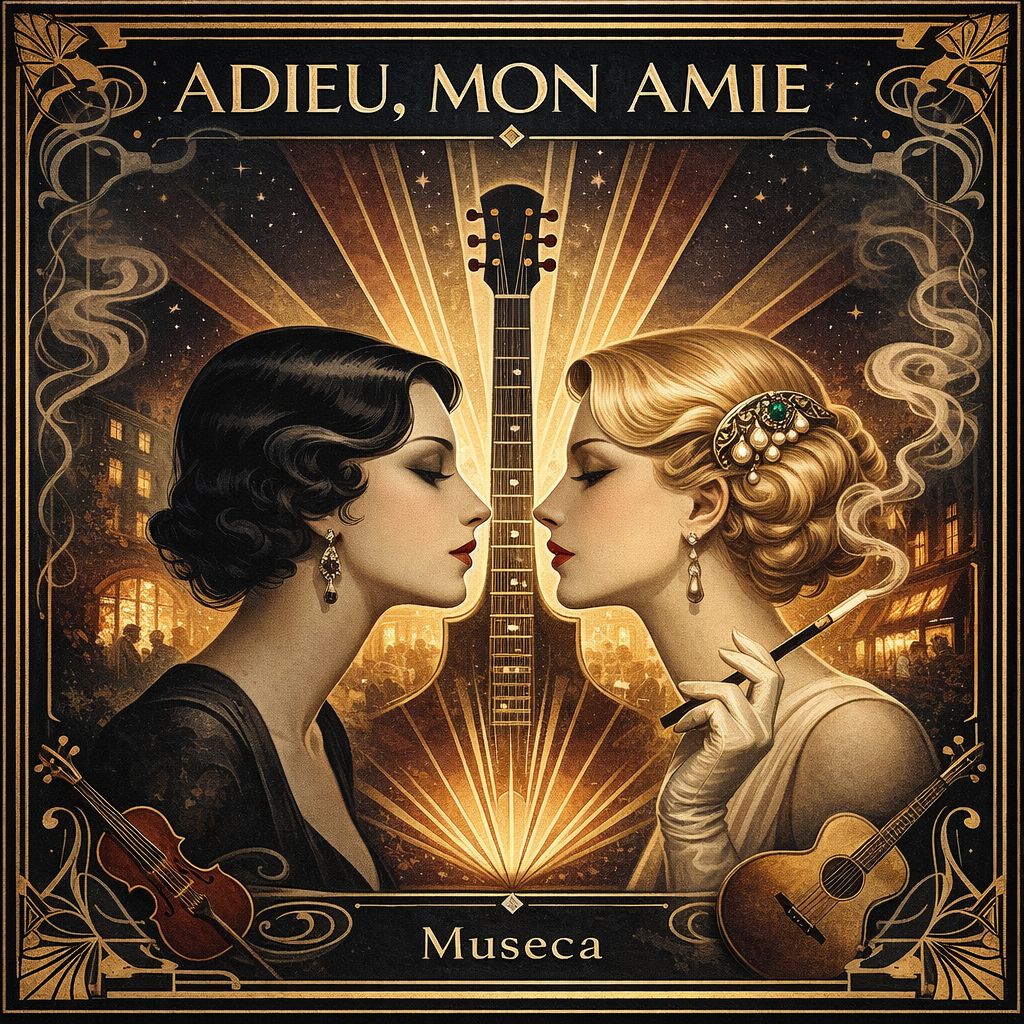
Adieu, Mon Amie
A Story with Music from the Last Days of Montmartre
Paris, 1935.
The jazz is hot, the champagne is cold, and La Grosse Pomme is alive with music. In a smoky Montmartre club, Django Reinhardt’s guitar laughs and weeps while Stéphane Grappelli’s violin soars and answers — two masters in conversation. And between them, a young French singer named Celeste Dupont finds her voice for the first time.
In the audience, a German woman raises her glass — a stranger with secrets of her own.
Over four extraordinary years, these two women will forge an unlikely friendship against the backdrop of Europe’s most vibrant jazz scene. But both are hiding dangerous truths. And as the world hurtles toward war, their bond will be tested by forces far greater than themselves.
Adieu, Mon Amie is a short story with an original eight-song soundtrack, inspired by the legendary gypsy jazz of Django Reinhardt, Stéphane Grappelli, and the Quintette du Hot Club de France. Set in the final golden years before World War II, it tells a tale of art, espionage, and a friendship that defied borders.
The music captures the joy, intimacy, and heartbreak of an era on the edge of darkness — from the celebratory swing of a packed jazz club to the fragile silence of a final goodbye.
Featuring:
- A six-chapter short story set in Paris, 1935–1939
- Eight original songs in authentic 1930s gypsy jazz style
- Themes of friendship, identity, and the cost of loyalty
- The spirit of Django Reinhardt, Stéphane Grappelli, and the Hot Club de France
Some bonds transcend the borders that divide us.
But sometimes love means letting go.
Entre nous. Toujours.
Between us. Always.
Download the Complete Story
Experience the full journey of Celeste and Katarina — from that first audition in 1935 to the final goodbye at Gare du Nord. Download Adieu, Mon Amie: A Story with Music from the Last Days of Montmartre as a PDF and read the complete six-chapter short story with all eight songs and lyrics, ready to accompany you as you listen to the soundtrack.
Adieu, Mon Amie
Liner Notes
1. Overture: Montmartre, 1935 (Instrumental)
Before a single word is spoken, the music sets the scene. A lone guitar awakens on the cobblestone streets of Montmartre as dawn breaks over Paris. The melody searches, tentative at first, until a violin answers — playful, flirtatious — and suddenly the night comes alive. This instrumental overture introduces the world of La Grosse Pomme: the swing, the smoke, the electricity of Django and Grappelli finding each other in musical conversation. But listen closely to the fourth movement, where a new theme emerges — something European, formal, slightly out of place. A stranger has arrived. Two worlds are about to collide.
2. La Petite Chanteuse (The Little Singer)
Celeste Dupont stands on the edge of a small stage in a secondhand green velvet dress, auditioning for the greatest jazz musicians in Europe. This song captures the terrifying hope of that moment — a young woman from Belleville who carries her dead mother’s dream in her throat. When Django strikes a chord in A minor and tells her to “sing what you feel,” Celeste discovers that her voice is not just technique but truth. The song is her origin story: nervous verses giving way to triumphant chorus, the moment a hat shop girl becomes la petite chanteuse. And in the bridge, she notices for the first time the mysterious woman watching from the corner, raising a glass in silent recognition.
Lyrics
[Intro — Solo acoustic guitar, Django-style arpeggios, intimate café ambience]
[Verse 1]
Secondhand dress and a borrowed dream
Standing where the blue smoke curls
A chord rings out like a question mark
Will you catch me when I fall?
[Verse 2]
Mama never made it to the stage
But she left her song in me
Now I’m standing in the amber light
Singing us both free
[Chorus]
La petite chanteuse, finding her voice
La petite chanteuse, making her choice
One song to open the door
One note to say I am more
Than the girl from Belleville
[Instrumental Break — Violin enters, weaving around guitar]
[Verse 3]
The Gypsy watches with ancient eyes
His fingers know my soul
He strikes a chord in A minor
And I surrender all control
[Chorus]
La petite chanteuse, finding her voice
La petite chanteuse, making her choice
One song to open the door
One note to say I am more
Than the girl from Belleville
[Bridge — Softer, vulnerable]
A stranger raises her glass to me
Across the smoky room
I don’t know her name, don’t know her game
But something shifts too soon
[Final Chorus — Building, triumphant]
La petite chanteuse, I found my voice
La petite chanteuse, I made my choice
The door is open wide
Mama’s dream alive inside
The girl from Belleville
[Outro — Guitar fades, single violin note holds, then silence]
[Whispered] Merci…
3. La Grosse Pomme (The Big Apple)
Eight months later, Celeste is no longer trembling — she’s soaring. This uptempo celebration captures the intoxicating peak of 1936 Paris, when the jazz clubs burst with artists from every corner of the world and tomorrow was just a rumor. The song pulses with the energy of a packed house at La Grosse Pomme, where Django’s guitar argues with God and the whole room sings along. But woven through the joy is a thread of mystery: “She watches from the front row seat / With winter in her eyes.” Celeste and Katarina’s friendship has begun to deepen, though questions remain unasked. The final toast — “To La Grosse Pomme, and to forgetting” — hints that Katarina is running from something she cannot name.
Lyrics
[Intro — Upbeat guitar rhythm, violin flourishes, crowd chatter fading in then under]
[Verse 1]
Montmartre lights are burning bright
The Seine is dressed in gold
Every doorway swings with jazz tonight
And every heart is sold
[Verse 2]
Americans and Africans
And dreamers from the south
We speak in rhythm, not in words
Music is our mother tongue
[Chorus]
La Grosse Pomme, take a bite
Sweet and red and ripe tonight
Django plays and Stéphane sways
And we chase the dark away
La Grosse Pomme, hold me tight
We’re alive, we’re alive tonight
[Instrumental Break — Guitar and violin trading fours, crowd clapping]
[Verse 3]
She watches from the front row seat
With winter in her eyes
But when I sing, I see her smile
Like sunrise through the blinds
[Verse 4]
Pour the champagne, raise it high
Tomorrow’s just a rumor
Tonight we own this Paris sky
And nothing lasts forever
[Chorus]
La Grosse Pomme, take a bite
Sweet and red and ripe tonight
Django plays and Stéphane sways
And we chase the dark away
La Grosse Pomme, hold me tight
We’re alive, we’re alive tonight
[Bridge — Slower, more intimate]
She says she comes to forget herself
I wonder what she’s hiding
But the music’s loud and the wine is sweet
And some questions can keep waiting
[Final Chorus — Full energy, crowd joining]
La Grosse Pomme, take a bite
Sweet and red and ripe tonight
Every soul beneath this roof
Is beautiful and living proof
La Grosse Pomme, one more song
Sing it with me, sing along
We’re alive, we’re alive
We’re alive tonight!
[Outro — Music fades to single guitar, then the clink of glasses]
[Spoken, over fading music] To La Grosse Pomme… and to forgetting.
4. Entre Nous (Between Us)
On a rainy night in March 1937, with the club empty and the bartender gone home, two women finally stop pretending. This intimate ballad is the heart of the story — the moment when Katarina confesses she is not a music teacher, and Celeste reveals her own secret life as a French intelligence operative. The song transforms what should be betrayal into something sacred: “Two liars who forgot to lie / Beneath a weeping sky.” Rather than becoming enemies, they forge a pact to protect each other, feeding their handlers crumbs and shadows while keeping their friendship holy. The sparse arrangement — solo guitar, a violin weaving melancholy — mirrors the vulnerability of two women building a country of their own, population two, borders drawn in trust.
Lyrics
[Intro — Solo guitar, slow and intimate, rain ambient fading beneath]
[Verse 1]
The rain keeps all our secrets safe
The empty room holds no disguise
Tonight we shed the masks we wear
And see with naked eyes
[Verse 2]
You are not what you pretend to be
And neither, love, am I
Two liars who forgot to lie
Beneath a weeping sky
[Chorus]
Entre nous, just between us two
A country with no borders
Entre nous, where the only truth
Is the trust we give each other
Let the world draw battle lines
We’ll meet where no one sees
Entre nous, mon amie
Just you and me
[Instrumental Break — Violin enters softly, weaving a melancholy line]
[Verse 3]
Your letter came with heavy words
Demands I cannot keep
How can I betray the only soul
Who’s seen me while I sleep?
[Verse 4]
So we’ll feed them crumbs and shadows
Give them nothing that is real
This one thing we will keep sacred
This one wound we will not heal
[Chorus]
Entre nous, just between us two
A country with no borders
Entre nous, where the only truth
Is the trust we give each other
Let the nations raise their flags
We’ll build our own frontiers
Entre nous, mon amie
Through the years
[Bridge — Sparse, almost spoken]
They trained us both to watch and wait
To gather, to betray
But here, tonight, we make a pact
That will not fade away
[Final Chorus — Slower, more fragile]
Entre nous, when the world has burned
And borders turn to dust
They’ll never know, they’ll never find
This stubborn, tender trust
Entre nous, mon amie
Entre nous, c’est promis
Just between us
[Outro — Guitar alone, last notes fading into silence]
[Whispered] Entre nous…
5. Before the Storm (Avant l’Orage)
By November 1938, the posters have appeared: Préparez-vous. Prepare yourselves. This urgent, building song captures the desperate energy of people dancing on the edge of an abyss. Katarina has received a letter recalling her to Berlin; Celeste has offered to run away with her. But escape is impossible — disappearing would endanger everyone they love. So instead they choose defiance: one more show, one more night, holding hands while the lightning gathers. The music mirrors their tension — Django playing like time is short, Grappelli’s bow crying — while the lyrics insist on the present tense: “Before the storm, I choose you / Before the flags tell us what to do.” It is a love song to borrowed time.
Lyrics
[Intro — Urgent guitar rhythm, violin building tension, distant thunder ambient]
[Verse 1]
Posters on the walls tonight
Telling us to prepare
The city holds its breath and waits
For thunder in the air
[Verse 2]
Your letter came with iron words
They’re calling you back home
But home is just a word for where
They bury what you’ve known
[Chorus]
Before the storm, hold my hand
Before the lightning strikes the sand
We don’t know what tomorrow brings
So tonight we are everything
Before the storm takes it all
We stand defiant, we stand tall
Let them draw their battle lines
Tonight, you’re mine
[Instrumental Break — Guitar and violin in urgent conversation, building intensity]
[Verse 3]
You say we cannot run, not yet
The shadows follow close
But I would burn the world entire
To save what matters most
[Verse 4]
So we’ll dance upon the precipice
And laugh into the wind
The only sin is not to live
Before the end begins
[Chorus]
Before the storm, hold me tight
Before they try to dim our light
We’ll give them smoke and misdirection
Guard this fragile resurrection
Before the storm breaks the door
We have tonight, who needs more?
Let the thunder do its worst
I loved you first
[Bridge — Slower, more desperate]
Django plays like time is short
Grappelli’s bow is crying
The whole room feels what we can’t say
Something beautiful is dying
But not yet — no, not yet
We have this hour, this breath, this set
One more song before the fall
One more night to have it all
[Final Chorus — Full intensity, almost defiant]
Before the storm, I choose you
Before the flags tell us what to do
Let nations rise and empires shake
There’s only so much they can take
Before the storm, hear me sing
You are my country, my everything
When the lightning finds us here
We will not disappear
[Outro — Music suddenly drops, single guitar, fragile]
[Sung softly] Before the storm…
[Whispered] Hold on…
[Final notes fade into the sound of rain]
6. One Last Song (Une Dernière Chanson)
September 1, 1939. Germany has invaded Poland. France will be at war within days. La Grosse Pomme opens its doors for the last time, and Celeste takes the stage knowing that Katarina — dressed in her gray traveling coat, suitcase at her feet — will board a train in one hour and disappear into the machinery of war. This heartbreaking ballad is the song Celeste has been writing in fragments for a year, finally given voice in the only moment that matters. Django’s guitar weeps; Grappelli’s violin prays. When Celeste reaches the final verse, she looks directly at Katarina and sings across the room, across the war already swallowing them. The door swings shut. The train whistle fades. Nothing will ever be the same.
Lyrics
[Intro — Solo guitar, slow and mournful, the sound of a room holding its breath]
[Verse 1]
The radio crackles with the news
The world we knew is falling
You stand there in your traveling coat
And I can hear you calling
[Verse 2]
One suitcase and a photograph
Is all you’re taking with you
A thousand nights inside this club
Now down to just a few
[Chorus]
One last song before you go
One last truth we’ll ever know
The borders close, the lights go dim
But you’ll live underneath my skin
One last note to say goodbye
One last reason not to cry
Hold it in your heart, mon amie
One last song from me
[Instrumental Break — Violin enters, weaving around the guitar like two voices saying farewell]
[Verse 3]
Django plays like he understands
Grappelli’s bow is praying
The whole room knows what we can’t say
But no one else is staying
[Verse 4]
You raise your hand across the room
I reach for you through smoke and tears
Four years of truth in lives of lies
Worth more than all my fears
[Chorus]
One last song before we part
I’ll stitch you deep inside my heart
The trains are leaving, clocks run down
But love like ours won’t stay underground
One last note, then you are gone
But something lives inside this song
Carry it wherever you may be
One last song from me
[Bridge — Stripped down, almost spoken]
They told us we were enemies
Two flags that couldn’t fly together
But here, inside this smoky room
We built our own forever
It wasn’t long enough — it’s never long enough
But it was true
And true is all I ever wanted
From me to you
[Final Chorus — Fragile, breaking]
One last song before the night
One last moment in the light
I see you standing by the door
I’ll love you now and evermore
One last note — the door swings wide
One last breath before you’re outside
Entre nous, toujours, mon amie
One last song…
[Outro — Guitar alone, fading]
[Whispered] …from me
[Silence. Then, very faint: the sound of a train whistle in the distance]
7. Celeste’s Lament (La Complainte de Celeste)
Two weeks after Katarina’s departure, Celeste returns alone to the shuttered club. The chairs are stacked, the piano draped in white, Django’s chair still angled as if he just stepped away. This sparse, aching song is not a performance — it’s a prayer sent into the void. Celeste doesn’t know if Katarina is in Switzerland, or if she’s already been swallowed by a Germany she no longer recognizes. She sings anyway, hiding Katarina’s name in every melody, leaving her photograph behind the bar where they once hid their private cognac. The song ends a cappella, just a voice in an empty room: “Entre nous… toujours…” It is grief and hope intertwined — the stubborn belief that music survives what borders destroy.
Lyrics
[Intro — Single guitar, sparse and lonely, the sound of an empty room]
[Verse 1]
The chairs are stacked, the lights are low
The music faded long ago
I stand where we used to stand
Your photograph in my hand
[Verse 2]
The dust is settling on the keys
The violin has lost its voice
But somewhere in these silent walls
I still can hear our choice
[Chorus]
Where are you now, mon amie?
Across the borders, across the sea
Do you hear me when I sing
Into the dark, into the nothing?
I don’t know where you are tonight
I don’t know if you’re alright
But I’ll keep singing just in case
You remember my face
[Instrumental Break — Guitar alone, wandering, searching]
[Verse 3]
I leave my picture by the bar
Where we hid the good cognac
A breadcrumb trail, a whispered prayer
That someday you’ll come back
[Verse 4]
The war is here, the world has changed
But one thing stays the same
In every song I’ll ever sing
I’ll hide your name
[Chorus]
Where are you now, mon amie?
Do you think of La Grosse Pomme and me?
When the bombs fall and the borders burn
Will you find your way to return?
I don’t know what tomorrow holds
I don’t know how this story ends
But I’ll keep singing through the years
Through all my tears
[Bridge — Fragile, almost breaking]
They say that music is just air
Vibrations that disappear
But I know better now, my love
You’re living in what I hear
Every note, a piece of you
Every silence, something true
The song remembers what we were
When all else becomes a blur
[Final Chorus — Quiet, but with growing resolve]
So I will sing, mon amie
Until you find your way to me
The club is dark, the stage is bare
But I am here, I’m always here
And if you never come again
If war has swallowed where you’ve been
Know that somewhere, someone sings
A lament for beautiful things
[Outro — Voice alone, no accompaniment]
[A cappella, tender]
Entre nous… toujours…
Entre nous…
[Long silence. Then, very faint: a door closing gently]
8. Adieu, Mon Amie (Reprise) (Final)
The album closes as it began — with fragments of melody, now transformed by everything we’ve witnessed. The reprise weaves together themes from all the previous songs: the hopeful arpeggios of “La Petite Chanteuse,” the joyful swing of “La Grosse Pomme,” the vulnerable intimacy of “Entre Nous,” the urgency of “Before the Storm.” Celeste’s voice moves through them like someone walking through rooms of memory, touching each doorframe one last time. The spoken bridge delivers the story’s quiet thesis: “Four years. Eight songs. One truth: Some people change everything just by listening.” As the final whispered “Adieu” fades, a distant guitar begins the Overture melody again — suggesting that somewhere, somehow, the music continues. The story ends, but the song survives.
Lyrics
[Intro — Solo guitar, playing fragments of “La Petite Chanteuse” melody, slow and reflective]
[Verse 1 — Soft female vocal enters]
We were strangers in the smoke
Two liars learning how to speak
You raised your glass across the room
Before we’d even learned to seek
[Instrumental — Violin plays the “Entre Nous” theme, guitar underneath]
[Verse 2]
The big apple, sweet and bright
We danced before the storm arrived
You taught me how to tell the truth
By showing me how you survived
[Chorus — Building slowly]
Adieu, mon amie
Though the world has come between
Adieu, mon amie
You’re in every song I sing
The borders close, the years go by
But some things never say goodbye
Adieu, mon amie
You’re still here with me
[Instrumental Break — Guitar plays “Before the Storm” motif, violin answers with “One Last Song” melody, interweaving]
[Verse 3]
I left my photograph behind
In the place we used to hide
And every night I wonder if
You’re singing on the other side
[Verse 4]
The club is dark, the chairs are stacked
The war has taken all we had
But in the silence, I still hear
Your voice turning sad to glad
[Final Chorus — Full but tender]
Adieu, mon amie
Not goodbye, just “until we meet”
Adieu, mon amie
Every ending is a heartbeat
The music lives in those who stay
And those who had to walk away
Adieu, mon amie
Toujours, you and me
[Bridge — Spoken over sparse guitar]
[Spoken, softly]
Four years. Eight songs. One truth:
Some people change everything just by listening.
[Outro — A cappella, fragments of all the songs woven together]
[Sung, fading]
La petite chanteuse… finding her voice…
La Grosse Pomme… we’re alive tonight…
Entre nous… just between us two…
Before the storm… hold my hand…
One last song… from me…
Where are you now… mon amie…
[Final line, barely a whisper]
Adieu… toujours… adieu…
[Silence. Then, very distant: a guitar begins to play — the Overture melody, as if starting again. It fades before it fully forms, leaving only the suggestion of continuation.]
Entre nous. Toujours.
Playlist
- Overture: Montmartre, 1935 Museca 2:20
- La Petite Chanteuse Museca 2:53
- La Grosse Pomme Museca 3:11
- Entre Nous Museca 4:05
- Before the Storm Museca 3:40
- One Last Song Museca 4:30
- Celeste's Lament Museca 4:17
- Adieu, Mon Amie (Reprise) Museca 1:34