
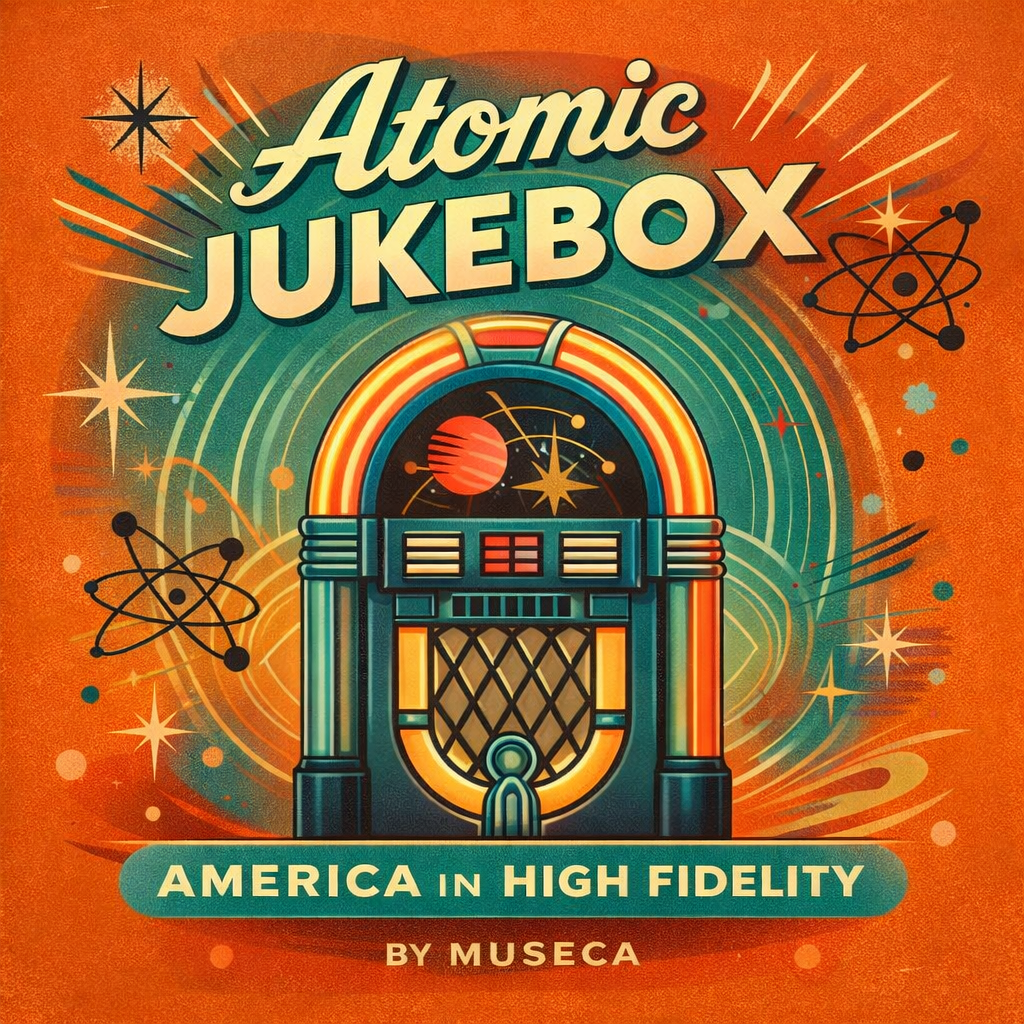
Atomic Jukebox: America in High Fidelity
The 1950s didn’t just change music—they plugged it in, turned it up, and let it shake the nation. Atomic Jukebox is a vibrant musical time capsule that captures the pulse of postwar America at the moment it discovered rebellion, rhythm, and romance—all pressed into wax and played loud enough to wake the future.
This album is not a tribute—it’s a reimagining. Each track is an original composition built in the spirit of the decade’s defining genres: the swagger of rockabilly, the swoon of crooners, the poetry of folk, the uplift of gospel, and the midnight moods of cool jazz. From corner jukeboxes to revival tents, malt shops to smoky clubs, this is the sound of a country searching for itself—and dancing through the static.
You’ll hear voices that dream, defy, shout, and swoon. A jukebox doesn’t ask you to pick a side—it just spins whatever song the moment needs. That’s the spirit we’ve captured here: eleven snapshots in high-fidelity color, crackling with charm, tension, and a little bit of comic mischief.
So drop in a coin, hit play, and let this atomic jukebox sing.
One nation, under groove—with liberty and reverb for all.
Liner Notes
Jukebox Commotion
The album kicks open with a burst of rockabilly energy—slap bass, twangy guitar, and teenage chaos erupting in a Memphis diner. This is where rebellion learned to dance. The jukebox doesn’t just play music—it starts a riot.
Blue Moonlights
A velvet doo-wop ballad crooned beneath Harlem streetlamps, where four-part harmony turns heartbreak into poetry. Every snap, falsetto, and echo feels like a love letter written in the sky and folded into sound.
Bop City Nights
Cool jazz walks in after midnight—brushed drums, muted trumpet, modal piano lines curling like cigarette smoke. It’s less a song and more a conversation whispered from the edge of a late-night San Francisco stage.
The Elvis Effect
High-voltage teen hysteria, as seen through the diary of a girl who just saw the King on TV. A rock & roll rave-up with punchlines and pelvises, where lipstick meets feedback and hormones meet 45 RPMs.
Highway 45
A country ballad that hums like an engine and aches like a letter never sent. It’s honky-tonk heartbreak on a Southern road—steel guitar sliding through memories as the past fades in the rearview.
Test Pattern Love
A lounge-pop oddball that finds romance in late-night static. As the television signs off, two awkward lovers tune in to something wordless and weirdly wonderful. Whistling optional. Charm required.
Shout Sister, Shout!
A gospel-rock burner lit by electric guitar and revival fire. Inspired by Sister Rosetta Tharpe, this is where the spirit stomps, the chords testify, and the walls shake with sacred rhythm.
Flat Top Rebellion
Raw electric blues growls from a back alley in Chicago. It’s youth in ducktail hair and switchblade swagger—amplified attitude with bottleneck grit. Rules were made to be bent. These strings were made to howl.
Red Scare Rag
A satirical folk tune served with banjo and paranoia. Equal parts protest and parody, it grins through the fog of Cold War absurdity. Duck, cover, and try not to rhyme “McCarthy” with “party.”
Falling for You in Mono
A crooner’s love song heard through one speaker, one heart. Lush strings and lounge piano wrap around a voice dipped in velvet. You don’t need stereo when the emotion is this pure.
Atomic Jukebox Finale
Every genre takes a bow in this riotous closing medley—a final spin through rock, jazz, gospel, country, and doo-wop, mashed together like a jukebox on fire. The dial is broken. The music is eternal.
Postscript: When the Dial Changed
The music you hear on Atomic Jukebox was born in a moment when America itself was changing frequency.
The 1950s marked a true musical revolution in the United States—not a clean break from the past, but a charged collision of traditions. As the nation emerged from wartime restraint and postwar conformity, its music began to reflect something restless and electric. Youth culture surged forward. Regional sounds crossed borders. Racial traditions that had long shaped American music moved closer to the center of the national conversation.
Rock and roll was born in this decade—but it did not rise alone. Blues, jazz, country, gospel, and pop evolved simultaneously, feeding one another and reshaping the musical landscape. What emerged was not a single sound, but a new attitude: louder, looser, more personal, and unmistakably modern.
In contrast to the 1940s—an era dominated by big band swing, formal orchestras, and radio-centered performance—the 1950s shifted toward individual voices and iconic personalities. Technology accelerated the change. Shellac 78s gave way to vinyl LPs and 45s. Jukeboxes became cultural engines. Television turned musicians into visual phenomena. The electric guitar rewired rhythm itself.
Music moved out of ballrooms and into bedrooms, diners, churches, garages, and street corners.
Several defining ideas took root during this decade:
Rock and roll fused rhythm and blues, country, and gospel into a driving new language of youth—marked by strong backbeats, simple chord progressions, and electric intensity.
Teenagers emerged as a musical force, not just an audience. Songs spoke directly to their desires, frustrations, romances, and rebellions.
Black and white musical traditions intersected more visibly than ever before. African-American artists shaped the sound of the era, while crossover success—sometimes celebrated, sometimes complicated—reshaped American popular music.
The 45 RPM single and the jukebox democratized success, allowing regional artists to break nationally.
Television transformed performance into spectacle, making charisma as important as sound.
Jazz evolved inward and outward at once—bebop maturing into cool jazz and hard bop, favoring mood, space, and experimentation.
Doo-wop brought harmony-driven street music into the mainstream, turning sidewalk serenades into chart-topping hits.
The artists of the 1950s were not merely entertainers; they were catalysts. From the raw swagger of early rock and roll to the elegance of crooners, from gospel fire to electric blues grit, these musicians reshaped how America heard itself.
Atomic Jukebox draws from this entire ecosystem—not to recreate it note-for-note, but to honor its spirit. Each track is an original composition shaped by the forces that defined the decade: invention, friction, joy, fear, faith, romance, rebellion.
This was the sound of a nation tuning itself—sometimes clumsily, sometimes brilliantly—toward a new future.
And once the dial changed, there was no going back.
— Museca
Playlist
- Jukebox Commotion Museca 2:19
- Blue Moonlights Museca 3:15
- Bop City Nights Museca 4:02
- The Elvis Effect Museca 2:33
- Highway 45 Museca 3:08
- Test Pattern Love Museca 2:55
- Shout Sister, Shout! Museca 2:48
- Flat Top Rebellion Museca 2:40
- Red Scare Rag Museca 2:35
- Falling for You in Mono Museca 3:41
- Atomic Jukebox Finale Museca 2:19