
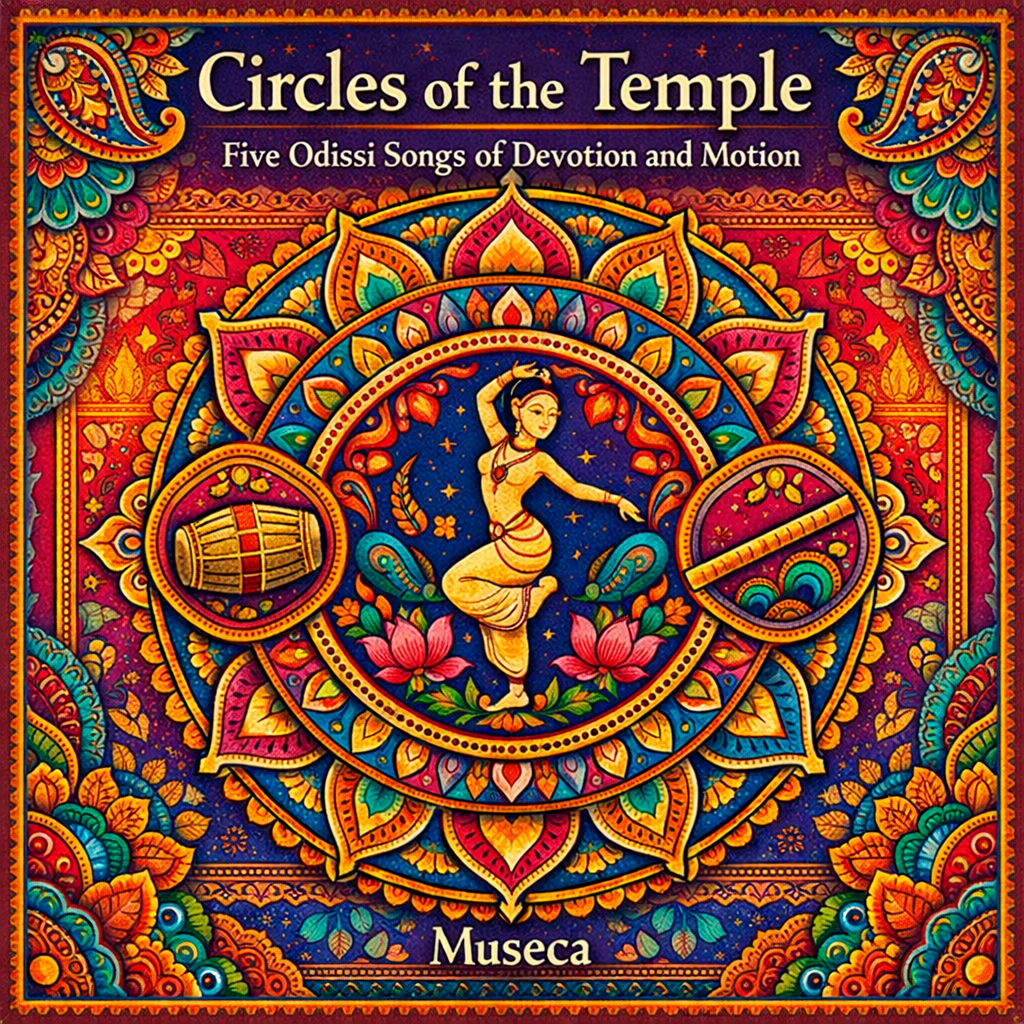
Circles of the Temple
Five Odissi Songs of Devotion and Motion
Circles of the Temple is a five-song EP inspired by Odissi music, the classical tradition of Odisha (eastern India). Odissi is more than a style—it is a living archive of temple culture, poetry, and embodied rhythm, shaped over centuries alongside Odissi dance. Where many listeners first encounter it through dance performance, Odissi music stands on its own as a refined classical system: devotional in purpose, lyrical in expression, and architectural in rhythm.
Historically, Odissi grew within the sacred world of the Jagannath Temple at Puri and the wider cultural ecosystem of Odisha’s poet-saints and courtly arts. A defining milestone is the 12th-century masterpiece Gīta Govinda by Jayadeva, whose song-poems set a high standard for how melody (rāga), rhythm (tāla), and spiritual emotion could merge into a single expressive act. In this tradition, music is not merely entertainment—it is offering, remembrance, and reverent storytelling. The texts often explore devotion as intimacy: longing, tenderness, awe, surrender, and joy, all treated with dignity rather than melodrama.
Odissi’s musical identity is shaped by two central ideas. First is rāga—not simply a scale, but a melodic personality with characteristic turns, emphasized tones, and expressive pathways. Odissi phrasing is famously curved and circular, favoring graceful motion over straight-line virtuosity, as if the melody itself were tracing temple carvings in air. Second is tāla, the rhythmic cycle, animated in Odisha by the mardala, a drum whose crisp articulation and dance-centered design give Odissi its distinctive pulse. The rhythm does not only “keep time”; it creates a structure for breath, gesture, and meaning—much the way a temple creates a structure for movement and prayer.
This EP honors that lineage by treating each track as a different “hour” in the same sacred space: tenderness (Ananda Bhairavi), grandeur (Sree), twilight reflection (Barādi), longing (Chinta Kamodi), and morning lift (Panchama). The instrumentation—mardala, bansuri, violin, and drone—serves a single goal: to let melody and rhythm return again and again to the same spiritual center. In Odissi, repetition is not redundancy; it is devotion. The circle is the form of remembering—of coming back, refining the feeling, and arriving closer to what cannot be said in words.
Liner Notes
Ananda, Quiet and Deep
This opening piece rests in the tender warmth of Ananda Bhairavi, a rāga associated with intimacy, grace, and inward devotion. The music unfolds in soft curves, with the mardala guiding a gentle, dance-aware pulse rather than asserting rhythmic dominance. Bansuri and violin move like paired breaths, circling the voice and returning again and again to stillness. The mood is one of quiet arrival—the moment before prayer becomes language—where devotion is felt more than spoken.
Temple Steps of Sree
Anchored in the dignified gravity of Sree rāga, this track adopts a slow, processional character shaped by a ten-beat Jhampā cycle. The rhythm feels architectural, as if each beat were a stone step worn smooth by centuries of movement. Melody is spacious and deliberate, allowing silence to play an active role. Rather than yearning forward, the music stands tall and composed, evoking the measured pace of entering a sacred space where reverence is expressed through restraint.
Evening Lamp in Barādi
Set in Barādi, a rāga often associated with twilight, this piece inhabits the hour when light softens and motion slows. The seven-beat cycle creates a gentle sway, neither hurried nor static, mirroring the ritual lighting of lamps at dusk. Melodic lines curve patiently, and the dialogue between flute and violin feels conversational, almost reflective. This is music for the threshold between day and night, where devotion takes on a contemplative glow.
Chinta Kamodi: The Unsaid Name
This track explores the emotional depth of Chinta Kamodi, a rāga colored by longing and quiet ache. The six-beat tāla flows smoothly beneath the surface, supporting phrases that feel suspended rather than resolved. Here, yearning is not dramatic; it is inward and disciplined, shaped by soft ornamentation and careful pacing. The music lingers on what remains unspoken, allowing desire itself to become an act of devotion.
Panchama Morning: Lotus in Motion
The closing piece turns toward light. Panchama rāga, paired with a crisp four-beat Ekatāli, brings clarity, lift, and gentle joy. The rhythm is clean and grounded, inviting movement without urgency, while melodic phrases open outward like petals responding to the sun. After the introspection of the earlier tracks, this piece offers release—a reminder that devotion can also be bright, simple, and unburdened. It ends the cycle not with finality, but with renewal.
Together, these five works form a single arc: a series of musical circles that move through stillness, dignity, twilight, longing, and light—always returning to the same center, where sound becomes presence.
Playlist
- Odissi Ananda Bhairavi Museca 2:18
- Temple Steps of Sree Museca 3:55
- Evening Lamp in Barādi Museca 3:38
- Chinta Kamodi: The Unsaid Name Museca 3:43
- Panchama Morning: Lotus in Motion Museca 3:36