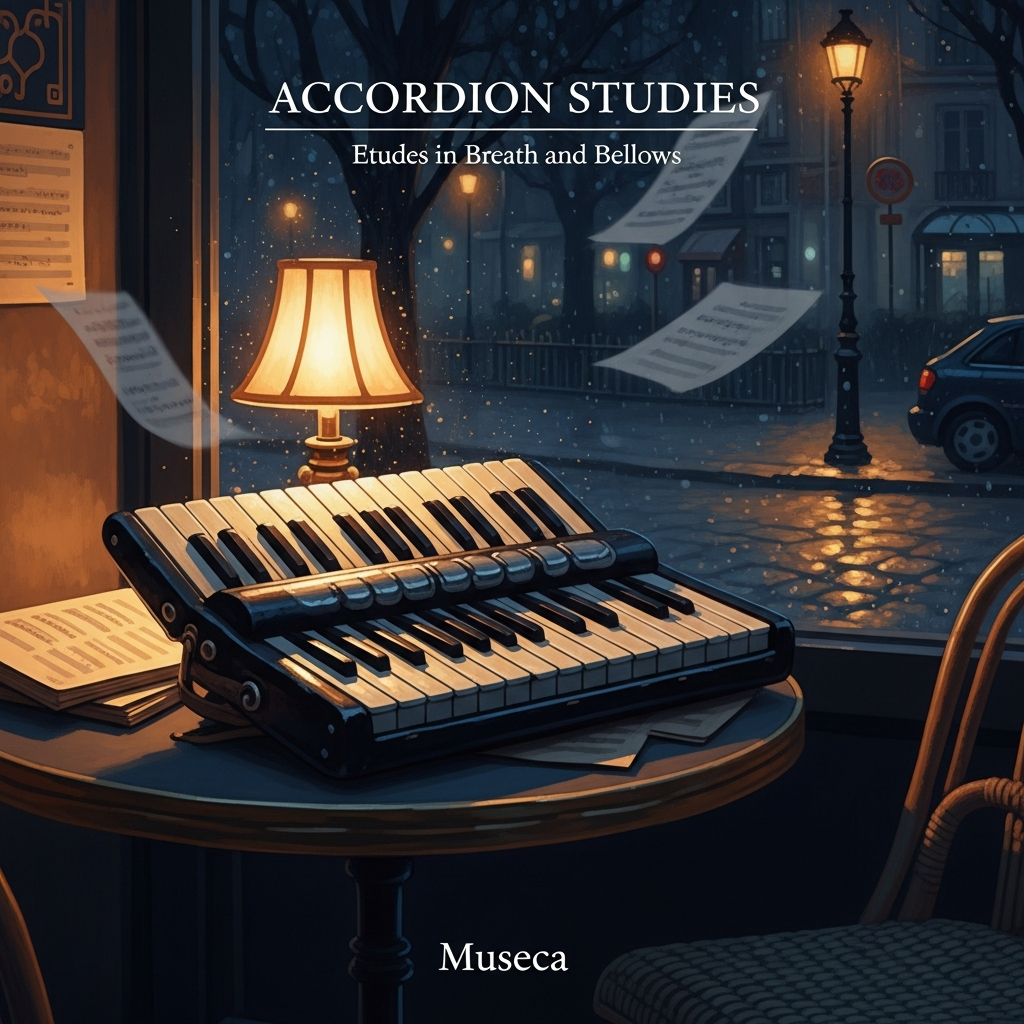
Accordion Studies is a focused portrait of the accordion as both instrument and storyteller—an instrument that breathes, whispers, snaps, and sings with a distinctly human pulse. This album is designed as a practical set of etudes, but it is also a cinematic walk through the accordion’s expressive identities: the shimmering elegance of Paris musette, the smoky restraint of noir, the rhythmic bite of manouche swing, the modern clarity of chamber counterpoint, and the hard-edged drama of nuevo tango.
Each study isolates a single “truth” of accordion writing—registration color, bellows-driven phrasing, Stradella motion, ornament craft, and articulation—then turns that technical focus into a complete miniature scene. The result is a collection that can be listened to as a suite of vivid vignettes, or used as a compositional toolkit: a reference library of groove engines, tone palettes, and phrasing strategies that make the accordion feel inevitable rather than decorative.
By the end, the album resolves as a unified language: one motif, many masks—held together by the same breath, the same bellows, and the same intimate sense that every note is physically lived into existence.
Liner Notes
Rue des Lanternes (Musette Waltz Study)
A straight Paris café waltz built as a discipline of inevitability: rubato as the curtain-raiser, then the unblinking oom-pah-pah that makes musette feel like a living street. The study is less about harmony than about gravity—how the bellows can “lean” into a phrase until the melody feels spoken, not played.
Neon on the Seine (Noir Accordion Cue Study)
This track treats the accordion as a camera close-up. The air in the bellows becomes audible emotion: hesitation, suspicion, tenderness. Chromatic shadows and restrained dynamics evoke a private scene—one figure, one cigarette ember, one thought that refuses to resolve.
Bal Musette à Montmartre (Manouche Swing Study)
Here the accordion steps into a tighter suit: comping discipline, rhythmic clarity, and the agility to solo without losing the pocket. The étude highlights the instrument’s dual identity—harmony machine and melodic acrobat—inside the brisk social electricity of a Paris swing floor.
Glass Reeds, Thin Light (Free-Bass Chamber Study)
A study in modern transparency: the left hand is liberated as a true contrapuntal voice, and the sound world narrows to timbre, interval, and breath. Rather than accompaniment, the accordion becomes a chamber organism—three voices moving with quiet inevitability, tension held in the smallest distances.
Midnight Arrastre (Nuevo Tango Study)
This is articulation as drama. Marcato stabs, arrastre swells, and sudden silences create a physical narrative—steps, pivots, stops. The study focuses on attack and release: how the accordion can strike like a blade, then immediately become a whisper.
Cassotto Mirrors (Register Study)
One theme, three identities: dry clarity, wet shimmer, and the mellow, inward glow of a cassotto-like color. The point is not “variation” as composition, but variation as photography—the same face under different streetlights, each revealing a different truth.
Bellows Ladder (Dynamics Study)
An étude of sustained control: each phrase is a single long breath that swells and retreats without breaking. Bellows tremolo and near-silent air noise are treated as expressive tools, not imperfections—proof that the accordion’s emotion is inseparable from its physiology.
Circle Keys (Stradella Motion Study)
This track is the engine room. Fast harmonic motion, circle-of-fifths logic, and clean Stradella punctuation turn the left hand into a precision drivetrain. The right hand responds with sequenced motifs and arpeggios—athletic, bright, and unapologetically functional.
Ornament Streetlight (Grace Note Study)
A chanson-style lesson in taste: ornaments are not decoration but syntax. Grace notes, turns, and appoggiaturas act like quick glances and half-spoken confessions, shaping the emotional contour while the accompaniment stays modest—present, supportive, and never in the way.
Suite des Études (Final Study)
The album’s closing argument: one motif wearing four masks—musette, noir, swing, and tango—stitched together with seamless transitions and purposeful breath. It is a recap not as a medley, but as a statement that the accordion’s technique is ultimately narrative: the same voice, told in different dialects.
Playlist
- Rue des Lanternes (Musette Waltz) Museca 1:35
- Neon on the Seine (Noir Accordion Cue) Museca 2:23
- Bal Musette à Montmartre (Manouche Swing) Museca 2:05
- Glass Reeds, Thin Light (Chamber Study) Museca 2:48
- Midnight Arrastre (Nuevo Tango) Museca 2:11
- Cassotto Mirrors (Register Study) Museca 1:28
- Bellows Ladder (Dynamics Study) Museca 1:39
- Circle Keys (Stradella Motion Study) Museca 0:54
- Ornament Streetlight (Grace Note Study) Museca 1:24
- Suite des Études (Final Study) Museca 1:37