
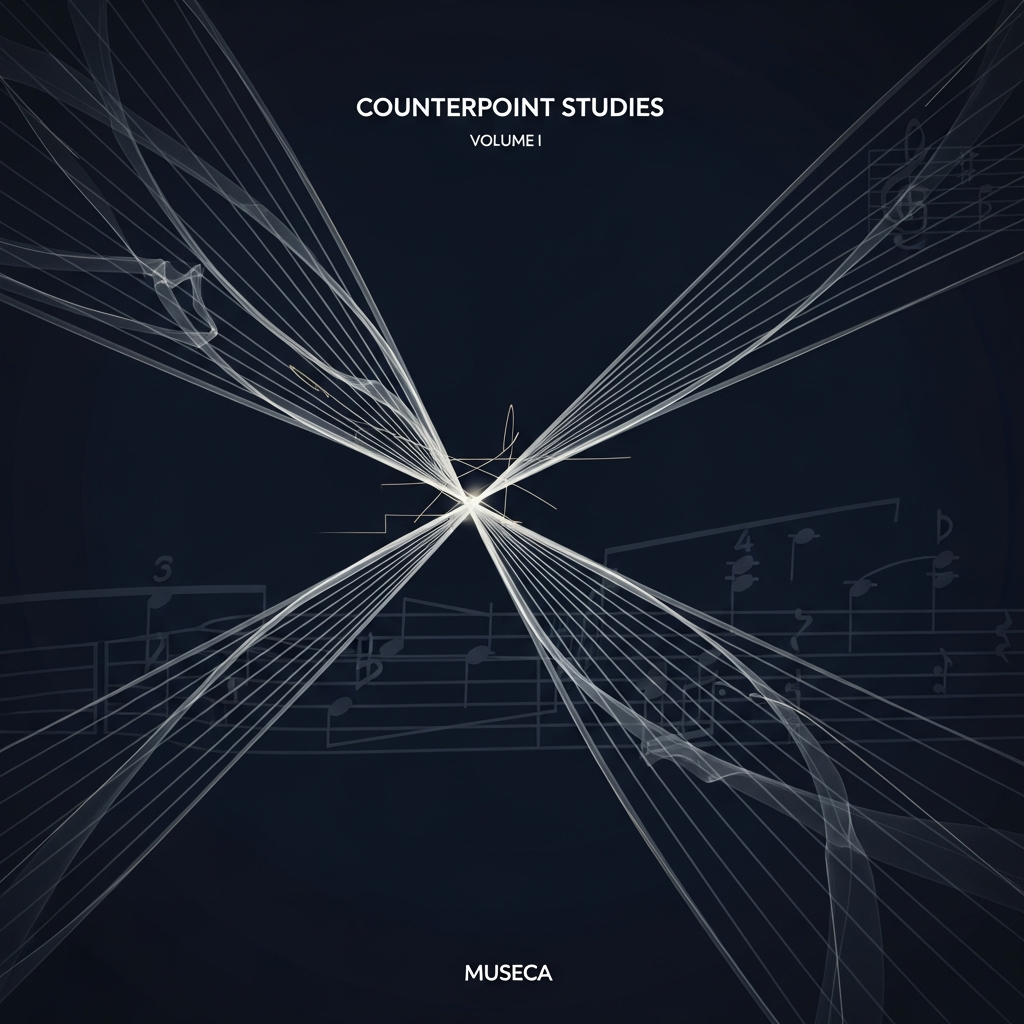
Counterpoint Studies, Vol. I is a set of pieces that wears two identities at once: a listening album and a clear, friendly guide to the craft of counterpoint. Each track is built from independent melodic lines—voices that think for themselves—so harmony is not “laid down” as chords, but emerges from motion, conversation, and timing.
The journey begins with intimate two-voice writing and gradually opens into fuller architectures: canon, invention, fugue-like stretto, and finally the luminous density of modern micropolyphony. You can enjoy these works purely as expressive chamber music—warm, searching, and alive—or you can listen a second time with the notes in hand and hear exactly how the lines are constructed. Either way, the premise is the same: when multiple voices remain independent, something deeper than accompaniment becomes possible—music that feels like thought turning into light.
Listener’s Guide — Counterpoint in plain language
What you’re listening for
Counterpoint is the art of writing more than one meaningful melodic line at the same time. Instead of “a melody with chords underneath,” you get multiple melodies that interlock. The beauty comes from how they cooperate:
Imitation: one voice echoes another’s idea.
Contrary motion: one line rises while another falls (creates clarity and lift).
Suspension: a note “hangs” briefly against the harmony, then resolves (the sigh effect).
Staggered entries: new lines join while others continue, like a conversation where no one stops talking.
You do not need theory to hear it. Just try to follow one line for a few seconds, then switch to another. The piece will feel three-dimensional.
Canon (Round) — “the same melody chasing itself”
A canon is the most disciplined kind of counterpoint. One voice sings a melody, then a second voice enters later with the exact same melody, and sometimes a third voice joins as well.
How it sounds: like a single idea creating a braid.
What to listen for: the moment the second entry begins—suddenly the first melody becomes both “leader” and “background” at the same time.
Invention — “a small idea explored intelligently”
An invention starts with a short motif and treats it like a theme in a lab: it gets repeated, flipped, shifted, sequenced, and handed from voice to voice. A two-part invention has two main lines; a three-part invention adds a third.
How it sounds: nimble, articulate, and “designed.”
What to listen for: the motif moving into different registers, and how the voices trade roles—no one stays accompaniment for long.
Fugue (and fughetta) — “entries, answers, and controlled momentum”
A fugue is a more formal cousin of the invention. A main theme (the subject) enters in one voice, then another voice enters with it (often on a different pitch level, an answer), while the earlier voice continues with a supporting line (a countersubject or free counterpoint).
A fughetta is simply a shorter fugue—compact but built the same way.
How it sounds: purposeful and architectural—like a structure assembling itself.
What to listen for: repeated subject entries returning at new moments, especially when they arrive before the previous one has finished (see stretto below).
Stretto — “the chase scene”
Stretto is a special fugue technique where subject entries come in closer together, overlapping like voices interrupting each other on purpose.
How it sounds: energized, urgent, tightly woven.
What to listen for: the feeling of acceleration without a tempo change—created purely by earlier, tighter overlaps.
Micropolyphony — “a cloud made of tiny lines”
Micropolyphony is advanced modern counterpoint associated with Ligeti: many voices move in close steps and slight time offsets, forming a shifting cluster. Instead of hearing a few distinct melodies, you hear a living harmonic cloud—but it is still made of individual lines.
How it sounds: a glowing fog, constantly changing.
What to listen for: slow internal motion—like watching light move through mist. The emotion is in the swell, tension, and release of density, not in a singable tune.
Liner Notes
Dance of Two Strings
This opening piece introduces counterpoint at its most human scale. Two independent voices move together without hierarchy, trading momentum and space like partners in motion. The listener can hear how harmony is not fixed in advance, but negotiated moment by moment through contrary motion, imitation, and breath. The clarity of two voices makes the mechanics audible, but the goal is expressive flow rather than demonstration.
What This Heart Is For (Instrumental Counterpoint)
Here the music explores subject and countersubject in a warm, lyrical setting. A central melodic idea is stated, then answered while the original line continues with a complementary thought. No instrument functions as accompaniment; each line carries intention. The emotional quality comes from interdependence—questions forming, answers reshaping the question, and meaning emerging only through interaction.
Canon on a Doorway (Strict Round Study)
This piece is built from discipline rather than expansion. A single melody enters, then returns in other voices at fixed intervals, unchanged. What transforms is not the material but the context: each re-entry reframes the line, creating depth through overlap alone. The doorway metaphor reflects the sensation of crossing the same threshold multiple times and finding it altered by presence rather than novelty.
Mirror Invention (2→3 Part Invention)
The invention begins with a small musical idea and treats it as something to be examined from every angle. First heard in two voices, the motif is inverted, sequenced, and redirected. When a third voice enters, the texture deepens without losing transparency. The pleasure lies in hearing intelligence at work—how coherence is maintained even as complexity increases.
Stretto Engine (Modern Pulse Fughetta)
Momentum defines this piece. Fugue-like entries arrive in quick succession, overlapping before earlier statements have resolved. The result is not speed but pressure: ideas insisting on coexistence. A subtle pulse supports the motion, but the true engine is contrapuntal timing. The piece demonstrates how energy can be generated entirely through voice interaction rather than external rhythm.
Polyphonic Study No. 1 — Six Voices of Light
With six independent lines, counterpoint becomes a fabric rather than a conversation. Each voice remains melodic, yet harmony arises only from collective motion. At times, consonance appears unexpectedly when lines align; at others, tension hovers as voices pass closely without settling. The light referenced in the title is not brightness, but clarity—many strands visible at once.
Polyphonic Study No. 2 — Twelve Voices of Shadowed Light
This work moves into modern territory, using dense micropolyphony to create a living harmonic cloud. Twelve voices move stepwise, slightly offset in time and register, forming clusters that shift continuously. The listener may not track individual lines, yet the emotional arc remains palpable: swelling intensity, compression, and eventual release. The darkness here is not absence, but depth—Romantic expression refracted through contemporary technique.
Coda: Dissolving Cloud
The album closes by thinning rather than resolving. Voices gradually separate, spacing widens, and density gives way to quiet resonance. What remains is an afterimage of motion, as if the lines have stepped out of hearing but not out of memory. The counterpoint does not conclude with a statement, but with space—allowing the listener to carry the conversation forward.
Playlist
- Dance of Two Strings Museca 1:34
- What This Heart Is For (Instrumental Counterpoint) Museca 2:05
- Canon on a Doorway (Strict Round Study) Museca 1:29
- Mirror Invention (2 → 3 Part Invention) Museca 1:24
- Stretto Engine (Modern Pulse Fughetta) Museca 0:47
- Polyphonic Study No. 1 — Six Voices of Light Museca 2:29
- Polyphonic Study No. 2 — Twelve Voices of Shadowed Light Museca 5:40
- Coda: Dissolving Cloud Museca 1:13