
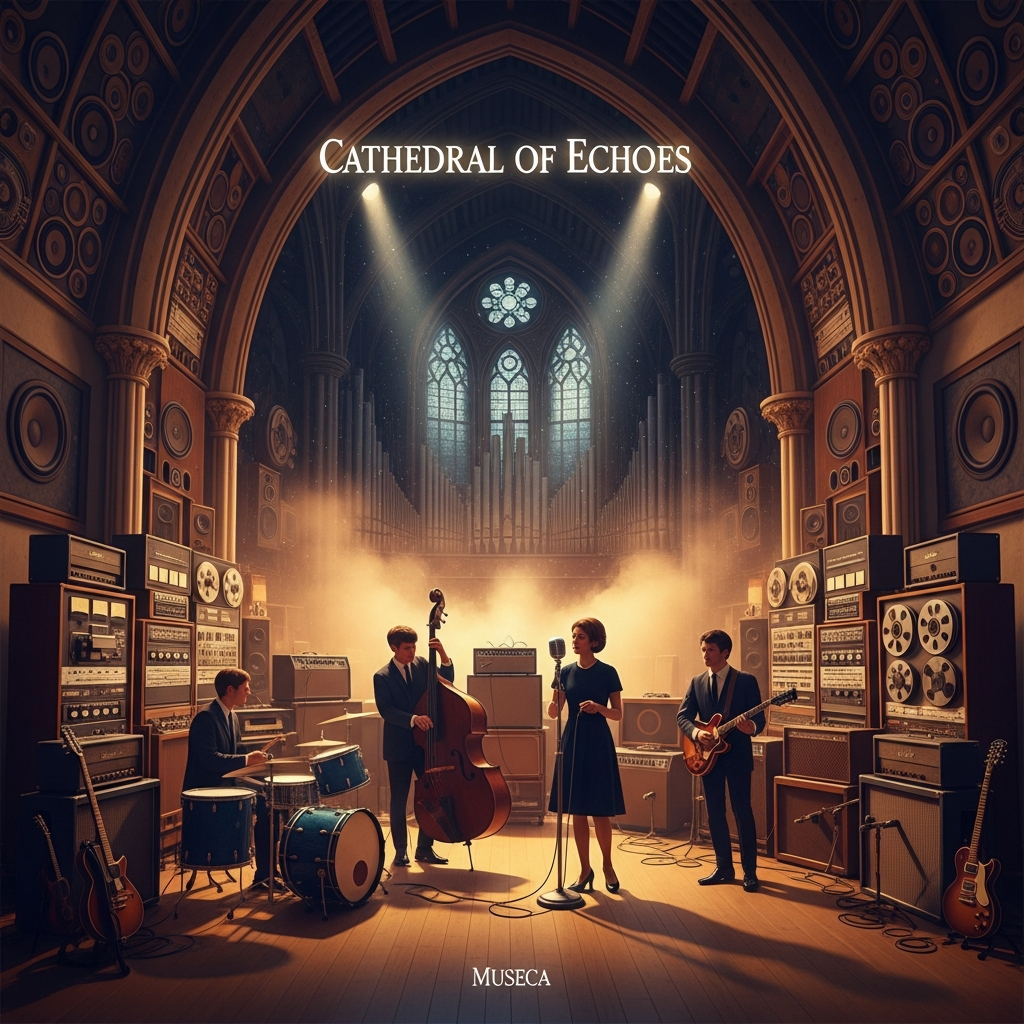
Cathedral of Echoes – Album Introduction
Cathedral of Echoes is a three-song mini-cycle built around a simple idea:
some loves never quite end – they just keep ringing in the spaces we leave behind. Each track is a different room in that emotional architecture: the intimate ache of memory, the radio signal of a lost connection, and finally the vast, consoling space where sound and feeling become a single, resonant whole.
“Echoes of You” opens the album as the most personal chamber. It is the moment when a single memory fills an entire interior world – a voice, a refrain, a face that refuses to fade. The arrangement embraces the Phil Spector–inspired Wall of Sound: layered pianos, guitars, strings, and backing vocals are not presented as separate parts, but as one woven fabric, like light filtered through stained glass. The density is deliberate; it mirrors how one relationship can occupy every available emotional frequency.
“Broken Radio Valentine” moves that same longing into the modern landscape: highways at night, static between stations, searching the dial for a song that will never quite come in clearly again. The Wall of Sound concept becomes a metaphor for the radio itself – powerful drums and tambourine, orchestral swells, and choirs rising behind the lead vocal create the feeling of waves of sound pressing in from all sides. The production nods to Spector’s mono philosophy even in stereo form: not a collection of isolated instruments, but a single, engulfing broadcast of feeling.
“Cathedral of Echoes,” the title track, is the culmination – a spiritualization of the entire idea. Here, the Wall of Sound becomes an actual “cathedral”: organ, strings, layered pianos, guitars, and choir are treated as pillars, arches, and vaults of resonance. The reverb is not just an effect; it is the air that carries the hymn. This is where the Spector influence is most explicit: big drums, long echo tails, and a symphonic approach to pop harmony transform a love song into something liturgical. The lyric imagines memory itself as a sacred hall where every tear, kiss, and goodbye is carved into stone and continues to sing long after we have left.
Throughout the album, the Wall of Sound is used in the spirit of Phil Spector’s original intention: not as nostalgia or imitation, but as a way to make the emotional core of each song feel larger than life. Layers, echo, and density are employed as expressive tools – a way of saying that some experiences are too big for a dry, minimal mix. Cathedral of Echoes is, at its heart, about how love, once truly felt, never fully disappears. It reverberates – through memory, through sound, and through the unseen chambers we build inside ourselves.
Liner Notes
Echoes of You
“Echoes of You” is the emotional gateway into the album’s world. At its core, it is a simple love song: one person, one memory, one voice that refuses to disappear. But the arrangement is purposely written to feel much larger than the story of two people. This is where the Wall of Sound influence first reveals itself.
The track is built around a classic, emotionally direct harmonic language in the spirit of early 1960s pop ballads: strong, clear progressions that support the vocal rather than compete with it. Underneath the melody, multiple pianos and guitars double one another, creating a harmonic “fog” that feels more like one big instrument than a collection of separate players. Strings enter not as a soloist, but as a glowing halo around the song, thickening the midrange and lifting the choruses into a more cinematic register.
Reverb here is not an afterthought; it is the environment in which the song exists. The drums, tambourine, and backing vocals all feed into a shared echo space that nods to Phil Spector’s Gold Star chamber. Instead of using reverb merely to add distance, it is used to “glue” every element into a single emotional mass. The result is a track that feels like a memory playing inside a cathedral of its own making—a voice carried by waves of sound that will not stop ringing, long after the last note has technically ended.
Lyrically, “Echoes of You” is about that persistent emotional resonance: the way someone’s presence continues to be felt in small phrases, in fragments of melody, in the uninvited flash of a remembered moment. The Wall of Sound production mirrors this idea by never allowing the listener to sit in silence; there is always a tail, always a reflection, always one more echo of the person at the center of the song.
Lyrics
Verse 1
The night remembers your name,
I hear it in every refrain.
Your shadow dances in time,
Still calling me across the line.
Pre-Chorus
I built a dream we never knew,
Each note still beats for you…
Chorus
Echoes of you — fill the air,
Every heartbeat says you’re there.
In the glow, through the tears,
Love keeps ringing through the years.
Echoes of you — never fade,
In this wall of sound we made.
Verse 2
Your voice, a whisper of fire,
Wrapped in the wires of desire.
Every chord I play tonight,
Burns like the last city light.
Pre-Chorus
If love’s a song that won’t come true,
I’ll keep on singing through…
Chorus (repeat)
Echoes of you — fill the air,
Every heartbeat says you’re there.
In the glow, through the tears,
Love keeps ringing through the years.
Echoes of you — never fade,
In this wall of sound we made.
Bridge
Every drumbeat is your name,
Every echo feels the same.
If silence falls, I’ll break it through —
With the echo, echo of you.
Final Chorus (grand)
Echoes of you — fill the air,
Every dream still finds you there.
Hearts collide, but never die,
Our forever multiplies.
Echoes of you — pure and true,
This wall of sound… is you.
Broken Radio Valentine
“Broken Radio Valentine” shifts the setting from interior memory to the outer world—cars on the highway, neon lights, and the restless scan of a radio dial. It is a love song set in motion, driven by the image of someone trying to tune in a relationship that no longer comes in clearly. Static, crackle, and fading reception become metaphors for distance, miscommunication, and the impossibility of perfectly recovering what has been lost.
Musically, the track leans into the rhythmic, radio-ready aspect of the Wall of Sound. The drums and tambourine lock into a steady, heartbeat-like pulse, with bass, pianos, and guitars layered in thick, doubled lines that give the impression of one huge rhythm section playing as a single creature. The arrangement is deliberately dense but never chaotic—each doubled instrument slightly detuned and time-shifted so that the blend shimmers rather than blurs.
The reverb and echo here are used to evoke the feeling of listening to a powerful station at the edge of its range. Vocals bloom into the chamber and return with a soft haze around them, as if the lead voice were being broadcast from a distant yet intimate place. The choruses are designed to feel “bigger than the speakers,” swelling with strings, backing choir, and harmonies that arrive in layers, like overlapping late-night transmissions.
In the lyric, the singer chases a song across the dial, hearing traces of the past in every fragment that breaks through the static. This is very much in the Spector tradition: a pop ballad that treats teen (and adult) heartbreak with nearly operatic seriousness. “Broken Radio Valentine” is both a narrative and a sound painting—the story of a relationship that cannot be fully tuned back in, told in a language of frequency, signal, and noise, rendered through the density and glow of a modern Wall of Sound.
Lyrics
Verse 1
Static on the line tonight,
Your song fades in and out of light.
I twist the dial, I chase your name,
Through every frequency of blame.
Pre-Chorus
Every station, every tune,
I’m just trying to find you…
Chorus
Broken radio Valentine,
Your love is lost between the lines.
In every crackle, every sigh,
I hear the way we said goodbye.
Broken radio, still I try,
To tune you back into my life.
Verse 2
Billboards blur and cities glow,
I drive through memories I know.
Your favorite chorus hits the air,
And suddenly you’re everywhere.
Pre-Chorus
I hold my breath, the volume high,
Praying you’ll reply…
Chorus
Broken radio Valentine,
Your love is lost between the lines.
In every crackle, every sigh,
I hear the way we said goodbye.
Broken radio, still I try,
To tune you back into my life.
Bridge
If I could call the DJ in the sky,
I’d ask for one last lullaby.
Spin our song and let it play,
Till all the noise just melts away.
Final Chorus
Broken radio Valentine,
You’re still the ghost in every line.
Through all the static, all the pain,
I’d fall in love with you again.
Broken radio, one last time,
Fade with me across the night.
Outro
Just a broken radio Valentine…
Still searching for your light.
Cathedral of Echoes
The title track, “Cathedral of Echoes,” is the album’s culmination and its most explicit statement of intent. If the first song is the private chamber of memory and the second is the restless search through the airwaves, this final piece is the moment where all of that longing finds a larger home. Love, loss, and remembrance are lifted into a quasi-sacred context; the emotional life becomes a liturgy, and sound itself becomes a form of prayer.
To reflect that, the arrangement steps fully into the symphonic side of Phil Spector’s legacy. A sustained organ part anchors the track, functioning as both harmonic support and symbolic “organ of the cathedral.” Around it, strings, layered pianos, guitars, and a full choir are carefully stacked to form a sonic architecture: pillars of harmony, arches of melody, and vaulted ceilings of reverb. The drums and percussion are bold but not aggressive—each snare hit designed to send a shockwave into the echo chamber, causing long, breathtaking tails that feel like the building inhaling and exhaling.
The chorus declares the central image—“In this cathedral of echoes…”—and the production takes that line literally. The vocal is surrounded by a choral aura, with backing voices placed like distant choirs high in the rafters of the mix. Reverb is intentionally long and enveloping; everything is routed through a shared “air,” so the track does not sound like a band in a room, but like a living, breathing space made entirely of sound.
Lyrically, this song suggests that no experience of love is ever truly wasted. Every joy, every wound, every apology, and every goodbye becomes part of a vast inner hall where nothing is lost, only transformed into resonance. The Wall of Sound technique—originally conceived to make pop records feel monumental through mono speakers—is reinterpreted here as a metaphor for emotional continuity. It is the idea that long after the physical moment has passed, the impact of love continues to ring within us, as persistent and immersive as a great reverberant chamber.
Lyrics
Verse 1
I lit a candle in my mind,
For every moment left behind.
Your footsteps ring in vaulted air,
Like quiet prayers that linger there.
Pre-Chorus
In every arch of memory,
Your voice keeps calling me…
Chorus
In this cathedral of echoes,
Our love still rises, soft and slow.
Every heartbeat, every tone,
Carved in chambers made of stone.
In this cathedral of echoes,
I’m never truly alone.
Verse 2
Stained-glass colors made of sound,
Falling in ribbons all around.
I hear your laughter in the choir,
A halo made of pure desire.
Pre-Chorus
The past and present start to blend,
Where all our broken pieces mend…
Chorus
In this cathedral of echoes,
Our love still rises, soft and slow.
Every heartbeat, every tone,
Carved in chambers made of stone.
In this cathedral of echoes,
I’m never truly alone.
Bridge
If silence is the sacred aisle,
I’ll walk it for a little while.
Then let the organ shake the sky,
As every echo multiplies.
Final Chorus
In this cathedral of echoes,
We are the hymn the heavens know.
Every tear and every kiss,
Folded into halls of bliss.
In this cathedral of echoes,
Our love keeps ringing on…
Outro
Long after we are gone.
“Cathedral of Echoes” closes the mini-album by bringing the concept full circle: three songs, one emotional architecture. The Wall of Sound, as pioneered by Phil Spector, is honored not through imitation but through philosophy. The density, the echo, the orchestral layering—all are used in service of a single statement: that human feeling, when fully expressed, is too large for a dry, narrow space. It needs a cathedral. And in these songs, that cathedral is made of echoes.
Bonus Track – “The Buried Cathedral (1962 Instrumental Étude)”
The Buried Cathedral (1962 Instrumental Étude)
This instrumental closes Cathedral of Echoes by stepping beneath the studio floor and listening to the building itself. “The Buried Cathedral (1962 Instrumental Étude)” is conceived as a lost early-1960s rock & roll B-side — a track built not for spectacle or narrative, but for atmosphere, repetition, and physical presence.
Unlike the preceding songs, there is no lyric to guide the listener. The meaning lives entirely in the groove and the space around it. A steady, unadorned backbeat anchors the piece, evoking the simple dance rhythms that defined early rock & roll. Bass and drums move in lockstep, while layered pianos and guitars repeat short harmonic figures, slightly offset from one another. The result is hypnotic rather than dramatic: a pulse that feels inevitable, almost ritualistic.
The Wall of Sound influence is present not through orchestral excess, but through density and blend. Multiple instruments play the same material, creating a thick midrange mass that behaves like a single instrument. Nothing is sharply separated. Instead, the sound arrives as a unified block — the way early Spector-era instrumentals felt when pushed through small radios and jukebox speakers.
The defining character of the track comes from its treatment of space. The echo chamber is used sparingly but decisively, darkening the tone and softening the edges of the groove. The reverb returns slightly delayed, with a low-lit quality that suggests depth below the surface rather than height above it. This is the “buried cathedral” effect: not a grand hall in the sky, but a concrete vault beneath the earth, where sound lingers longer, heavier, and closer to the body.
Tambourine accents strike the chamber and bloom outward, guitars shimmer and then recede, and piano chords seem to dissolve into stone. Each echo feels less like an effect and more like an afterimage — the trace left behind when a sound has already passed. The final decay is allowed to ring naturally, as if the musicians have stopped playing but the room has not finished speaking.
As an étude, the piece functions as both homage and experiment. It distills the essence of early-1960s instrumental rock — groove, repetition, and analog weight — while revealing how much emotional power Phil Spector’s Wall of Sound derived not from complexity, but from controlled excess and the physical behavior of sound in space. “The Buried Cathedral (1962 Instrumental Étude)” invites the listener to stand still, feel the rhythm, and hear what happens when rock & roll is allowed to echo underground.
Playlist
- Echoes of You Museca 3:36
- Broken Radio Valentine Museca 3:39
- Cathedral of Echoes Museca 4:05
- The Buried Cathedral (1962 Instrumental Étude) Museca 2:05