
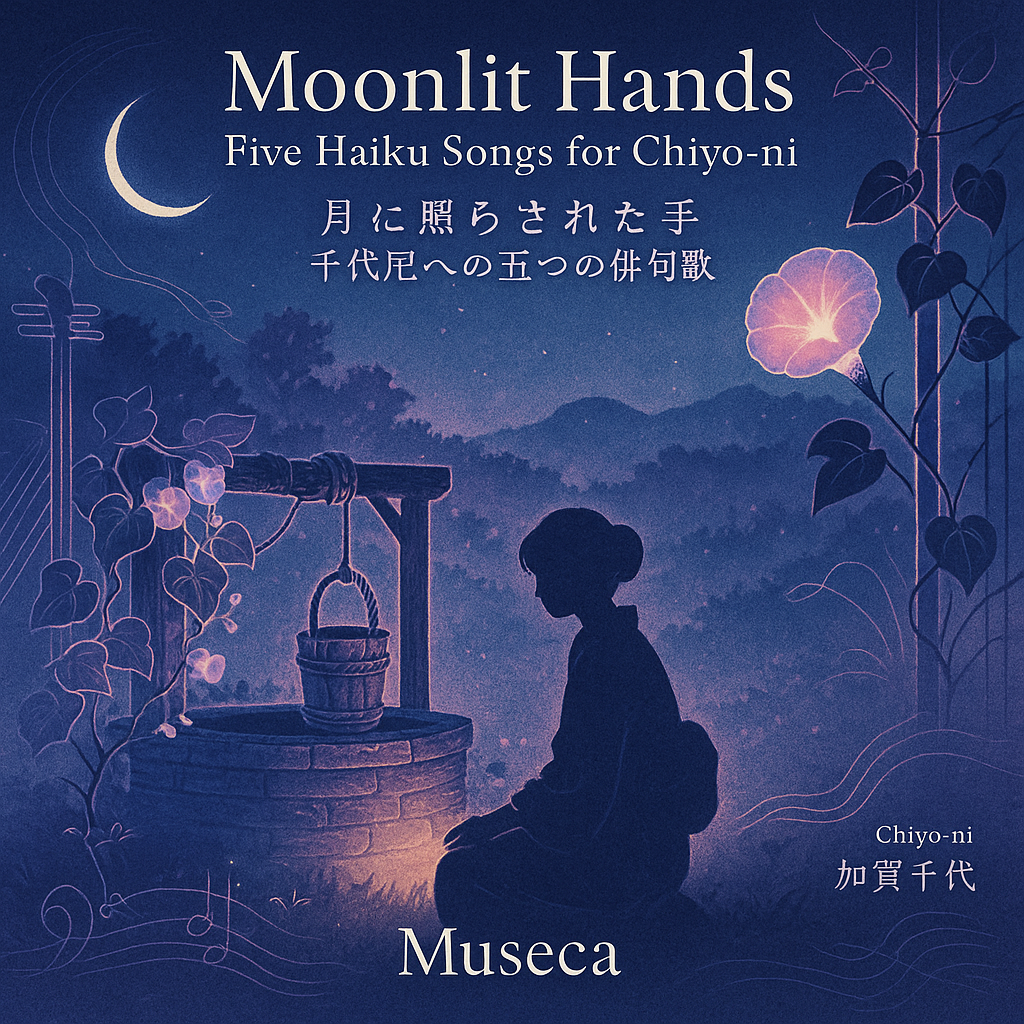
Moonlit Hands: Five Haiku Songs for Chiyo-ni
An Homage by Museca
Fukuda Chiyo-ni (also known as Kaga no Chiyo-jo, 1703–1775) was a haiku poet of the Edo period and later a Buddhist nun. She is widely regarded as one of the greatest haiku poets in Japanese history and one of the very few pre-modern women to gain national recognition in the form. Born in Matto, in Kaga Province (today Hakusan, Ishikawa Prefecture), the daughter of a scroll-mounter, she was introduced to art and poetry very early and began writing haiku at the age of seven.
By twelve she was studying with local poets who had themselves been students of Matsuo Bashō. By seventeen, her work was known throughout Japan.
Although she absorbed Bashō’s influence, she was not merely an imitator: her voice is distinctly her own—quiet, observant, and deeply rooted in everyday life. Her haiku dwell on small, concrete things: morning glories climbing a well rope, the feel of hands freed from the work of arranging hair, the pale skin of a young woman at dusk. Through these very small scenes she evokes the larger themes of interdependence, impermanence, and kindness.
Chiyo-ni spent much of her life in modest circumstances, helping with the family’s mounting business and caring for her parents. After they died, she chose to become a Buddhist nun in her fifties, taking the name Sōen. She is said to have explained that she did not become a nun to escape the world, but to “teach her heart to be like clear water flowing night and day.”
Even as a nun she continued to write and paint, and she encouraged other poets and artists; later scholars have seen her as an important forerunner for women’s literary voices in Japan.
Perhaps her most famous haiku is the “morning glory” poem, in which she chooses to leave the flower entwined around the well-bucket and instead goes to a neighbor to borrow water. That quiet, almost invisible act of kindness embodies much of what makes Chiyo-ni beloved: a gentle respect for nature, a willingness to be inconvenienced for the sake of beauty, and a sense that the sacred hides inside ordinary gestures. Today, morning glories are a symbol of her hometown, and museums and memorials there preserve her calligraphy and effects.
Moonlit Hands: Five Haiku Songs for Chiyo-ni sets five of her haiku as a cycle of modern, Café del Mar-influenced pieces. Each track blends downtempo electronic textures with traditional Japanese instruments—koto, shakuhachi, and soft percussion—while a single female voice moves between Japanese and English. The English lyrics are original adaptations, written to open her images to a wider audience; the Japanese haiku appear in their original form. The aim is not to imitate Edo-period music, but to let Chiyo-ni’s images live in a contemporary sound world: intimate, spacious, and quietly luminous.
Liner Notes
- Morning Glory Grace
Source haiku
朝顔に
釣瓶とられて
もらひ水
Morning glories twine
around the well-bucket—
I go to borrow water.
This opening track takes Chiyo-ni’s most famous scene: she comes to draw water and finds that overnight the morning glory has wrapped itself around the well-bucket. Rather than tear the vine, she leaves it as it is and walks to a neighbor to ask for water. The song expands that moment into a gentle act of surrender: choosing beauty over convenience, and discovering that grace often comes “second-hand,” through others.
Musically, Morning Glory Grace lives in a warm, mid-tempo Café del Mar groove—soft kick, brushed percussion, nylon guitar, koto arpeggios, and shakuhachi phrases floating above a glowing pad. The English verses narrate the walk to the neighbor’s house; the chorus returns to the idea of “drinking by grace,” and each refrain closes with the original Japanese haiku sung clearly. The result is both a portrait of a single flower and a quiet manifesto for a more considerate way of moving through the world.
Lyrics
[Verse 1]
Morning on the step, the well is still and silent,
vines have climbed the rope in the night.
Blue bells in the sun, holding what I wanted,
guarding all the water in their light.
[Pre-Chorus]
I could pull you down just to have my way,
break a tender stem for an easy day,
but something in your breathing face
says, “Let me stay… let me stay.”
[Chorus]
So I walk the dusty road, empty bucket in my hand,
but my heart is overflowing anyway.
If the water comes from kindness,
every cup will taste the same—
I drink by grace, I drink by grace.
[Chorus – Japanese haiku]
朝顔に
釣瓶とられて
もらひ水
(Asagao ni
tsurube torarete
morai-mizu)
[Verse 2]
Knocking at a door, laughter in the shadows,
copper kettle warming on the fire.
Neighbors at the well, passing me a ladle,
cooler than the thing that I desire.
[Pre-Chorus 2]
I can feel the roots curling round the stone,
tying me to more than what I own.
In a borrowed glass on a borrowed day
I taste my home… I taste my home.
[Chorus]
So I walk the dusty road, empty bucket in my hand,
but my heart is overflowing anyway.
If the water comes from kindness,
every cup will taste the same—
I drink by grace, I drink by grace.
[Bridge – layered whispers]
朝顔に… (asagao ni…)
little morning star,
釣瓶とられて… (tsurube torarete…)
hold the rope, hold my heart,
もらひ水… (morai-mizu…)
and I will walk, and I will walk…
[Final Chorus]
So I walk the dusty road, empty bucket in my hand,
but my soul is overflowing anyway.
If the water comes from kindness,
every drop will say your name—
I drink by grace, I drink by grace.
[Final haiku]
朝顔に
釣瓶とられて
もらひ水
- Empty Hands, Warm Coals
Source haiku
髪を結ふ
手の隙あけて
炬燵かな
No longer putting up my hair—
my hands now have time
to warm at the kotatsu.
This haiku comes from Chiyo-ni’s nun period, when she no longer needed the elaborate hair arrangements expected of women of her time. What might look like a small domestic detail—hands freed from styling hair and resting instead under a winter kotatsu—becomes a symbol of spiritual and emotional freedom. She has laid aside one form of beauty and discovered another, quieter warmth in its place.
Empty Hands, Warm Coals is an intimate 3/4 or 6/8 ballad, centered on piano, soft pads, and delicate koto figures. The arrangement leaves plenty of space for the voice, which stays close to the listener, almost like someone thinking aloud beside the heater on a cold night. The English lyrics trace her journey from mirror and adornment to simplicity; in the chorus, the image of empty hands under the quilt becomes the emotional anchor. After each chorus, the original haiku appears in Japanese, grounding the song in the exact words she wrote.
Lyrics
[Verse 1]
Once I spent my dawns
twisting hair into a crown,
pins and combs and little sighs of steam.
Every mirror’s frame
held a younger, restless face,
chasing after someone else’s dream.
[Pre-Chorus 1]
Now the mirror’s bare,
no more braids to tame,
just a line of winter light across the floor.
What I lay aside
falls like loosened strands,
and I don’t wear that weight anymore.
[Chorus]
Empty hands, warm coals,
I hide my fingers in the quilt,
feeling every heartbeat slow and wide.
When I let my beauty go,
I found another kind of glow—
quiet as the embers by my side.
[Chorus – Japanese haiku]
髪を結ふ
手の隙あけて
炬燵かな
(Kami o yū
te no hima akete
kotatsu kana)
[Verse 2]
Friends still paint their lips,
lace their lives with perfume names,
pouring colors in the spaces of their days.
Here, the kettle sings,
and the winter night leans in,
softly listening to my silent praise.
[Pre-Chorus 2]
I have traded curls
for a wooden bowl,
old robes brushing tatami underfoot.
Every strand I’ve dropped
opened up my palms—
space where tender warmth could be put.
[Chorus]
Empty hands, warm coals,
I hide my fingers in the quilt,
feeling every heartbeat slow and wide.
When I let my beauty go,
I found another kind of glow—
quiet as the embers by my side.
[Bridge – JP + EN, very close-mic]
髪を結ふ… (kami o yū…)
I don’t bind it up anymore.
手の隙あけて… (te no hima akete…)
There is time in my hands now.
炬燵かな… (kotatsu kana…)
Under this quilt,
my heart keeps its own vow.
[Final Chorus]
Empty hands, warm coals,
I hide my fingers in the quilt,
feeling every heartbeat slow and wide.
What I thought I had to be
falls away like cut hair, free—
and the warmth I sought was always inside.
[Final haiku]
髪を結ふ
手の隙あけて
炬燵かな
- Skin of Dusk
Source haiku
夕顔や
女子の肌の
見ゆる時
Evening-glory—
the moment when a young woman’s skin
can be seen.
Here Chiyo-ni links the pale evening-glory flower with the glimpse of a young woman’s skin at twilight. The haiku is sensual but not explicit: it notices how dusk softens edges, how both flower and body glow in the half-light. Desire, modesty, and the changing sky exist in the same brief moment.
In Skin of Dusk, this becomes a slow, dusky chillout track with Rhodes-like electric piano, a soft beat, and breathy shakuhachi lines. Harmonically it leans toward a Dorian-flavored palette, giving a gentle, soulful color without losing transparency. The English verses describe the city at dusk, lanterns blooming, sleeves shifting in the evening breeze; the chorus names “skin of dusk” as the place where daylight slips away. The Japanese haiku is presented in full after the chorus, like the compact seed from which the whole song has grown.
Lyrics
[Verse 1]
Light falls off the roofs,
streets exhale a violet haze,
paper doors breathe shadows in and out.
Lanterns wake and bloom,
small moons in the evening air,
drawing out the whispers from the crowd.
[Pre-Chorus 1]
In the half-lit room
colors learn to fade,
edges blur and soften into tone.
Something in the dusk
gently lifts the veil—
no one here is standing quite alone.
[Chorus]
Skin of dusk,
where the daylight slips away,
pale as petals opening to night.
In that hush,
I see you in a tender way—
not concealment, not display, just light.
[Chorus – Japanese haiku]
夕顔や
女子の肌の
見ゆる時
(Yūgao ya
onago no hada no
miyuru toki)
[Verse 2]
Evening blossoms breathe,
climbing slowly up the gate,
white against the deepening of the sky.
You remove a sleeve
just to feel the summer wind,
and it turns the air around you into dye.
[Pre-Chorus 2]
Not a single word,
only quiet skin,
still as water holding on to stars.
In the fading glare
I can finally see
who you are beneath the day’s old scars.
[Chorus]
Skin of dusk,
where the daylight slips away,
pale as petals opening to night.
In that hush,
I see you in a tender way—
not concealment, not display, just light.
[Bridge – JP + EN, floating and breathy]
夕顔や… (yūgao ya…)
evening-face, white and slow—
女子の肌の… (onago no hada no…)
soft as breath along the glow—
見ゆる時… (miyuru toki…)
in this moment, we both know.
[Final Chorus]
Skin of dusk,
where the daylight slips away,
pale as petals opening to night.
When we trust
what the shadows want to say,
every hidden thing turns into light.
[Final haiku]
夕顔や
女子の肌の
見ゆる時
- I Have Seen the Moon
Source haiku (often treated as her death poem)
月も見て
我はこの世を
かしく哉
Having seen the moon,
I find this world
strangely, deeply precious.
This poem is traditionally read as a final summing-up of Chiyo-ni’s life as a nun. After everything—loss, work, solitude, small joys—she looks at the moon and, in that light, the world feels “kashiku”: strange, moving, worthy, almost sacred. It is not an escape from the world, but a renewed affection for it.
I Have Seen the Moon closes the main cycle as a slow, spacious ambient piece. Soft piano, long string chords, and shakuhachi lines move very gently over a nearly bare rhythm. The English lyrics recall buckets and morning flowers, winter coals, and walks with grief, circling back through images that have appeared in earlier songs. Each chorus returns to the declaration “I have seen the moon,” and then yields to the original Japanese haiku, sung simply. The track is a meditation on finding holiness in ordinary days.
Lyrics
[Verse 1]
I have watched the years
fold like paper in the rain,
ink of every joy and sorrow run.
Carried buckets home,
warmed my hands on winter coals,
walked the streets before the day was done.
[Pre-Chorus 1]
Every little loss,
every borrowed cup,
every name that slipped out of my hand—
when I look back now,
standing under this sky,
all of it is stranger than I planned.
[Chorus]
I have seen the moon,
gazing down on all I’ve been,
silver on the edges of my days.
Now this fleeting world
feels so rare, so bright within—
holier than all my careful ways.
[Chorus – Japanese haiku]
月も見て
我はこの世を
かしく哉
(Tsuki mo mite
ware wa kono yo o
kashiku kana)
[Verse 2]
I have walked with grief,
arm in arm along the fields,
thinking every ending was the end.
Then a flower climbed
up a well-rope in the dawn,
and a stranger’s hand became my friend.
[Pre-Chorus 2]
All the quiet work
no one ever saw,
all the nights I could not fall asleep—
in the moon’s soft eye
nothing’s thrown away,
every moment counts, and counts so deep.
[Chorus]
I have seen the moon,
gazing down on all I’ve been,
silver on the edges of my days.
Now this fleeting world
feels so rare, so bright within—
holier than all my careful ways.
[Bridge – JP + EN, very sparse]
月も見て… (tsuki mo mite…)
I have seen you shining there.
我はこの世を… (ware wa kono yo o…)
Now I feel this world made bare—
かしく哉… (kashiku kana…)
strange and sacred, thin as air.
[Final Chorus]
I have seen the moon,
gazing down on all I’ve been,
silver on the edges of my days.
If I leave tonight,
I will leave in wonder then—
loving all the fragile, holy ways.
[Final haiku]
月も見て
我はこの世を
かしく哉
- Crescent Silence (Bonus Track)
Source haiku
三日月に
ひしひしと
物の静まりぬ
At the crescent moon,
pressing in, layer by layer,
everything grows quiet.
The bonus track turns entirely to Japanese text. The central haiku evokes a slender crescent moon and a stillness that seems to press gradually into all things. It is less a narrative than a feeling: the world’s noise receding, the heart becoming transparent in the thin lunar light.
Crescent Silence keeps the same instrumental language—piano or Rhodes, koto, shakuhachi, warm pads—but lets the tempo slow to a nocturne. The lyrics are new Japanese verses built around Chiyo-ni’s haiku: quiet roofs under the crescent moon, city sounds unraveling, footsteps stopping, clouds parting to leave the sky as a stage for the moon. The haiku itself appears in the choruses, untouched, at the center of the track. For non-Japanese listeners, an English translation can be printed in the booklet, but on the record itself the voice remains entirely in Japanese, allowing the sound of the language and the music to carry the meaning together.
Lyrics
[Intro – softly, almost spoken]
三日月が 窓の外にかかり
胸の奥 そっと冷たく光る
[Verse 1]
屋根の上 細い月のしずく
街の音 少しずつほどけてゆく
誰の声も 今はもう聞こえない
自分だけの 息の音が残る
[Pre-Chorus]
足音を そっと止めてみれば
心まで 波がやむようで
[Chorus – include original haiku]
三日月に
ひしひしと
物の静まりぬ
胸の底
言葉より先に
夜が満ちてゆく
[Verse 2]
消えかけた 灯りさえやさしく
指先を 静けさが包んでゆく
過ぎた日々 眠りのなか溶けて
名もいらぬ 想いだけが光る
[Pre-Chorus 2]
ひとすじの 白い雲が切れて
空すべて 月のための舞台
[Chorus]
三日月に
ひしひしと
物の静まりぬ
胸の底
涙にもならぬ
温い風が吹く
[Bridge – whispered, with shakuhachi]
三日月よ
まだ消えないで
この静けさ
もう少しだけ
ひしひしと
ひしひしと
心まで 澄ませてゆく
[Final Chorus – very soft]
三日月に
ひしひしと
物の静まりぬ
目を閉じて
何も願わずに
ただ 夜を受け入れる
[Outro – almost a cappella]
三日月に
ひしひしと
物の静まりぬ
Playlist
- Morning Glory Grace Museca 4:18
- Empty Hands, Warm Coals Museca 3:54
- Skin of Dusk Museca 4:30
- I Have Seen the Moon Museca 4:45
- Crescent Silence / 三日月の静けさ Museca 4:28