
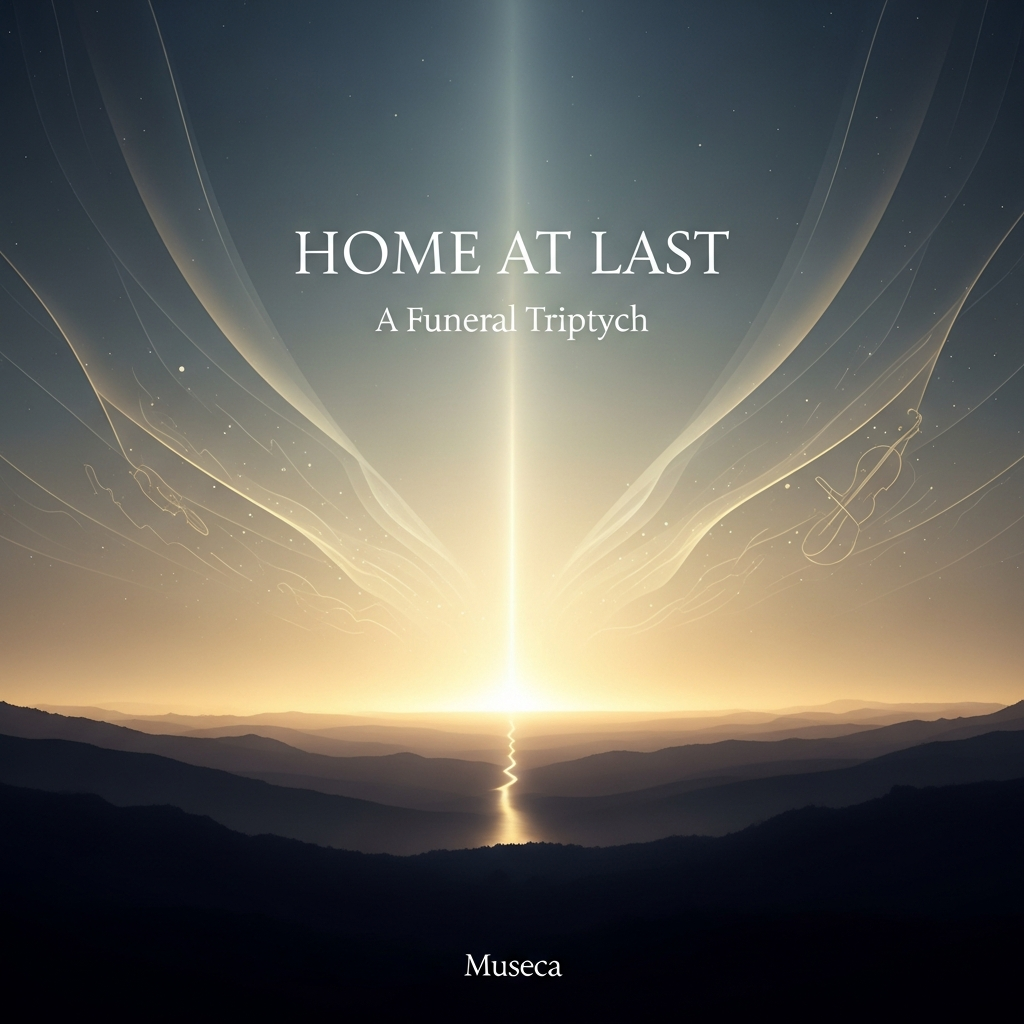
Home at Last: A Funeral Triptych
Funeral music, across centuries, has spoken almost exclusively with the voice of the living. From the solemn requiems of the Baroque and Classical eras to the grand Romantic laments and modern memorial compositions, the emotional center has always been the same: grief, loss, and the bewilderment of those who remain behind.
These works—magnificent as they are—arise from a single vantage point:
death as rupture,
death as absence,
death as the silencing of a beloved presence.
In Musikalische Exequien, Heinrich Schütz gave voice to Lutheran sorrow. Purcell’s Funeral Music for Queen Mary offered dignified mourning for a sovereign. Mozart, Verdi, Berlioz, Dvořák, Fauré, Duruflé, Brahms, Mahler, Tavener, Pärt—each in their own style—crafted music that surrounds the bereaved in dignity, reverence, and often awe in the face of the great mystery.
Yet these masterpieces, for all their emotional reach, address only one side of the veil.
They express the cry of those left standing at the grave.
They rarely imagine the experience of the one who has passed.
A New Perspective
Home at Last: A Funeral Triptych attempts something notably absent in the historical canon:
to give musical voice to the soul who has just died.
This triptych is inspired, in part, by the spiritual perspective articulated in Neale Donald Walsch’s Home with God. In that framework, death is not an ending but a homecoming, a release from suffering, a return to awareness, and—astonishingly—the happiest moment of the soul’s existence.
Traditional funeral music honors the mourners.
This work seeks to honor both the mourners and the departed.
Where the historical repertoire is weighted toward sorrow, solemnity, and supplication, Home at Last introduces another emotional truth:
The one who died is not in darkness.
The one who died is not lost.
The one who died is more alive than ever.
The Triptych
I. For Those Who Remain
A movement firmly rooted in tradition: slow, processional, minor, grounded.
It honors the shock, disbelief, and heavy ache of the living.
This is the world history knows well—the world of requiems and lamentations.
II. Home at Last
Here the perspective shifts entirely.
The music follows the soul’s first awareness after death:
the dissolution of pain,
the lifting of fear,
the recognition that consciousness continues,
the gentle embrace of something vast, luminous, and familiar.
This is music of astonished clarity, of quiet joy without sentimentality.
A first-person musical monologue from the other side—a stance rarely, if ever, explored in the classical funeral tradition.
III. The Bridge
The third movement is a meeting place.
It begins in sorrow and ends in light, drawing together the two emotional worlds.
It neither denies grief nor diminishes the mourner’s pain.
Instead, it allows the living to sense—softly, without dogma—the reality of the soul’s wellbeing.
It is the musical reconciliation of two simultaneous truths:
We have lost someone.
And they are finally home.
A Contemporary Reimagining of the Requiem
Home at Last: A Funeral Triptych does not replace the centuries of funeral music that came before it. Rather, it expands the landscape.
It adds a voice that classical tradition never fully embraced:
the voice of the one who has crossed the threshold.
In doing so, it reframes the emotional architecture of a funeral work:
from lament alone toward understanding,
from fear toward recognition,
from finality toward continuity,
from darkness toward luminous mystery.
The triptych invites listeners—whether grieving, contemplating mortality, or seeking meaning—to sit inside both the sorrow of human separation and the quiet joy of spiritual return.
In the world of historical funeral music, death is an end.
In this work, death is a doorway.
It is the moment the soul comes home at last.
LINER NOTES
I. For Those Who Remain
This opening movement stands in continuity with the long tradition of funeral and requiem music. Its world is the world of the living—heavy, grounded, and dimly lit. The music unfolds slowly, with low strings and organ forming a solemn procession, echoing the great laments of earlier centuries.
A simple descending motif shapes the emotional architecture. It is the motif of the lowered head, the weakened breath, the flower placed upon a casket. The movement honors the stunned quiet that enters a room after a final breath—the hollow pause before grief finds its full voice.
Here, mourning is neither dramatized nor pushed aside. It is treated with dignity, as something ancient and human. In this opening movement, we hear the sorrow of those who remain, the gravity of absence, and the honest weight of a world that feels suddenly incomplete.
II. Home at Last
The central movement introduces a perspective seldom explored in classical funeral music: the inner experience of the soul who has just crossed beyond the body.
The music begins suspended, as if consciousness has not yet learned how to stand without the weight of the flesh. Gradually, the world brightens. Strings open upward, winds float in soft arcs, and faint choral colors bloom like distant light. What begins as uncertainty becomes recognition: I am still here.
Pain falls away. Fear finds no anchor. A deep, all-embracing presence surrounds the listener—tender, luminous, and vast. Bells and gentle harmonies mark moments of remembrance, as if the soul is seeing its life with unprecedented clarity and compassion.
What emerges is not triumph, but a quiet joy. A joy without spectacle. A joy that comes from remembering something ancient and intimate: that nothing was ever lost, and nothing is lost now. At the heart of this movement lies the simple revelation that gives the entire triptych its name: the soul has come home at last.
III. The Bridge
The final movement brings the two emotional worlds into conversation. It begins in the familiar shadows of Movement I, where grief still sits close to the skin. Slowly, gently, something new enters: themes and colors from Movement II. The lament motif and the homecoming motif begin to weave around one another—first cautiously, then with growing trust.
In this shared musical space, sorrow does not vanish, but it is transformed. The living are not asked to forget their loss; they are invited to sense a truth that exists alongside it: the well-being of the one they grieve.
The climax of the movement is not loud. It is a moment of quiet integration, where the music arrives at a harmony that is neither fully mournful nor fully radiant—both, at once. This is the bridge: the place where human pain and spiritual peace coexist without contradiction.
The work closes in a soft, luminous cadence that neither resolves nor resists. It simply rests. The sound fades the way light does at the end of day—not disappearing, but slipping gently beyond sight.
TRACK-BY-TRACK AUDIO GUIDE NOTES
Home at Last: A Funeral Triptych
I. For Those Who Remain — Audio Guide
This first movement begins at the place where all funerals begin:
with absence, with breath held, with a heaviness that has no words at first.
Listen to the opening seconds.
The low strings and organ do not “announce” anything—they simply arrive, the way grief arrives: quietly, and all at once. The harmony settles into a minor landscape that feels familiar, almost ancestral. This is the sound of the world after someone has gone quiet.
You will hear a descending four-note motif throughout the movement.
It falls like a slow exhale, or the closing of a door. Every time it returns, it deepens the sense of reality settling in: this has happened, and the world is changed.
As the movement progresses, the texture grows heavier—not louder, but more concentrated. The choir enters softly, almost like the memory of voices rather than voices themselves. The sense is not dramatic sorrow, but the weight of a day when time moves differently.
Toward the end, the harmony does not “resolve.”
It simply rests, as if placing a hand on a coffin lid, acknowledging what is.
This movement is for the living.
It honors the truth that grief is real, and that love sometimes feels like loss.
II. Home at Last — Audio Guide
The second movement begins as if we have stepped through an unseen door.
The opening is suspended, almost floating.
Notice how the harmony feels neither major nor minor—it is untethered, as though consciousness is waking up on the other side of its last breath.
Gradually, delicate rising gestures appear in the upper strings and winds. These are the first moments of recognition:
I am still here.
The texture is weightless. Pain is absent. A subtle warmth enters beneath the sound, as if the music is breathing more freely than before. You may hear faint choral tones—wordless, gentle—suggesting an embrace without form, something surrounding the listener rather than approaching them.
At several points, soft bells or high, clear tones mark moments of realization.
These are the musical equivalents of inner awakenings:
I am safe.
I am known.
Nothing was taken from me.
In the middle of the movement, listen for a brief shift—slightly darker hues mingling with the light. This is the life review, an honest look at one’s lived experience, held inside compassion.
Then the music widens again.
Strings open upward, winds rise in arcs, and the harmony blossoms into something quietly radiant. This is the sound of the soul remembering its origin.
The movement ends in a warm, glowing chord that fades into silence—
not a disappearance, but a dissolving into peace.
This track is the soul’s voice.
It is the sound of coming home.
III. The Bridge — Audio Guide
The final movement is where both worlds meet.
You will hear the first few notes echo the darkness of Movement I.
The lament motif returns, but softer, as if heard from a distance. This is the sound of the living, still in their grief.
Then something new begins to enter: tiny traces of the ascending homecoming theme from Movement II. High strings and winds glow faintly behind the shadows, like a lantern seen through fog.
Listen carefully as the movement progresses.
The two motifs—the world of sorrow and the world of light—start to answer one another. They do not clash. They simply coexist, the way grief and peace do in the heart of someone beginning to heal.
Halfway through, the textures weave together.
The lament motif does not vanish; it softens, reshaped by compassion. The glowing theme from Movement II rises gently above it, not in triumph but in reassurance:
they are well… they are well… they are well.
The climax is understated—no grand finale, just a moment of deep inward quiet, where the two musical languages finally agree. This is the bridge: the point where the living sense that the one they lost is not lost at all.
The movement ends in an open, luminous chord, held long enough for the listener to breathe with it. It fades not into darkness, but into stillness.
This final track is a gesture of comfort.
It allows grief to remain honest while offering a glimpse of the soul’s joy on the other side.
Epilogue
When the Music Fades
“When the Music Fades” is the closing piece of Home at Last: A Funeral Triptych, and it serves as the album’s final gesture of comfort, reflection, and quiet reassurance.
Where the three-movement suite explores death through instrumental voices—the mourners, the departed soul, and the bridge between them—this song gives that bridge a human voice. It is written not as a declaration of belief, but as a moment of listening: to silence, to memory, and to the space that remains after loss.
The song begins where grief often does—after everything has stopped. After the service ends. After the room empties. After the music fades. What follows is not emptiness, but a softer sound: the lingering presence of love, the subtle warmth that persists even when someone is no longer physically near.
Lyrically, the piece reflects the central idea of the album: that two truths can exist at once. We remain here, missing deeply. And yet, those we mourn may have entered a state of peace, clarity, and homecoming beyond our immediate sight. The song does not rush sorrow away, nor does it minimize loss. Instead, it allows grief to coexist with the possibility of continuity.
Musically, “When the Music Fades” is intimate and restrained—piano, warm strings, and a gentle vocal line that rises only when it needs to. It is designed as a closing light rather than a climax, offering stillness rather than resolution. The final moments fade softly, suggesting not an ending, but a transition.
This piece is for anyone who has stood in the quiet afterward.
For anyone who has reached for someone who is no longer there.
And for anyone who senses—however faintly—that love does not end where sound stops.
When the music fades, something remains.
Liner Notes — “When the Music Fades” (All Versions)
1) “When the Music Fades” — Instrumental Prelude (Standalone)
The standalone prelude is the doorway before the words—a brief, wordless piece designed to sound like the moment after a service ends, when the room empties and meaning begins to settle. It is intentionally sparse: piano first, then warm strings, with gentle rising gestures that suggest breath returning.
As a standalone track, the prelude functions like a ritual pause. It does not tell the listener what to feel; it makes space for whatever is already present—grief, gratitude, numbness, or quiet remembrance. It is equally suitable as an opening track to the song, a transition within the album, or a short contemplative interlude on its own.
2) “When the Music Fades” — Album Version (Full)
The album version is the complete statement: a closing song that gently gathers the emotional threads of the triptych into one sung reflection. Where the three instrumental movements present grief, homecoming, and reconciliation through pure musical language, this version gives the listener a final, human voice—quiet, direct, and unforced.
Structurally, the full form allows the lyric to breathe. The second verse deepens the intimacy—moving from the abstract hush after a funeral into the everyday geography of mourning: the chair, the night, the reflex of reaching. The bridge is the song’s emotional hinge, acknowledging the paradox at the heart of the album: two paths exist at once—one in tears, one in light—and yet they still meet. Rather than ending in triumph, the final chorus reframes the message with tenderness, letting acceptance arrive softly, not as certainty, but as a kind of inner permission to exhale.
This is not a song meant to erase grief. It is meant to stand beside it, and to suggest that the silence after loss may still carry love.
Lyrics
Verse 1:
When the last note falls to silence,
And the speakers all go still,
There’s a hush that fills the doorway,
There’s an echo only you can feel.
In the dust of quiet rooms
Where their laughter used to stay,
Something tender, almost hidden,
Starts to sing in its own way.
Pre-Chorus:
We call it loss,
We call it pain,
But underneath the broken names
Another truth remains…
Chorus:
When the music fades, there’s a softer sound,
In the hollow places where your heart sits down.
In the reach of your hand to an empty space,
In the quiet ache that time can’t erase.
You are here, they are home, love is still between—
Like a chord in the dark you can’t quite see.
What you fear as the end, when the lights are gone,
Is only the light, only the light coming on.
[Soft instrumental interlude]
Verse 2:
You remember how they held you,
How their voice could change a room,
Now the chair is folded, waiting,
And the nights arrive too soon.
Still your hand keeps reaching outward,
Still your thoughts drift back in time,
And the air around your longing
Holds a warmth you can’t define.
Pre-Chorus:
We call it grief,
We call it night,
But when your heartbeat slows enough
You feel a flicker of light…
Chorus:
When the music fades, there’s a softer sound,
In the hollow places where your heart sits down.
In the reach of your hand to an empty space,
In the quiet ache that time can’t erase.
You are here, they are home, love is still between—
Like a chord in the dark you can’t quite see.
What you fear as the end, when the lights are gone,
Is only the light, only the light coming on.
Bridge:
Two paths winding through the same sky,
Yours in tears, and theirs in light.
For a while they seem so far apart,
But they cross in the middle of your heart.
Every breath you take in the deepest night,
Every memory edged with light,
Is the place where sorrow and mercy meet,
Where their joy is standing at your feet.
Chorus (Reframed):
When the music fades, there’s a softer sound,
In the hush that settles when you lay burdens down.
In the way that your chest learns to breathe again,
In the way that love lives where a life once been.
You are here, they are home, but the thread holds fast—
Nothing real in you, nothing real in them is past.
What you feared as the end, when the lights were gone,
Was only the light, only the light coming on.
Outro:
So when the last note falls
And you stand alone,
Know the silence you’re hearing
Is them coming home.
You are here, they are home,
But you’re never alone—
It’s only the light,
Only the light coming on.
3) “When the Music Fades” — Radio Edit
The radio edit distills the heart of the song into its most immediate emotional arc: one verse, one full chorus, a shortened bridge, and a final reframed refrain. This version is designed for listeners who want the essence without the extended meditation—still touching, still spacious, but more concise and direct.
The edit keeps the central image intact: that after the music stops, something remains—subtle, persistent, and felt more than heard. The shorter bridge preserves the “meeting point” idea with minimal words, allowing the closing chorus to land quickly and clearly. It is especially effective as a standalone single, a memorial piece, or a closing track in curated playlists where a long form might feel too expansive.
In short: the radio edit is the song’s message in a single breath—brief, compassionate, and quietly uplifting.
Lyrics
Verse:
When the last note falls to silence,
And the speakers all go still,
There’s a hush that fills the doorway,
There’s an echo only you can feel.
In the dust of quiet rooms
Where their laughter used to stay,
Something tender, almost hidden,
Starts to sing in its own way.
Pre-Chorus:
We call it loss,
We call it pain,
But underneath the broken names
Another truth remains…
Chorus:
When the music fades, there’s a softer sound,
In the hollow places where your heart sits down.
In the reach of your hand to an empty space,
In the quiet ache that time can’t erase.
You are here, they are home, love is still between—
Like a chord in the dark you can’t quite see.
What you fear as the end, when the lights are gone,
Is only the light, only the light coming on.
Bridge (shortened):
Two paths winding through the same sky,
Yours in tears, and theirs in light.
For a moment they seem far apart,
Then they meet in the middle of your heart.
Chorus (repeat, shortened):
When the music fades, there’s a softer sound,
In the quiet place where your heart sits down.
You are here, they are home, love is still between—
What you feared as the end was the light coming on.
4) “When the Music Fades” — Unified Prelude + Vocal Version
The unified version is the most cinematic rendering: a brief instrumental prelude that functions as a threshold, followed by the vocal entry as if the song is stepping into the room rather than beginning abruptly. The prelude is intentionally spare—piano and warm strings—designed to feel like the quiet moment after the service, after the last footsteps fade, before anyone speaks again.
Because the prelude shares the harmonic world of the vocal section, the transition is meant to feel seamless, almost inevitable: the listener is emotionally “inside” the song before the first lyric arrives. In this form, the music becomes a narrative device. It does not simply introduce the song; it recreates the experience the lyric describes—the hush, the held breath, the sense of presence in silence.
This is the version most aligned with the album’s wider purpose: to reframe funeral music not only as mourning, but as a passage—where grief remains real, yet the doorway opens toward peace.
Lyrics
Verse:
When the last note falls to silence,
And the speakers all go still,
There’s a hush that fills the doorway,
There’s an echo only you can feel.
In the dust of quiet rooms
Where their laughter used to stay,
Something tender, almost hidden,
Starts to sing in its own way.
Pre-Chorus:
We call it loss,
We call it pain,
But underneath the broken names
Another truth remains…
Chorus:
When the music fades, there’s a softer sound,
In the hollow places where your heart sits down.
In the reach of your hand to an empty space,
In the quiet ache that time can’t erase.
You are here, they are home, love is still between—
Like a chord in the dark you can’t quite see.
What you fear as the end, when the lights are gone,
Is only the light, only the light coming on.
[Short instrumental break – keep same harmony and texture]
Bridge (shortened):
Two paths winding through the same sky,
Yours in tears, and theirs in light.
For a moment they seem far apart,
Then they meet in the middle of your heart.
Chorus (reframed):
When the music fades, there’s a softer sound,
In the quiet place where your heart sits down.
You are here, they are home, love is still between—
What you feared as the end was the light coming on.
COMPOSER’S STATEMENT
Home at Last: A Funeral Triptych
For centuries, funeral music has given shape to the grief of the living. It has offered dignity to sorrow, structure to mourning, and musical solace to those navigating loss. It is a tradition I respect deeply. Yet I found myself drawn to a question rarely asked in the canon:
What would funeral music sound like if the departed could speak?
This question is the seed of Home at Last.
I wanted to explore the emotional landscape described in writings such as Neale Donald Walsch’s Home with God—a view in which death is not a rupture but a return, not an extinguishing but an arrival. A perspective in which the day we call “an ending” is, for the soul, a moment of breathtaking clarity, relief, and homecoming.
Traditional requiems give voice to the mourners.
This triptych gives voice to both sides of the threshold.
Movement I honors the heaviness, the gravity, and the honest ache of those left behind. Movement II turns the lens around, entering the luminous world of the one who has just crossed over. Movement III brings these two worlds into dialogue, seeking to reconcile human sorrow with spiritual continuity.
My hope is that these three movements do more than accompany grief—they expand our understanding of it. That they might remind listeners that loss and love are not opposites, and that behind the raw experience of absence there may be a larger truth: that the ones we mourn are not diminished, but restored.
This is not meant to replace tradition, but to invite a new vantage point alongside it.
To honor the living without forgetting the light that may meet the dead.
To reshape funeral music from a single expression of lament into a fuller conversation about what death might be.
If this music offers even a moment of comfort, clarity, or peace—if it allows anyone to feel that the veil between worlds is thinner and gentler than they imagined—then this work has fulfilled its purpose.
— Museca