
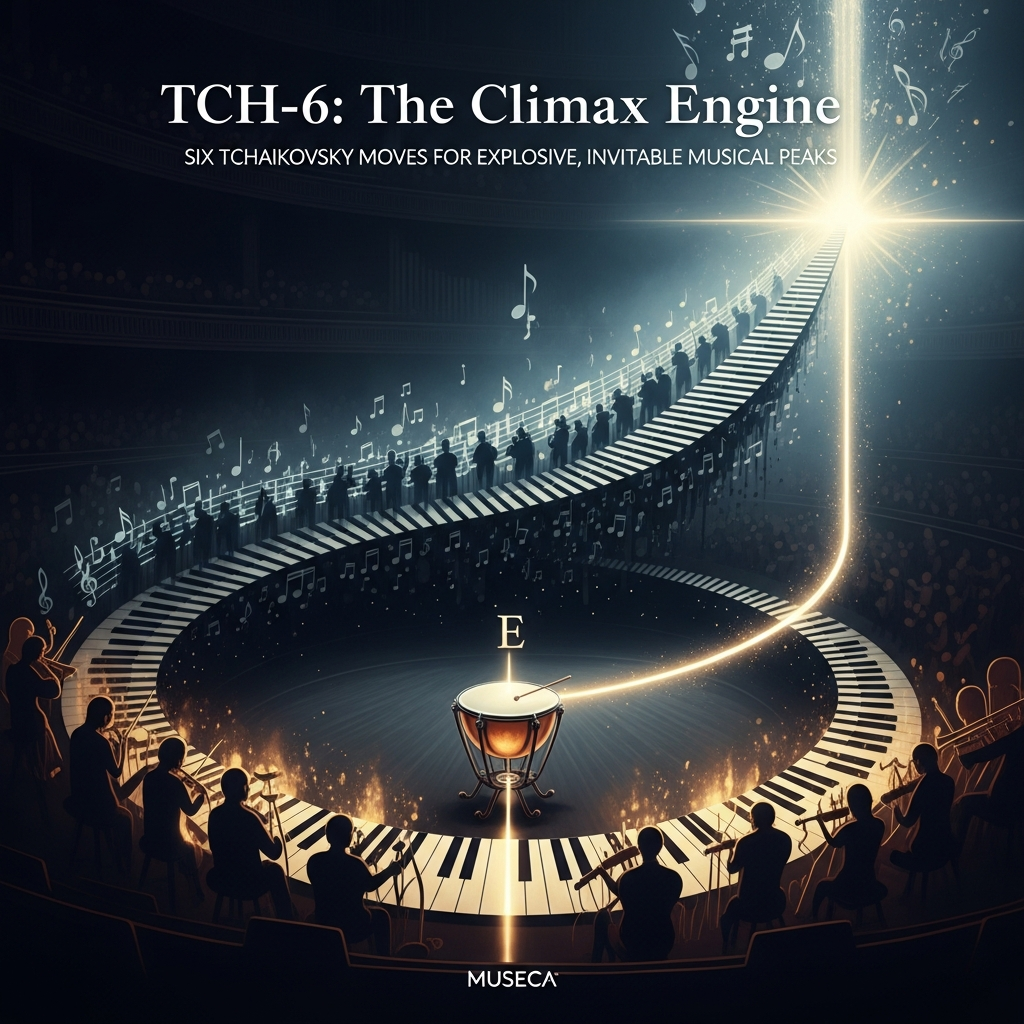
Album Introduction — TCH-6: The Climax Engine
This album is a practical, composer-facing study of Tchaikovsky’s climactic architecture—not as biography or homage, but as a set of repeatable mechanisms that reliably produce the sensation of inevitability. Across six tracks, you will hear a single idea transformed through six distinct “engines,” each one designed to intensify urgency without merely turning up the volume. The purpose is simple: to teach your ear—and your hands—how to build climaxes that feel earned, unavoidable, and emotionally explosive.
Each track isolates one engine so you can recognize it instantly, then apply it to your own work in any style (orchestral, cinematic, hybrid, symphonic rock, even electronic). Together, the six engines form a complete toolkit: tension is manufactured, accelerated, anchored, weaponized through contrast, extended beyond expectation, and finally revealed through orchestration. What makes the approach powerful is that it delays gratification with precision; the listener is continuously convinced the release is “about to happen,” and yet the music keeps finding new ways to refuse resolution—until the final impact lands.
The Staircase of Tension
What it is: A steady chromatic rise or fall (often in the bass, sometimes in the melody) that functions like climbing stairs in the dark—each step is small, but the destination feels increasingly ominous.
What you’ll hear in this track:
A chromatic line that never stops moving, creating a sense of “no exit.”
Above it, “contender chords”—harmonies that sound plausible but never fully resolve, keeping the listener suspended.
The psychological effect is a controlled panic: the floor keeps shifting upward, but the harmony refuses to become home.
Why it works: The ear interprets chromatic motion as progress and unresolved harmony as problem. Put them together and tension becomes self-propelling.
Diminution and Fragmentation
What it is: Taking a melody, breaking it into a small cell, then repeating it while shortening the rhythm in stages—quarters to eighths, to triplets, to sixteenths—so time itself feels like it is compressing.
What you’ll hear in this track:
A recognizable motif reduced to a fragment (a few notes).
Repetition that becomes obsession: the same cell returns faster, tighter, more urgent.
The sense of acceleration is created without necessarily changing tempo—urgency comes from rhythmic density.
Why it works: The listener experiences the music as gaining traction. The motif stops “singing” and starts “insisting.”
The Pedal Point
What it is: A single sustained “locking” pitch—often reinforced by timpani and low strings—that stays present through harmonic changes, making the climax feel grounded, fated, and inescapable.
What you’ll hear in this track:
A persistent pedal note acting like a nail in the floor.
Harmonies that push upward or outward while that pitch remains immovable.
A powerful sensation of inevitability: the harmony strains against the anchor, but cannot break it.
The Last-Minute Pullback
Why it works: The pedal supplies certainty while everything else destabilizes. That contradiction creates pressure—like a vice tightening.
What it is: The “raised hammer” moment: just before the peak, the music suddenly inhales—texture thins, dynamics drop, motion stalls—so the eventual hit lands harder than volume alone could achieve.
What you’ll hear in this track:
- A build that seems ready to explode, then an abrupt withdrawal.
- A brief moment of exposed fragility—sometimes even a sliver of silence.
- Then the climax arrives with amplified impact, because the ear was forced to lean in.
Why it works: Contrast creates shock. The pullback is not weakness—it is leverage.
Pushing Past the Expected Climax Point
What it is: Reaching the “obvious” arrival—where most composers would resolve—then refusing to stop. The music overshoots the finish line, stretching tension beyond what the listener thought was possible.
What you’ll hear in this track:
A convincing near-cadence that feels like the end…
…followed by continued escalation: sequence higher, intensify harmony, extend the phrase.
Multiple plausible “endings” are offered and denied until the final, true release.
Why it works: It upgrades surprise into awe. The listener learns they misjudged the size of the emotional room.
Orchestration Gradualism
What it is: A controlled, stepwise orchestral expansion—starting with bare bones and adding forces in a deliberate order—so the same idea appears to grow into its own inevitability.
What you’ll hear in this track:
A skeletal beginning (low voices, thin texture, limited color).
Layer-by-layer additions: inner winds, horns, upper strings, brass edge, percussion weight.
The climax feels earned because the orchestra itself seems to assemble in real time.
Why it works: Density reads as power. When color arrives gradually, the final tutti feels like destiny—not decoration.
How to Listen (and How to Use This Album)
On a first pass, listen like an audience member and note where your body tenses, where you expect release, and where the music denies it. On a second pass, listen like a composer: identify the engine in motion—the chromatic staircase, the rhythmic tightening, the pedal nail, the inhale, the overshoot, the orchestral layering. Each track is essentially a reusable blueprint.
By the end, the album’s promise is practical: you will not only recognize why Tchaikovsky’s climaxes hit so hard—you will have six concrete, transferable ways to make your own climaxes feel just as inevitable.
Liner Notes — TCH-6: The Climax Engine
Track 1 — Chromatic Stairs (Staircase of Tension)
This piece is built on a single governing idea: stepwise chromatic motion that refuses to stop. The low register functions like a slowly tightening vise—each semitone is a physical notch upward, and because the motion is continuous, the listener never receives permission to relax. Above the staircase, the harmony is deliberately chosen to sound structurally “correct” while withholding resolution—a parade of contender sonorities that keep the ear oriented yet unsatisfied.
Orchestrationally, the bass line is treated as an engine room: it begins with weight and restraint, then grows broader and more insistent as additional low colors join (contrabasses, bass clarinet, trombone weight). The climax is not “arrived at” so much as forced into existence by the cumulative pressure of the climb. The emotional effect is classic Tchaikovsky logic: inevitability created through motion that cannot morally turn back.
Track 2 — The Spiral Cell (Diminution and Fragmentation)
Here the album pivots from harmonic architecture to rhythmic inevitability. The piece takes a small melodic fragment—a compact cell—and treats it as an obsession that becomes increasingly urgent through diminution. Without needing to accelerate the tempo, the music creates the illusion of speeding up by shortening durations in clear stages: broad pulses become quicker subdivisions, then triplet energy, then the nervous brightness of sixteenths and mixed-grouping bursts.
The craft is in the sequencing: the fragment returns slightly higher and more insistent each time, so the listener experiences both vertical pressure (register) and temporal pressure (density). Orchestration mirrors the psychological tightening: early statements are exposed and almost calm; later ones recruit sharper timbres and stronger attacks until the motif stops being melodic and becomes mechanical insistence. The climax feels like the inevitable consequence of a thought that will not release its grip.
Track 3 — Gravity Nail (Pedal Point)
This piece demonstrates how a single pitch can generate enormous dramatic force when treated as a fixed law. From the opening, a pedal note is anchored in the lowest forces—timpani and low strings—quietly at first, then increasingly unavoidable. Above that anchor, harmonies change and rise as if trying to escape, yet the pedal remains: a sensation of the floor staying still while the walls tilt.
The key technique is containment: many of the shifting chords are voiced to include the pedal pitch, even when the harmony suggests instability. That subtle consistency gives the build its grounded, fated quality—tension is not created by chaos, but by strain against certainty. The climax lands as an act of physics rather than surprise: the audience senses long beforehand that the structure must eventually snap into release.
Track 4 — Hammer Inhale (Last-Minute Pullback)
This piece is about leverage, not loudness. The build is deliberate, layered, and convincing—then, at the precise moment the listener expects the strike, the music performs a sudden inhale. Texture thins, dynamic collapses, and time seems to widen for a beat. The effect is theatrical but not sentimental: it is the compositional equivalent of raising the hammer one last time so the downward blow becomes unavoidable.
The pullback is engineered through contrast: fewer instruments, reduced register, softened attacks, and a brief stalling of harmonic motion. By asking the ear to lean in, the piece prepares the nervous system for impact. When the climax arrives, it is not merely “bigger”—it is more final. The listener experiences the peak as the only possible outcome, made devastating by the momentary vulnerability that preceded it.
Track 5 — Elastic Cadence (Push Past the Expected Climax)
This movement is built around a psychological trick: it offers a believable ending, then denies closure and keeps climbing. The first “arrival” is shaped like a proper cadence—enough structural logic to convince the listener the journey is complete. But rather than resolving, the music extends the sequence, escalates register, and intensifies harmonic ambiguity. The elastic band stretches further than expected, and each added extension makes the eventual release feel more costly—and more satisfying.
This is the Tchaikovsky lesson of over-delivering tension: multiple perfect stopping points appear, and each one becomes a springboard into a larger, more urgent continuation. The climax is therefore not a single peak but a series of near-peaks, each teaching the listener to fear that the true summit has not yet arrived. When the final resolution finally comes, it feels less like “ending a phrase” and more like surviving an ordeal.
Track 6 — From Bone to Blaze (Orchestration Gradualism)
The final piece reveals how orchestration itself can be the climax engine. The motif remains essentially the same, but the orchestra is introduced in purposeful stages, as if the music is assembling its own body. It begins skeletal—low strings and a spare wind color—then gradually gains inner voices, resonance, brightness, and weight. Each new layer is not decoration; it is a structural escalation of power.
The magic is that the listener can track the growth: what began as an outline becomes a machine. Upper strings bring nervous electricity, horns bring inevitability, trumpets bring edge, percussion brings physical force. By the time full tutti arrives, the climax feels earned because the orchestra has been carefully “constructed” in the listener’s ear. The ending functions as the album’s thesis statement: a climax hits hardest when it has been built, not merely announced.