
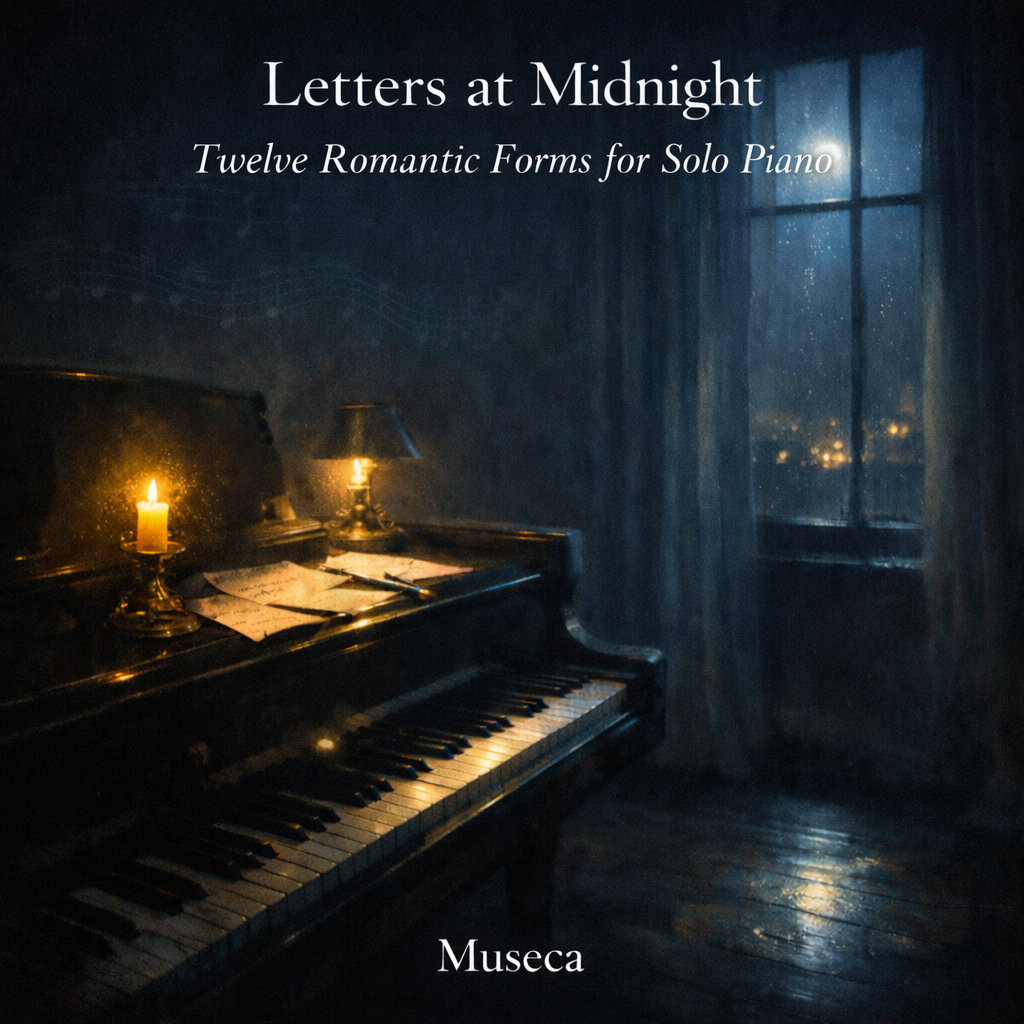
Letters at Midnight
Letters at Midnight is a suite of original solo-piano works written in respectful conversation with the expressive world of Frédéric Chopin. Rather than imitating any specific composition, the album explores the classic forms through which Chopin shaped the Romantic piano—each track conceived as its own miniature universe, with a distinct architecture, character, and emotional purpose.
Across the collection you will hear the intimacy of the Nocturne, the concentrated intensity of the Prelude, the virtuosic poetry of the Étude, the refined brilliance of the Waltz, the ceremonial strength of the Polonaise, the narrative sweep of the Ballade, the high-contrast electricity of the Scherzo, the spontaneous flow of the Impromptu, and the larger horizons of the Sonata and Fantaisie. The album also embraces the rocking shimmer of the Barcarolle, the tender variation-world of the Berceuse, and the returning refrains of the Rondo—a full gallery of the piano’s most eloquent dialects.
Each piece is imagined as a private “letter” written after hours: a singing right hand that confesses, a left hand that keeps the candle lit, and harmonies that drift between glow and shadow. Letters at Midnight invites you into that quiet room—where the piano speaks softly, and everything important is said without raising its voice.
Liner Notes
1) Nocturne for a Quiet Lantern (E♭ major)
A candlelit aria for one instrument: the right hand sings in long breaths while the left hand keeps a steady, hushed tide of arpeggios. The piece leans into tender suspensions and delayed resolutions—those “almost-confessions” that define the nocturne—before dissolving into a closing sigh, as if the last word was written and then softly erased.
2) Prelude in Ashlight (A minor)
A concentrated page of ink: brief, inevitable, and emotionally direct. One persistent figure drives the entire span, tightening its grip through chromatic turns and harmonic pressure, then releasing into a stark, restrained ending—like a thought that arrives fully formed and leaves no room for explanation.
3) Étude in Silver Arpeggios (C♯ minor)
Virtuosity as storytelling. A near-continuous arpeggio design becomes the engine, but the goal is not display—it is song: a clear top voice emerges from the shimmer, climbing toward a single, controlled summit before the final torrent resolves with hard-won clarity.
4) Waltz of the Gilded Room (A♭ major)
Elegance with a private ache beneath it. The “oom–pah–pah” dances with crisp poise, while the melody glints with ornaments and quick turns, as if catching light from chandeliers. Episodes arrive like passing conversations in a salon—some bright, some wistful—before a witty coda closes the door with a smile.
5) Polonaise of the Crimson Banner (A♭ major)
Processional and proud, built on the unmistakable polonaise stride. Banner-like chords and octave declarations suggest ceremony without bombast—dignity carried by rhythm. A contrasting middle offers brief warmth, then the return arrives larger and more resolute, culminating in a decisive, commanding final cadence.
6) Ballade of the Winter Letter (G minor)
A narrative in evolving themes: a quiet question becomes argument, then song, then storm. Motives transform across shifting tonal rooms—moments of warmth, sudden gusts of agitation—until the closing presto coda feels inevitable, like a sealed envelope finally torn open.
7) Scherzo of Black Snow (B minor)
Brilliance with teeth. The opening snaps into motion—wide leaps, sharp accents, sudden silences—creating a sense of icy exhilaration. Then comes a contrasting trio: a chorale-like warmth that feels almost impossible in this weather. The return is fiercer, and the coda spins into a final, breathless rush.
8) Impromptu of the Streetlamp Breeze (F♯ major)
A piece that pretends to be casual while hiding precision. Continuous motion ripples like light wind, the melody surfacing and vanishing inside the figuration. A more intimate middle darkens the color, then the opening returns brighter, finishing with an airy flourish—quick, clean, and gone.
9) Sonata of the Midnight Staircase (B♭ minor)
A larger architecture framed as a single nocturnal journey. The first movement argues in bold contrasts, balancing chordal pillars against flowing passagework; the slow movement steps into a warmer, singing calm; the finale drives forward with restless inevitability. The closing pages feel less like an ending than the final turn of a stairwell—out of sight, but still resonant.
10) Fantaisie of the Unwritten Page (F minor)
Rhapsodic, episodic, and deliberately “free”—yet bound by returning ideas that reappear in altered light. Recitative-like openings speak in pauses and gestures; sweeping arpeggios answer with motion. The work expands to one vast climax, then withdraws into a reflective afterglow, as if the page remained half unwritten by choice.
11) Barcarolle of Soft Lanterns (G♭ major)
A rocking 12/8 cradle of water and light. The left hand maintains a gentle gondola pulse while the right hand sings in long, luminous arcs, occasionally breaking into pearly ornamentation. The harmony drifts into deeper shades and returns, ending in a moonlit coda that feels like distance rather than closure.
12) Berceuse of the Sleeping Garden (D♭ major)
A lullaby built on repetition and transformation. Over a calm, recurring foundation, the right hand grows increasingly ornate—each variation a finer thread of lace—until the music reaches a soft peak and gradually unwinds. The ending does not “finish” so much as fall asleep.
13) Rondo of the Returning Smile (E major)
A bright refrain that keeps coming back, each time with new polish—more sparkle, sharper wit, and slightly higher spirits. Contrasting episodes provide lyric shadow and virtuosic detours, but the refrain’s optimism wins every argument. The coda closes with a playful flourish: a final sentence underlined twice.
Playlist
- Nocturne for a Quiet Lantern (E♭) Museca 1:38
- Prelude in Ashlight (A minor) Museca 2:37
- Étude in Silver Arpeggios (C♯ minor) Museca 0:39
- Waltz of the Gilded Room (A♭ major) Museca 3:05
- Polonaise of the Crimson Banner (A♭ major) Museca 2:35
- Scherzo of Black Snow (B minor) Museca 2:20
- Impromptu of the Streetlamp Breeze (F♯ major) Museca 1:13
- Sonata of the Midnight Staircase (B♭ minor) Museca 3:45
- Fantaisie of the Unwritten Page (F minor) Museca 2:14
- Barcarolle of Soft Lanterns (G♭ major) Museca 2:53
- Berceuse of the Sleeping Garden (D♭ major) Museca 0:31
- Rondo of the Returning Smile (E major) Museca 2:05