
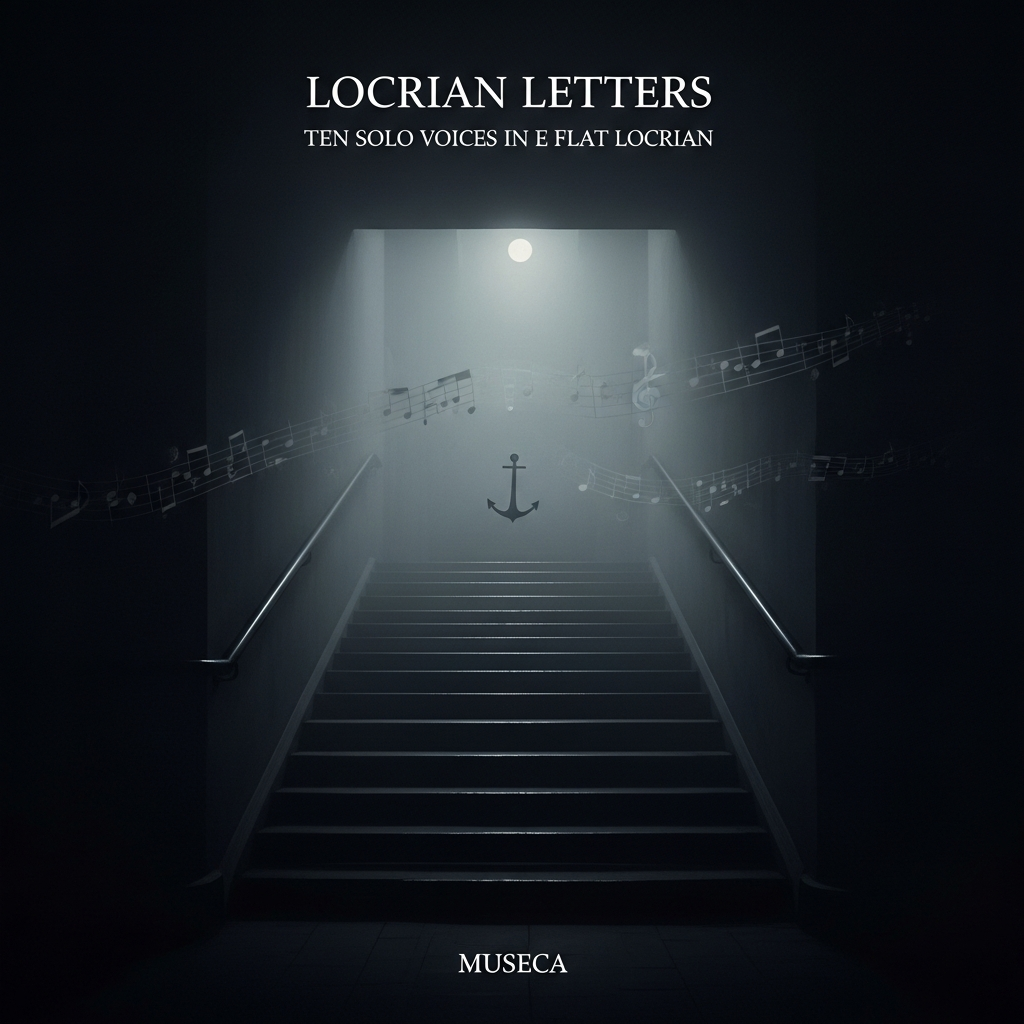
Locrian Letters
Ten Solo Voices in E♭ Locrian
This collection is a set of short, intimate studies written in E♭ Locrian and performed as solo voices—one instrument at a time. Locrian is often described as unstable, even “unresolved,” because its defining tones—the lowered second (♭2) and lowered fifth (♭5)—tilt the ear away from comfortable closure. In this project, that instability is not treated as a problem to solve. It is treated as a psychological truth: the sound of a thought that will not settle, a step that never fully lands, a room where the light is slightly wrong.
To make Locrian feel vivid rather than theoretical, each piece is built around a simple idea: E♭ remains the handrail. The tonic returns repeatedly—sometimes as a drone, sometimes as a landing point—while the “wrong-step” tones enter like intrusions. Instead of loud dissonance, the tension is delivered in small doses: a close neighbor tone, a tritone pivot, a fragile cadence that dissolves before it can reassure. Silence is part of the language. So is breath.
Hearing the same mode through different solo instruments reveals how timbre reshapes meaning. On solo piano (and in its foggier, lightly prepared colors), Locrian becomes architecture: a private stairwell of pedals, gaps, and brittle harmonies. On solo cello and solo viola, the mode turns bodily and human—less like a theory and more like a confession sung into the wood. On solo oboe, Locrian feels like a thin thread of air under pressure: exposed, tender, and quietly unnerving. On solo bass clarinet, the darkness deepens into velvet—whispered wrong-steps that feel unmistakable, not because they shout, but because they linger. On solo French horn and solo muted trumpet, the mode becomes a distant signal—nocturnal, solitary, hovering at the edge of memory. On solo harp, Locrian transforms into moonlit myth: glassy, spectral, and suspended. And on solo contrabass or solo tuba, the tension becomes physical—deep breath and low resonance, as if the floor itself is speaking.
Together, these pieces form a single experiment in intimacy: one mode, many voices, each revealing a different emotional face of the same unstable center. The result is not a demonstration of Locrian, but a portrait of it—haunted, quiet, and strangely beautiful.
Locrian Letters — Tracklist (Solo Instrument Studies)
♭2 Whisper — Solo Cello (E♭ Locrian)
Locrian Reed Letter — Solo Oboe (E♭ Locrian)
Haunted Street Waltz — Solo Bandoneon / Accordion (E♭ Locrian)
Moonlit Spectral — Solo Harp (E♭ Locrian)
Shadow Thread — Solo Viola (E♭ Locrian)
Valley Signal — Solo French Horn (E♭ Locrian)
Ghost Signal — Solo Muted Trumpet (E♭ Locrian)
Black Velvet Step — Solo Bass Clarinet (E♭ Locrian)
Deep Breath in the Stairwell — Solo Tuba (E♭ Locrian)
Cracks in the Floor — Solo Contrabass / Double Bass (E♭ Locrian)
♭2 Whisper — Solo Cello (E♭ Locrian)
Locrian Reed Letter — Solo Oboe (E♭ Locrian)
Haunted Street Waltz — Solo Bandoneon / Accordion (E♭ Locrian)
Moonlit Spectral — Solo Harp (E♭ Locrian)
Shadow Thread — Solo Viola (E♭ Locrian)
Valley Signal — Solo French Horn (E♭ Locrian)
Ghost Signal — Solo Muted Trumpet (E♭ Locrian)
Black Velvet Step — Solo Bass Clarinet (E♭ Locrian)
Deep Breath in the Stairwell — Solo Tuba (E♭ Locrian)
Cracks in the Floor — Solo Contrabass / Double Bass (E♭ Locrian)
Playlist
- ♭2 Whisper (E♭ Locrian) — Solo Cello Version Museca 2:20
- Locrian Reed Letter — Solo Oboe (E♭ Locrian) Museca 1:59
- Haunted Street Waltz — Solo Bandoneon / Accordion (E♭ Locrian) Museca 2:03
- Moonlit Spectral — Solo Harp (E♭ Locrian) Museca 2:19
- Shadow Thread — Solo Viola (E♭ Locrian) Museca 2:18
- Valley Signal — Solo French Horn (E♭ Locrian) Museca 2:04
- Ghost Signal — Solo Muted Trumpet (E♭ Locrian) Museca 1:30
- Black Velvet Step — Solo Bass Clarinet (E♭ Locrian) Museca 1:15
- Deep Breath in the Stairwell — Solo Tuba (E♭ Locrian) Museca 1:51
- Cracks in the Floor — Solo Contrabass (E♭ Locrian) Museca 2:09