
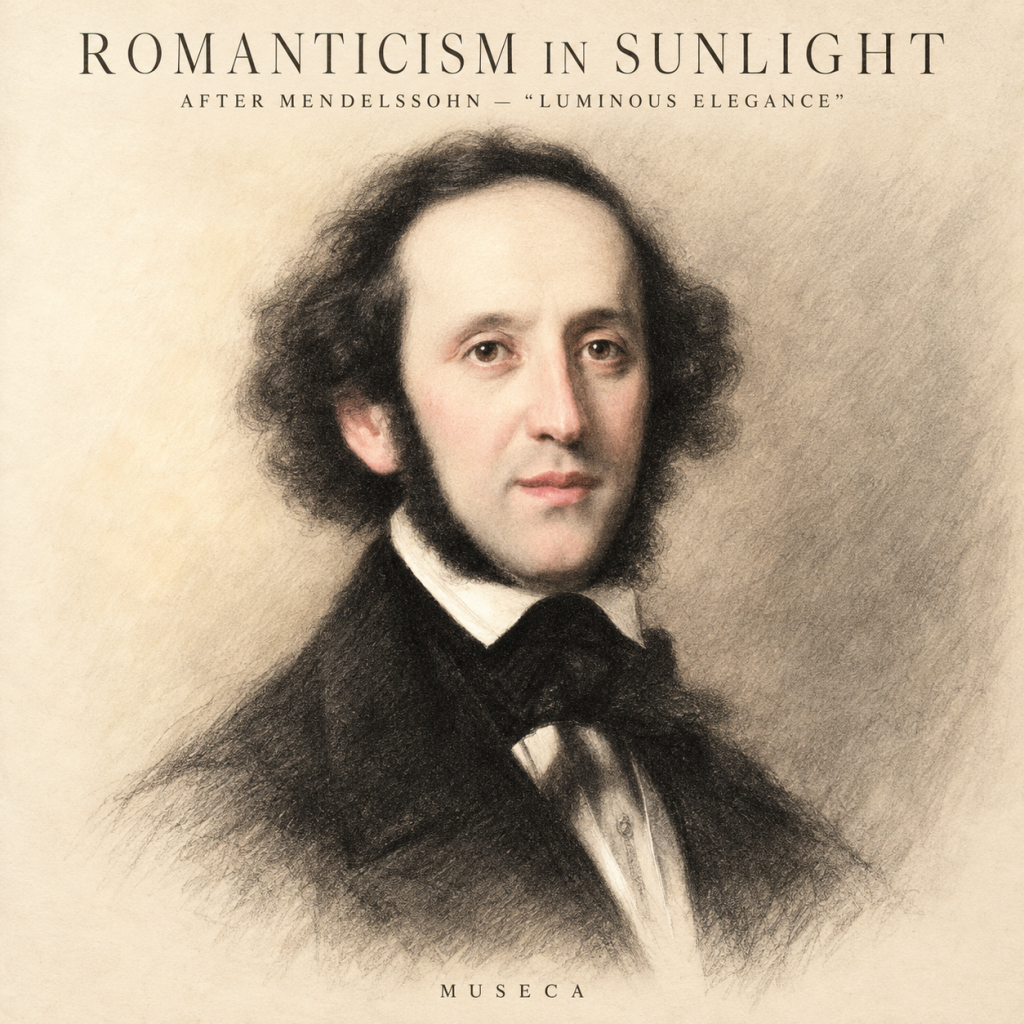
Romanticism in Sunlight
after Mendelssohn — “Luminous Elegance”
Museca
This album is new music written from a single composer’s signature — six movements in the forms, the instruments, and the idiom that Felix Mendelssohn himself used.
It is not a translation and it is not a transcription. Nothing here is arranged from his works. The pieces are original: a concert overture, a song without words, a fairy scherzo, an andante for violin, a string sinfonia, and a saltarello. What they share with him is the set of behaviors that made his music recognizably his — and that requires saying what a signature is.
Genre, style, signature
A composer’s genre is the container they worked in — the symphony, the concert overture, the piano miniature. Their style is the shared language of their time and place: in Mendelssohn’s case, early German Romanticism. Neither belongs to one person. Many composers wrote symphonies, and everyone in Leipzig in 1835 had the same accent.
Signature is the third layer, and the only one that does belong to a single human being. It is the set of behaviors a composer performs that nobody else performs in quite that combination — how they treat a melody, what they do with rhythm, where they place weight, what they refuse to do. Mendelssohn shares the Romantic orchestra and the lyrical melody with his contemporaries. His signature is the way only he commands them.
Luminous elegance
His signature is the fusion of Romantic warmth, lyricism, color, and atmosphere with Classical clarity, balance, polish, and formal mastery. He is the great Romantic classicist — never excessive or formless, his Romantic feeling held always in Classical grace.
Six behaviors sit underneath that.
He is one of the supreme melodists. His line is beautiful, flowing, elegant, and memorable, with a natural and effortless grace. The melody is the heart of the music — even his own title, Song Without Words, declares it.
He invented the gossamer fairy-scherzo. Rapid, feather-light staccato strings and twinkling winds woven into a shimmering, weightless transparency that seems to hover in the air, scored so delicately that the orchestra appears to dissolve into moonlit air. Nobody had written this before him. Every subsequent attempt at musical magic descends from it.
His rhythm is winged. Light, fleet, buoyant, quicksilver — a vitality found nowhere else. It is never heavy or driven. The buoyant, elfin patter is his rhythmic fingerprint, and the leaping saltarello is its other face.
His harmony is warmth held in clarity. He uses chromatic color and expressive shifts for feeling and atmosphere, but never lets harmony grow turgid or obscure. For Mendelssohn, harmony is warmth and clarity — not crisis.
He paints places. He founded the Romantic concert overture: the standalone orchestral piece that depicts a scene. The rolling Hebridean sea, sunlit Italy, misty Scotland.
And he wears Bach lightly. In 1829, aged twenty, he mounted the first performance of the St Matthew Passion since Bach’s own lifetime and began the Bach revival that re-rooted Western music in the contrapuntal art it had nearly lost. His own writing weaves an elegant counterpoint through its Romantic warmth — deep learning in the service of grace rather than weight.
What holds it together
One quality runs through all six: transparency. His textures are clear, balanced, and never thick. Every line is audible. The texture breathes.
That is the governing rule of this record, and the standard every movement was held to. Warmth, atmosphere, drive, and brilliance are all permitted. Muddiness is not.
Not merely pretty
The oldest charge against Mendelssohn is that he is lightweight — charming, well-made, and shallow. It is a misreading. His clarity and grace conceal real depth and craft; the ease is the mark of supreme mastery, not of shallowness.
An album of uniformly gracious music would prove the charge right, so this one does not do that. The overture darkens into real weather before the sea clears. The andante turns troubled in its middle section. And the finale — a leaping Italian dance of enormous energy and brilliance — is in the minor from first bar to last. He is the composer of sunlight, but he knew what shadow was for.
The books
The framework behind this album is documented in full, and both volumes are free to download and read.
Volume I — The Signature Method sets out the theory: the distinction between genre, style, and signature, and how to isolate what belongs to one composer alone.
Volume II — The Signature Cards applies it to fifty-one composers from Hildegard of Bingen to Philip Glass. Each entry gives a signature formula, a core statement, the primary elements at a glance, and essential listening.
Mendelssohn’s entry is the source of everything here. You can read it, disagree with it, and write completely different music from the same page. That is the intended use.
Download both volumes for free
Liner Notes
Concert Overture
The concert overture was Mendelssohn’s own invention, and it solved a problem nobody had quite articulated. An overture had always been the thing that came before something — an opera, a play, an oratorio. He wrote one that came before nothing. A single orchestral movement, complete in itself, depicting a place.
The Hebrides is the model: he saw Fingal’s Cave on the Scottish coast in 1829 and wrote down the opening bars the same day. What he produced was not a description of a cave but a portrait of water moving against rock — a rising and falling figure in the low strings that repeats without ever quite repeating, the way a swell does.
The form is sonata form, which is to say a movement in three parts: an exposition presenting two contrasting themes, a development that takes them apart and moves through unstable keys, and a recapitulation that brings them back home. It is the standard architecture of the Classical period, and his fidelity to it is exactly the point — Romantic atmosphere housed in Classical structure.
Here the first theme is a flowing melody in the cellos and clarinets, laid over the sea figure rather than replacing it. The second is warmer and higher, in the violins. The development darkens into real weather: minor harmony, restless strings, urgency. Then the storm passes, the themes return, and the swell recedes.
Listen for the transparency. Even at the height of the storm, the inner voices stay audible. That is the whole signature in one movement — Romantic feeling that never clouds the texture.
Song Without Words in A Minor
The Lied ohne Worte is his other invention, and the title is an argument. A song, with everything a song has — a singing line, a phrase that breathes, an accompaniment beneath — except the words. The melody carries the meaning alone.
The form is ternary: A–B–A. A section is stated, a contrasting middle follows, and the first returns. It is the simplest shape in music, and it offers nowhere to hide. There is no development to admire, no counterpoint to follow, no orchestration to impress with. If the tune is not beautiful, there is no piece.
The craft is in the texture, and it is a three-layer texture played by two hands. The right hand sings, in the middle register where a human voice sits, sustaining as a voice would. Beneath it, a quiet figure of broken chords fills the harmony. Below that, a clear bass — and in Mendelssohn the bass often sings too, a second melodic voice supporting the first. The middle layer must never cover the top. That balance is the entire technique of the genre.
The middle section turns to the major and opens out. Then the melody returns, slightly varied and more inward, and the piece ends with a fragment of the tune alone.
He wrote forty-eight of these across eight volumes. Most of their familiar titles — Spring Song, Venetian Gondola Song — were added by publishers after his death. He preferred to leave them unnamed, which was the point.
Fairy-Scherzo
The most original thing he ever did.
A scherzo is a fast movement in triple time, usually with a contrasting middle section called a trio — Beethoven’s replacement for the courtly minuet, and by 1830 a standard symphonic component. The form here is scherzo–trio–scherzo, another A–B–A, but at speed.
What Mendelssohn invented was a sound. Rapid, feather-light staccato in the strings, played very quietly, with woodwinds flickering between the figures rather than doubling them — a shimmering transparency that seems to hover rather than move. He first wrote it in the Octet at sixteen, then again in the Midsummer Night’s Dream music, and it has been the sound of musical magic ever since. Every fairy, every enchantment, every moonlit scene in two hundred years of concert hall and cinema descends from it.
The technical paradox is that everything is fast and almost nothing is loud. Musical energy usually comes from volume; here it comes entirely from velocity and articulation. The strings detach every note rather than joining them, the bass stays light, the register sits high, and there are audible silences between phrases — small lifts that keep the music airborne.
The trio is warmer and more sustained, which lets the shimmer return as a relief rather than a continuation. And the movement does not conclude so much as vanish: a sudden quiet flick, and it is gone.
Andante for Violin and Orchestra
The slow movement, and the album’s emotional center.
The form is ternary again, and deliberately so. All three of the album’s lyrical movements use the simplest available shape, because his slow music is not argumentative. It states something beautiful, troubles it, and returns.
The solo violin sings a long melody on long bows — the writing of a man who understood the instrument completely. His Violin Concerto is famously both deeply lyrical and perfectly playable, which is rarer than it sounds: most Romantic concertos ask the soloist to struggle, and the struggle becomes part of the drama. Mendelssohn asks the soloist to sing. There is no cadenza here, no display passage, no bravura. The virtuosity is entirely in the sustaining of a line.
Underneath, the orchestra accompanies and stays out of the way. Clear woodwind answers, a well-defined bass, and a texture that never swells enough to cover the soloist. The balance is the craft.
The middle section turns to the minor and grows searching — the shadow that keeps the movement from being merely lovely. Then the melody returns, warmer and more inward than the first time, and the violin holds a long note while the orchestra thins away beneath it.
Sinfonia for Strings
Between the ages of twelve and fourteen, Mendelssohn wrote twelve string symphonies for the Sunday concerts held at his family’s house in Berlin. They are extraordinary — fluent, inventive, and saturated in the Bach and Handel he had been raised on. They are also, for the most part, the work of a child.
A sinfonia is simply a symphony for strings alone, and this movement uses sonata form: two contrasting themes, a development, a return. But what distinguishes it is the counterpoint.
Fugato means writing that uses fugal technique in passages, without becoming a fugue. A theme enters in one voice, is answered in a second, then a third and a fourth, each arriving audibly against what is already sounding — and then the imitation dissolves back into ordinary ensemble writing. It is counterpoint as a passing event rather than a governing structure.
That distinction matters for understanding him. He was the great reviver of Bach and possessed a genuine contrapuntal fluency almost unique among the Romantics — but he never let it become academic. The learning is woven through the writing, warm and light and elegant, present without announcing itself.
Listen for the inner parts. In lazy string writing, violas and cellos supply chords. Here they have real material, and the ability to follow any one of the four lines through the movement is the mark of the tradition he was reviving.
Saltarello
Saltare means to leap.
The saltarello is an Italian folk dance in fast triple time, and Mendelssohn met it on the journey that produced the Italian Symphony. He made it the finale, and then did something no one expected: he wrote it in the minor. A sunlit symphony that ends in shadow, at tremendous speed.
The form is sonata form again, but the experience is one of perpetual motion. Running figures in the strings begin at the first bar and essentially never stop — under the themes, under the development, under the return. The momentum is the material. The leaping accent that gives the dance its name sits on top of that motion, bounding rather than marching.
Everything else about the album’s signature holds even here. The orchestra stays modest — strings, woodwinds, light horns, timpani used sparingly. The texture stays transparent at full power, which is far harder than transparency at low volume and is the real test of his scoring. There is no wall of sound and no massed brass. The brilliance is achieved by clarity and speed rather than by weight.
And it does not resolve into the major. The dance drives to a full, brilliant close, still in the minor, exhilarating and dark at once.
It is the best possible answer to everyone who ever called him merely charming.
The framework behind this album — the distinction between genre, style, and signature — is set out in The Signature Method (Volume I) and The Signature Cards (Volume II), both free to download and read.
Playlist
- Track 1 — Concert Overture Museca 3:08
- Track 2 — Song Without Words in A Minor Museca 2:18
- Track 3 — Fairy-Scherzo Museca 3:14
- Track 4 — Andante for Violin and Orchestra Museca 3:23
- Track 5 — Sinfonia for Strings Museca 2:18
- Track 6 — Saltarello Museca 2:43
Felix Mendelssohn
Luminous Elegance
1809–1847 · The Romantic classicist
Composer Identity
| Field | Detail |
|---|---|
| Period | Early–mid German Romantic |
| Cultural world | The wealthy, intellectual Berlin household of the grandson of the philosopher Moses Mendelssohn; Sunday musicales, the finest education, and a privileged, civilized milieu |
| Primary genres | Symphony; concert overture; concerto; oratorio; chamber music; piano miniature (Songs Without Words); organ works |
| Historical position | The supreme Romantic classicist; founder of the Romantic concert overture; inventor of the fairy scherzo; reviver of Bach |
He had Schubert’s gift for melody and an orchestral imagination to set beside Berlioz’s, but he channeled all of it through Classical clarity, balance, and grace. He invented a new sound-world of gossamer fairy-magic, founded the Romantic concert overture, painted the sea and the landscape, revived the forgotten Bach, and held Romantic feeling always in elegant poise. He died at thirty-eight, beloved across Europe.
Genre, Style, Signature
| Layer | Mendelssohn example | Meaning |
|---|---|---|
| Genre | Symphony, concert overture, concerto, oratorio, chamber music, piano miniature, organ work | The container or type of piece |
| Style | Early–mid German Romantic, distinguished by Classical clarity, elegance, balance, and polish | The broader shared musical language |
| Signature | Luminous elegance — Romantic warmth fused with Classical clarity; the songful melody, the gossamer fairy-scherzo, the picturesque overture, and the Bach-rooted craft | The personal fingerprint recognizable across his works |
Mendelssohn shares the Romantic orchestra and the lyrical melody with his contemporaries, but his signature is the way only he commands them. The chapter must not let “it is a tuneful, well-made Romantic work” stand in for what makes it his — and must not mistake the clarity and ease for a lack of depth.
Core Signature Statement
Mendelssohn’s signature is luminous elegance: the fusion of Romantic warmth, lyricism, color, and atmosphere with Classical clarity, balance, polish, and formal mastery. He is the great Romantic classicist — never excessive or formless, but clear, elegant, and beautifully crafted, his Romantic feeling held always in Classical grace.
He is one of the supreme melodists and the inventor of the gossamer ‘fairy’ scherzo and the magical, weightless, elfin orchestration. He founded the Romantic concert overture and painted the picturesque and the landscape; and, steeped in the Bach he revived, he wove an elegant contrapuntal fluency through his Romantic style.
Where Berlioz reached for the wild, the grandiose, and the macabre, Mendelssohn offers the luminous, the gracious, and the perfectly poised — Romanticism in sunlight, held in Classical clarity.
Primary Musical Signature
A. Melodic Signature
Mendelssohn is one of the supreme melodists. His melody is beautiful, flowing, elegant, and memorable — a natural, effortless grace of line, from the soaring lyric song of the Violin Concerto to the singing miniatures of the Songs Without Words. The melody is the heart of his music; even his title, ‘Song Without Words,’ declares it. His lines are warm, perfectly shaped, and unfailingly graceful — Romantic in feeling, Classical in poise.
B. Harmonic Signature
Clear, warm, and elegant — Romantic color held in Classical balance. He uses chromatic warmth and expressive shifts for feeling and atmosphere, but never lets harmony grow turgid, excessive, or obscure; his progressions are refined, well-shaped, and luminous. Harmony, for Mendelssohn, is warmth and clarity, not crisis.
C. Rhythmic Signature
Light, fleet, and buoyant, with a quicksilver vitality found nowhere else. The fairy scherzos race by on rapid, feather-light staccato; the dances lilt; the symphonies bound forward with clear, well-defined momentum. His rhythm is never heavy or driven; it is winged — the buoyant, elfin patter that is his rhythmic fingerprint.
D. Meter and Dance Signature
The scherzo is his signature dance-world — above all the fairy scherzo, light and quicksilver and weightless. He also delights in the buoyant saltarello (the leaping finale of the Italian Symphony), the gracious lilt, and the song-dance. Meter, in his hands, is clear and buoyant — the body made weightless, dancing on air.
E. Motivic Signature
Clear, elegant, and fluent — the inheritance of the Classical masters. He develops with grace and balance rather than Beethovenian struggle, binding works with cyclic touches and seamless transitions. The craft is masterly, but it is worn lightly.
F. Contrapuntal Signature
The great reviver of Bach, he possesses a genuine contrapuntal fluency rare among the Romantics. He weaves elegant counterpoint, fugato, and fluent part-writing gracefully into his Romantic style — and the Bach-rooted craft never sounds academic; it is made warm, light, and elegant. His is the rare Romantic art in which deep contrapuntal learning serves grace rather than weight.
G. Textural Signature
Clear, transparent, elegant, and perfectly balanced — never muddy or thick. His most original is the gossamer fairy-light texture: rapid, feather-light staccato strings and twinkling winds woven into a shimmering, weightless transparency that seems to hover in the air. Every line is audible; the texture breathes.
H. Orchestration Signature
Clear, refined, and brilliant — and capable of pure magic. His signature invention is the gossamer fairy-light scoring: a weightless, twinkling, elfin transparency, scored with such delicacy that the orchestra seems to dissolve into moonlit air. He is also a master of the picturesque — the rolling swell of the Hebridean sea, the sunlit brilliance of Italy. His color is always brilliant, but always clear.
I. Formal Signature
A master of Classical form filled with Romantic content. His symphonies, concertos, and chamber works are clear, balanced, and perfectly proportioned. And he was an innovator within that discipline: he founded the Romantic concert overture — the standalone, picturesque, programmatic orchestral piece — and refashioned the concerto, with seamless linked movements and an early entry for the soloist.
Emotional World
Warm, gracious, elegant, and poised — Romantic feeling without Romantic excess. Often sunny, serene, optimistic, and lyrical; it holds the magical, the elfin, the fairy-light; the picturesque and the atmospheric; the wistful and the gently tender; and, in the oratorios and stormier works, the grand, the dramatic, and the devout. But it is always controlled, balanced, and clear.
Where Berlioz’s world is the opium-dream and the abyss, Mendelssohn’s is the serene, gracious, and civilized — the most luminous and elegant of all Romantic worlds, and proof that depth and restraint are not opposites.
Rescuing Bach: The Passion of 1829
For nearly eighty years after his death, Johann Sebastian Bach was a half-forgotten figure — revered by a handful of connoisseurs, but his great choral works unperformed and largely unknown. Then, in 1829, a twenty-year-old Mendelssohn mounted a public performance of Bach’s St Matthew Passion in Berlin — the first since Bach’s own lifetime.
It was a sensation, and it changed the course of music. The Bach revival had begun: the Passions and cantatas returned to the repertoire, and Western music re-rooted itself in the contrapuntal art it had nearly lost. That Mendelssohn — himself the most elegant of melodists — should have been the one to resurrect the supreme contrapuntist is no accident: his own music is steeped in Bach.
Signature Behaviors
| # | Repeatable Mendelssohn behavior |
|---|---|
| 1 | Fuses Romantic warmth and color with Classical clarity, balance, and polish. |
| 2 | Pours out beautiful, flowing, elegant, memorable melody. |
| 3 | Invents the gossamer ‘fairy’ scherzo — weightless, elfin, quicksilver. |
| 4 | Scores with magical, transparent, fairy-light delicacy. |
| 5 | Paints the picturesque and the landscape (the sea, Italy, Scotland). |
| 6 | Founds the Romantic concert overture — the standalone picturesque piece. |
| 7 | Weaves an elegant, Bach-rooted counterpoint through his Romantic style. |
| 8 | Crafts clear, balanced, perfectly proportioned forms. |
| 9 | Creates the ‘Song Without Words’ — the lyrical piano miniature. |
| 10 | Continues the grand oratorio tradition of Bach and Handel (Elijah). |
| 11 | Holds emotion in gracious, luminous, poised restraint. |
| 12 | Writes with fluent, effortless, prodigious mastery. |
Common Misreadings
| Misreading | What it misses |
|---|---|
| “Mendelssohn is lightweight or merely pretty.” | His clarity and grace conceal real depth, craft, and substance — the ease is the mark of supreme mastery, not shallowness. |
| “He just imitated the Classical masters.” | He fused Classical form with genuine Romantic content and invented new things — the fairy scherzo, the concert overture, the Song Without Words. |
| “It is all sunny and untroubled.” | He has stormy, dramatic, devout, and wistful registers too — the Scottish, the Hebrides, Elijah, the late chamber works. |
| “He is a lesser Romantic — not progressive enough.” | He is the supreme Romantic classicist — a different, equally valid path, the line that runs to Brahms. |
| “The fairy music is just charming decoration.” | It is a genuine, original sound-world invention of magical delicacy that shaped all later ‘magic’ music. |
Period-Bound Elements
These belong largely to Mendelssohn’s historical surface. They may be useful, but they are not the deep signature.
| Period-bound element | Why to use it carefully |
|---|---|
| The early-Romantic orchestra and instruments | Period; the transferable traits are the clear, elegant orchestration and the gossamer-fairy scoring. |
| The oratorio and sacred-choral conventions | Period and genre; what travels is the grandeur and the Bach-rooted craft. |
| The ‘Song Without Words’ salon genre | Period; transferable as the lyrical melody-over-accompaniment miniature. |
| The Classical forms (sonata, symphony) | Period; the engine is the clarity, balance, and craft. |
| The specific picturesque programs | Period and personal; transferable as the picturesque, scene-painting principle. |
Transferable Elements
The Romantic-Classical balance
Romantic feeling and color held in clarity, elegance, and form — the model for music that is warm and expressive but clear, well-crafted, and never excessive or bombastic.
The songful, elegant melody
Beautiful, flowing, memorable lyrical melody — a supreme model for elegant, singing melody in any genre.
The gossamer-fairy sound-world
The weightless, shimmering, twinkling, elfin texture and orchestration — the ‘magic’ idiom that runs straight into fantasy film, game music, and every later evocation of enchantment.
The picturesque and atmospheric
Music that paints a place, a scene, or nature — the concert overture as a ‘musical postcard,’ the model for atmospheric, cinematic, and ambient scene-painting.
Clarity, transparency, and polish
Clean, well-balanced, un-muddy textures — a model for clear, refined arrangement and production in any medium.
The lyrical miniature and the elegant counterpoint
The ‘Song Without Words’ — a singing melody over a clear accompaniment — the model for the neoclassical and lo-fi piano piece; and the Bach-rooted counterpoint made warm and graceful.
Signature Evaluation Rubric
Melody, texture, orchestration, idiom, form, and cultural identity are rated at the maximum — Mendelssohn is a supreme melodist, the master of the gossamer-fairy texture, and the consummate Romantic classicist.
| Category | 1–5 | Notes |
|---|---|---|
| Melody | 5 | One of the supreme melodists; the elegant, songful, memorable line — defining. |
| Harmony | 4 | Clear, warm Romantic color held in Classical balance; elegant rather than radical. |
| Texture | 5 | The gossamer fairy-light transparency — his most original invention. |
| Orchestration | 5 | Clear, refined, brilliant; the magical fairy-light scoring. |
| Form | 5 | Classical mastery renewed — and the invention of the concert overture. |
Final Signature Summary
Mendelssohn is the great Romantic classicist: Romantic warmth, lyricism, color, and atmosphere held always in Classical clarity, balance, and grace. He is one of the supreme melodists; he invented the gossamer fairy-scherzo and the weightless, elfin orchestration that became the sound of musical magic; he founded the Romantic concert overture and painted the sea, Italy, and Scotland; and, having revived the forgotten Bach, he wove an elegant counterpoint through his Romantic style, learning made light.
The early-Romantic orchestra, the salon miniature, and the oratorio apparatus are the costume. The engine — warmth held in clarity, the singing elegant line, the shimmering weightless texture, the picturesque scene, and the craft worn lightly — travels anywhere. Romanticism in sunlight.
Felix Mendelssohn
Luminous Elegance
1809–1847
Signature Formula
Core Signature Statement
Mendelssohn fuses Romantic warmth, lyricism, color, and atmosphere with Classical clarity, balance, polish, and formal mastery — the great Romantic classicist, never excessive or formless, his Romantic feeling held always in Classical grace.
He is one of the supreme melodists and the inventor of the gossamer ‘fairy’ scherzo and the magical, weightless orchestration. He founded the Romantic concert overture and painted the picturesque; and, steeped in the Bach he revived, he wove an elegant counterpoint through his Romantic style. Where Berlioz reached for the wild and the grandiose, Mendelssohn offers the luminous, the gracious, and the perfectly poised — Romanticism in sunlight.
Primary Elements at a Glance
| Element | Mendelssohn signature |
|---|---|
| Romantic classicism | Romantic warmth and color fused with Classical clarity, balance, and polish. |
| Melody | Beautiful, flowing, elegant, memorable, songful melody — a supreme melodist. |
| The fairy scherzo | The gossamer, weightless, elfin, quicksilver sound-world. |
| Orchestration | Clear, refined, brilliant — and the magical fairy-light scoring. |
| The picturesque | The concert overture and symphony that paint a place and a scene (the sea, Italy). |
| Counterpoint | An elegant, Bach-rooted contrapuntal fluency. |
| Spirit | The gracious, luminous, poised Romantic — Romanticism in sunlight. |
Surface Style vs. Deep Signature
| Surface style (costume) | Deep signature (engine) |
|---|---|
| The early-Romantic orchestra and its instruments | The clear, elegant, transparent scoring — and the gossamer fairy-light texture |
| The salon ‘Song Without Words’ genre | The singing melody over a clear accompaniment — the lyrical miniature |
| The oratorio and sacred-choral apparatus | The grandeur and the Bach-rooted craft |
| The Classical forms — sonata, symphony, concerto | The clarity, balance, proportion, and craft themselves |
| The specific programs — the Hebrides, Italy, Scotland | The picturesque, scene-painting principle |
| Early-Romantic harmonic convention | Warmth held in clarity — Romantic color, never turgid |
Transferable Engine
- The Romantic-Classical balance — warmth and color held in clarity, elegance, and form
- The songful, elegant melody — a supreme model for singing line in any genre
- The gossamer-fairy sound-world — weightless, shimmering, elfin texture; the ancestor of every later ‘magic’ idiom
- The picturesque — music that paints a place, a scene, or nature
- Clarity, transparency, and polish — clean, balanced, un-muddy texture in any medium
- The lyrical miniature — a singing melody over a clear accompaniment
- Elegant, Bach-rooted counterpoint — learning made warm and light
Common Misreading
“Mendelssohn is lightweight — charming, well-made, and shallow; a lesser Romantic who wasn’t progressive enough.”
His clarity and grace conceal real depth, craft, and substance: the ease is the mark of supreme mastery, not of shallowness. He fused Classical form with genuine Romantic content and invented new things — the fairy scherzo, the concert overture, the Song Without Words. He has stormy, dramatic, devout, and wistful registers alongside the sunlit ones. And he is not a lesser Romantic but the supreme Romantic classicist — a different and equally valid path, the line that runs forward to Brahms.
Essential Listening
| Listen for | Work |
|---|---|
| The gossamer fairy-scherzo | A Midsummer Night’s Dream — Overture and Scherzo |
| The supreme singing melody | Violin Concerto in E minor — first and second movements |
| The picturesque overture | The Hebrides (Fingal’s Cave) |
| The lyrical miniature | Songs Without Words — any volume |
| Youthful contrapuntal fluency | Octet in E-flat, Op. 20 — and the String Sinfonias |
| The buoyant leaping finale | Symphony No. 4 ‘Italian’ — Saltarello |
| The grand and devout | Elijah |