
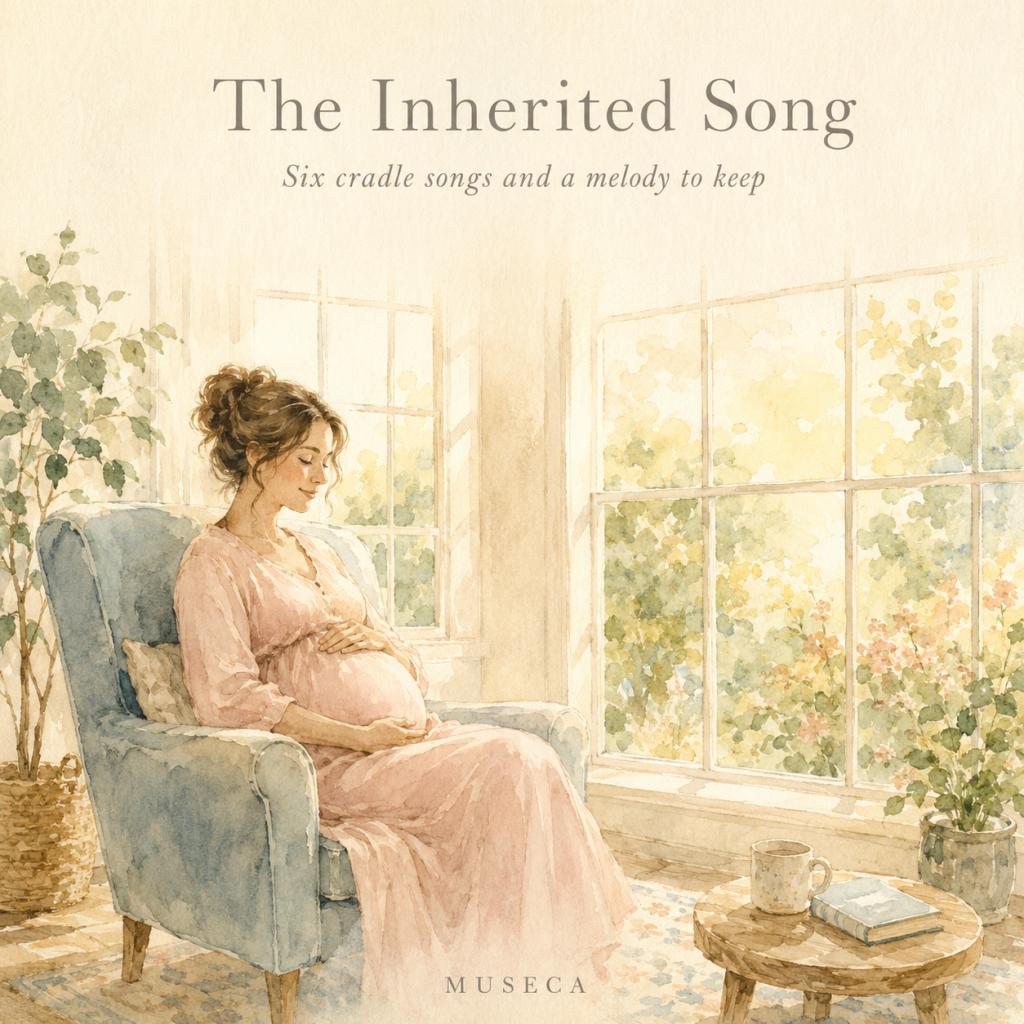
The Inherited Song
Six cradle songs and a melody to keep
This album began with a question I thought I already knew the answer to.
Most people my age grew up alongside a piece of common knowledge: that playing classical music to a baby makes the baby smarter. It was everywhere. It came with cassettes and CDs and video series, with a name attached — the Mozart effect — and with the comfortable authority of something science had settled. I had absorbed it the way you absorb any fact you never had reason to examine. When I started thinking about writing music for the very young, it seemed like the obvious foundation. So I went to look at it properly.
It does not hold up.
The original study, published in 1993, involved college students, not infants. They listened to ten minutes of a Mozart sonata and then performed slightly better on a single kind of spatial puzzle. The researchers themselves noted the improvement lasted about a quarter of an hour. That is the entire finding. Everything else — the babies, the head start, the industry — was built on top of it by people who had not read it, and it grew until it was worth a great deal of money and had been written into state legislation.
Meanwhile, other laboratories tried to reproduce the result and largely could not. When someone finally ran the experiment properly, comparing Mozart not against silence but against a narrated story that people enjoyed just as much, the advantage disappeared entirely. The mechanism had never been Mozart. It was simply that a person who has just heard something they like is a little more alert than a person who has been sitting in a quiet room. Anything pleasant does it. Coffee does it.
I found this genuinely disappointing for about a day. Then I found it clarifying, because it meant I had to go and ask what music actually does to someone who is very small — and the real answer turned out to be far more interesting than the one I had lost.
Here is what is true.
A fetus can hear, in the last months, and what reaches them is not what reaches us. The body is a filter. Low sound passes through almost unchanged; high sound is muffled and thinned. What arrives is the bass, the pulse, the shape of a phrase rising and falling, the vowels of speech without most of its consonants. The mother’s own voice, travelling from inside rather than in, comes through a little louder than everything else in the world. It is not silence in there. It is a low, warm, muffled room with one voice in it that is closer than the others.
And they remember. This is the part that changed the album. When a melody is played to a fetus repeatedly across the last trimester — the same tune, night after night — the newborn responds differently to that melody than to one they have never heard. The response is measurable at birth and still measurable months later, and the strength of it tracks how many times they heard it. Not how good the music was. How many times.
There is more. Babies settle to lullabies from languages they have never encountered and could not possibly understand, which tells you the calming is carried by the music itself and not by the words. And, most usefully for anyone thinking about what a record like this is for: a caregiver singing, imperfectly, in the room, does more for an infant than a recording of a better singer does. Live and present beats polished and absent, every time it has been measured.
So the honest version of what music does for the very young is not that it makes them cleverer. It is that it makes something familiar. It gives a child one thing they already know on a day when everything else is new, and it gives the person holding them something to do with their voice at three in the morning.
That is a smaller claim. I think it is a better one.
The Inherited Song is built on it directly.
There are six cradle songs here, in English, Italian, Japanese, French, Spanish and German, and every one of them was written to be learned. That was the constraint I set before anything else: each melody moves by step, stays inside a sixth, and can be sung by someone with no training and no confidence. Each has a refrain built from open syllables — lullay, ninna nanna, nenneko, dodo, ea, schlaf — chosen because they survive being pronounced badly by a tired person in the dark. You do not need to speak these languages. Neither will the child.
All six live in the same key, so you never have to find your pitch again between them, and all six share one small five-note figure that turns up in every refrain. It is the same five notes each time, bent to fit whichever mode the song lives in — warm in the Italian, austere in the Spanish, open in the Japanese — but it is always the same shape. That figure is the point of the record. Everything else is a different way of handing you the same thing.
Which is why the album ends the way it does. The seventh track is not a song. It is that figure alone, sung once or twice by one voice with nothing underneath it and no language attached, and then it stops. Thirty-eight seconds. It is called Yours.
I am aware that a record which asks you to sing is a strange thing to record. But the research is unambiguous about this, and I would rather be useful than impressive. These recordings are the teaching copy. They are meant to be played while you learn one of them, and then to matter less as your own voice takes over. If a year from now you are singing one of these badly, from memory, to a child who has never heard the recording, then the album has done exactly what it was built to do.
I make no claim that this will make anyone smarter. It will not. What it might do is give a child something they recognise, and give you something to sing — and after everything I read, I have come to think that is the more valuable of the two things anyway.
Liner Notes
Cradle Song
The plainest thing here, and deliberately so. It asks nothing of you — no unfamiliar language, no unusual mode, no ornament — and it is the door the rest of the album opens from. A guitar begins alone, out of time. A cello arrives halfway through and stays. Somewhere in the middle the voice stops and the cello takes the tune by itself, so that you hear the melody without words and discover you already know it. The refrain is built on lullay, the oldest English cradle syllable, which has survived several centuries largely because it is impossible to get wrong at three in the morning.
English Lyrics
The lamp is low, the door is wide,
the coats are hanging in the hall,
the night is standing still outside.
Lullay, lullay,
lullay, lullay,
lullay, lullay —
I am not far away.
The floor is cool, the window grey,
the kettle’s quiet on the stove,
there’s nowhere I have got to be.
Lullay, lullay,
lullay, lullay,
lullay, lullay —
I am not far away.
Your hand is open, small and warm,
the dark is only dark, my love,
and morning knows the way back home.
Lullay, lullay,
lullay, lullay,
lullay, lullay —
I am not far away.
Lullay, lullay,
lullay, lullay,
lullay, lullay —
I am not far away.
Ninna nanna
The warmest and fullest thing on the album, and the only track where nearly everyone is playing. A mandolin doubles the guitar an octave up, but only in the refrains — it appears, then it goes away again. Italian is the most forgiving of these six languages for a singer who does not speak it: everything is open vowels, and ninna nanna is a phrase you can hold in your mouth without effort. The five-note figure from the first song returns here, note for note, but the ground beneath it has changed from a flat two to a rocking six, and it sounds like a different idea entirely. It isn’t.
Italian Lyrics
La luce è bassa, la sera viene,
il vento dorme sopra il mare,
non c’è più niente da fare.
Ninna nanna, ninna nanna,
ninna nanna, ninna nanna,
ninna nanna, ninna nanna —
io resto qui con te.
La casa è calma, la strada è vuota,
la luna sale piano piano,
e tengo la tua mano.
Ninna nanna, ninna nanna,
ninna nanna, ninna nanna,
ninna nanna, ninna nanna —
io resto qui con te.
Il buio è solo buio, amore,
domani torna il sole ancora,
dormi, dormi, è ora.
Ninna nanna, ninna nanna,
ninna nanna, ninna nanna,
ninna nanna, ninna nanna —
io resto qui con te.
Ninna nanna, ninna nanna,
ninna nanna, ninna nanna,
ninna nanna, ninna nanna —
io resto qui con te.
English translation
The light is low, the evening comes,
the wind is sleeping on the sea,
there is nothing left to do.
Ninna nanna, ninna nanna,
ninna nanna, ninna nanna,
ninna nanna, ninna nanna —
I am staying here with you.
The house is calm, the street is empty,
the moon climbs slowly, slowly,
and I am holding your hand.
Ninna nanna, ninna nanna,
ninna nanna, ninna nanna,
ninna nanna, ninna nanna —
I am staying here with you.
The dark is only dark, my love,
tomorrow the sun comes back again,
sleep now, sleep, it’s time.
Ninna nanna, ninna nanna,
ninna nanna, ninna nanna,
ninna nanna, ninna nanna —
I am staying here with you.
Komoriuta
Here the album goes quiet and stays quiet. A koto takes the harp’s place, the clarinet sits the song out, and nothing is struck except one small bell, twice. The silences between the phrases are longer than anywhere else on the record, and they are meant to be genuinely empty — a Japanese cradle song lives as much in the rests as in the notes. The recurring figure cannot survive intact in this mode, so it bends: the same shape, the same rhythm, one note moved. It should still sound like the thing you have already heard twice.
Japanese Lyrics
やまは しずか、
つきが のぼる。
ねんねこ、ねんねこ、
ねんねこ、ねんねこ —
ここに いるよ。
かぜは やんで、
とりも ねむる。
ねんねこ、ねんねこ、
ねんねこ、ねんねこ —
ここに いるよ。
やみは やさしい、
あさは くるよ。
ねんねこ、ねんねこ、
ねんねこ、ねんねこ —
ここに いるよ。
ねんねこ、ねんねこ、
ねんねこ、ねんねこ —
ここに いるよ。
English translation
The mountain is quiet,
the moon is rising.
Nenneko, nenneko,
nenneko, nenneko —
I am here.
The wind has stopped,
the birds are sleeping too.
Nenneko, nenneko,
nenneko, nenneko —
I am here.
The dark is gentle,
the morning will come.
Nenneko, nenneko,
nenneko, nenneko —
I am here.
Berceuse
Something is very slightly out of tune here, and it is on purpose. The voice sings one note and the harmony underneath insists on another a half step away, and the two never come to an agreement. It is not dissonance — you may not consciously notice it — but it is the reason this song feels blurred where the others feel clear. The harp comes forward for the only time on the album and rocks continuously; the guitar gives up playing chords altogether and holds single low notes that decline to resolve. Late evening music. The point in the night when you stop knowing quite what time it is.
French Lyrics
La lampe est basse, la nuit est douce,
le vent s’endort au bord de l’eau,
il n’y a plus rien à faire.
Dodo, dodo,
dodo, dodo,
dodo, dodo —
je reste près de toi.
La maison dort, la rue est vide,
la lune monte lentement,
et je tiens ta main.
Dodo, dodo,
dodo, dodo,
dodo, dodo —
je reste près de toi.
Le noir n’est que le noir, mon coeur,
demain le jour revient encore,
dors, dors, il est temps.
Dodo, dodo,
dodo, dodo,
dodo, dodo —
je reste près de toi.
Dodo, dodo,
dodo, dodo,
dodo, dodo —
je reste près de toi.
English translation
The lamp is low, the night is soft,
the wind falls asleep at the water’s edge,
there is nothing left to do.
Dodo, dodo,
dodo, dodo,
dodo, dodo —
I am staying close to you.
The house is sleeping, the street is empty,
the moon climbs slowly,
and I am holding your hand.
Dodo, dodo,
dodo, dodo,
dodo, dodo —
I am staying close to you.
The dark is only the dark, my heart,
tomorrow the day comes back again,
sleep now, sleep, it’s time.
Dodo, dodo,
dodo, dodo,
dodo, dodo —
I am staying close to you.
Nana
The floor of the album, and the only song here that is not comforting in an easy way. It has no meter at all — the guitar does not keep time, it answers the voice, and the silences between phrases are as long as they need to be. The mode is the old Andalusian one, austere and unsweetened, and the singing sits closer to speech than to song. Real nanas are like this. They do not soothe by reassuring you; they soothe by stating the situation plainly and staying in the room. If you skip this one on a difficult night, I understand. It is here so that what follows means something.
Spanish Lyrics
La noche es larga,
el campo está oscuro,
no llores más.
Ea, ea,
ea, ea,
ea, ea —
aquí estoy yo.
El agua duerme,
la puerta está cerrada,
no llores más.
Ea, ea,
ea, ea,
ea, ea —
aquí estoy yo.
La sombra pasa,
la mañana viene,
no llores más.
Ea, ea,
ea, ea,
ea, ea —
aquí estoy yo.
Ea, ea,
ea, ea,
ea, ea —
aquí estoy yo.
English translation
The night is long,
the field is dark,
cry no more.
Ea, ea,
ea, ea,
ea, ea —
I am here.
The water is sleeping,
the door is closed,
cry no more.
Ea, ea,
ea, ea,
ea, ea —
I am here.
The shadow passes,
the morning is coming,
cry no more.
Ea, ea,
ea, ea,
ea, ea —
I am here.
Wiegenlied
The lift. A violin has been waiting six tracks to appear and finally does, alone and out of time, before anything else. The guitar abandons its fingerpicking for plain block chords and the harmony turns honest and diatonic, which after the Spanish song lands like a hand on your shoulder. This is also the one place where I let the album say the thing the other five keep to themselves — that the child will one day take the song and leave. Every real lullaby tradition knows this and most of them mention it. On the last line, a second voice joins the first in unison, as though someone else in the house had been listening and decided to sing along.
German Lyrics
Das Licht ist klein, das Haus ist still,
der Abend legt sich auf das Feld,
und alles ruht.
Schlaf, schlaf,
schlaf, schlaf,
schlaf, schlaf —
ich bleibe hier bei dir.
Der Weg ist weit, die Nacht ist lang,
die Sterne stehen über dir,
und alles ruht.
Schlaf, schlaf,
schlaf, schlaf,
schlaf, schlaf —
ich bleibe hier bei dir.
Einmal gehst du von hier fort,
und trägst dies Lied in dir hinaus,
und alles ruht.
Schlaf, schlaf,
schlaf, schlaf,
schlaf, schlaf —
ich bleibe hier bei dir.
Schlaf, schlaf,
schlaf, schlaf,
schlaf, schlaf —
ich bleibe hier bei dir.
English translation
The light is small, the house is still,
the evening settles on the field,
and everything is at rest.
Sleep, sleep,
sleep, sleep,
sleep, sleep —
I am staying here with you.
The road is long, the night is long,
the stars are standing over you,
and everything is at rest.
Sleep, sleep,
sleep, sleep,
sleep, sleep —
I am staying here with you.
One day you will go from here,
and carry this song out with you,
and everything is at rest.
Sleep, sleep,
sleep, sleep,
sleep, sleep —
I am staying here with you.
Yours
Not a song. Thirty-eight seconds, one voice, no instruments, no language: the five-note figure that has been moving through all six of these, finally on its own with nothing around it. After that it stops. This is the part of the album I care most about, because it is the part that is no longer mine. The recordings were only ever a way of teaching you something small enough to carry. Here it is, without the packaging. Sing it badly. That is the whole idea.
Playlist
- Track 1 - Cradle Song Museca 3:15
- Track 2 - Ninna nanna Museca 3:03
- Track 3 - Komoriuta Museca 3:07
- Track 4 - Berceuse Museca 2:35
- Track 5 - Nana Museca 2:35
- Track 6 - Wiegenlied Museca 3:23
- Track 7 - Yours Museca 0:38