
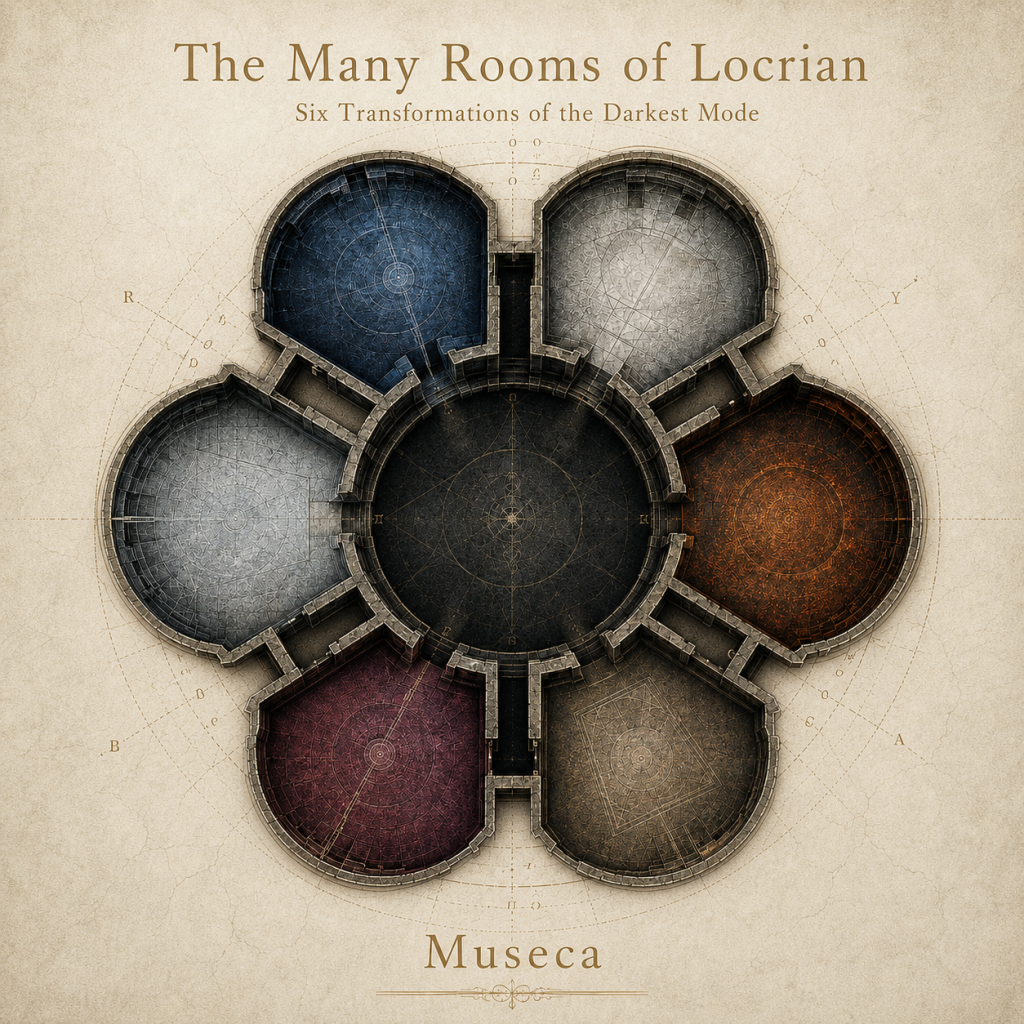
The Many Rooms of Locrian is built on a simple but fertile premise: the Locrian mode does not lose its identity when it changes style. It changes costume. The same unstable center, the same pressure of the flat second, the same compromised fifth, and the same refusal of ordinary arrival can survive inside very different musical worlds. What changes is not the mode’s inner condition, but the social and emotional body through which that condition speaks.
Across these six tracks, Locrian passes through six distinct chambers: chamber noir jazz, sacred ambient minimalism, ritual groove, flamenco-shadow writing, expressionist cabaret, and chamber folk. In one room it becomes urban insomnia; in another, prayer without doctrinal closure. In one, it moves through the body with rhythmic confidence; in another, it speaks as theatrical confession. By the end, it sounds less like an abstract scale and more like an old presence wearing many historical masks.
The album remains unified by a common musical ethic. Each piece preserves a restrained, nocturnal, and intelligent atmosphere. The harmonic language avoids conventional tonal resolution, leaning instead on pedals, drones, modal ostinati, and the recurring pressure of the flat second. The bass clarinet serves as the album’s hidden thread, binding together city, chapel, stage, and village. The result is not a sampler of genres, but a single modal intelligence moving through six different worlds—one mode, six rooms, one enduring wound.
Liner Notes
Rain Over the Diminished Fifth
The album opens in the city, but not in motion—in suspension. This chamber noir jazz setting introduces Locrian as a language of urban interiority: rain on pavement, soft neon reflected in glass, thought turning inward after midnight. The bass clarinet becomes the principal shadow-voice, moving through the mode with a dark lyricism that never fully settles, while muted trumpet, vibraphone, piano, and brushed drums form a restrained harmonic weather around it. What matters here is not conventional jazz resolution, but the persistence of an unstable center. The diminished fifth is not treated as a passing color; it hangs over the piece like a structural bruise, giving the track its intimate unease and nocturnal elegance.
Prayer with No Final Amen
The second room withdraws from the city into a space of stillness, but not certainty. Here Locrian enters sacred ambient minimalism, where harmonium or organ drone, bass flute, sparse piano, and suspended upper textures create the sensation of devotion without doctrinal closure. The mode’s refusal of ordinary arrival becomes spiritually meaningful: prayer continues, but no final “amen” seals it. Rather than collapse, the music offers hovering endurance. The pressure of the flat second remains quietly active throughout, lending the track an atmosphere of unresolved consecration. This is sacred music for an unfinished threshold—music that reaches upward without pretending the answer has already come.
The Body Learns the Abyss
With the third track, Locrian moves into pulse and embodiment. The groove is steady, confident, even trance-inducing, yet the harmonic floor never stops shifting beneath the listener’s feet. This is what makes the piece so unusual: the body is allowed to trust rhythm while the harmony withholds full security. Deep bass, hand percussion, restrained kick, atmospheric electronics, and modal fragments shape an Afro-house-inflected ritual space in which instability becomes something inhabitable. The title is the key to the track’s meaning. The abyss is not merely contemplated here; it is learned through repetition, through motion, through breath and cycle. The result is less like dark club music than like disciplined trance under modal pressure.
Veil of Ash and String
This track places Locrian inside a flamenco-shadow language, where heat and fracture coexist. The expected Phrygian pull of the flamenco world is darkened further, and the mode acquires a more subterranean intensity. Nylon-string guitar establishes tense, brittle voicings and rhythmic figures, while cajón and palmas keep the music embodied rather than abstract. Bass clarinet deepens the atmosphere with breath-darkened lines, and viola introduces an inward flame—more lament than declaration, more burn than blaze. The piece feels elegant, but veiled; dramatic, but never theatrical in the obvious sense. What emerges is a stylized, shadowed cousin to flamenco: a dance of withheld fire conducted in the grammar of Locrian.
Confession Under a Crooked Lamp
The fifth room is theatrical, literary, and psychologically unstable. Here Locrian enters the world of expressionist art song and cabaret, where irony and sincerity live too close together to be separated cleanly. Piano gives the song its angular frame, while bass clarinet and viola surround the voice like a private audience of shadows. The mode proves especially suited to unstable persona: confession that may also be performance, self-exposure that may also be mask. The “crooked lamp” of the title suggests exactly this tilted illumination—light enough to reveal, distorted enough to wound. The track is not parody, and not pastiche; it is a serious use of cabaret’s broken elegance to expose how naturally Locrian can speak in tones of theatrical self-consciousness, inward drama, and philosophic unease.
Village at the Edge of the Root
The final track carries the mode into its oldest-sounding form. After city, chapel, groove, court, and stage, Locrian arrives in a chamber-folk landscape where it feels less like a theoretical anomaly than like an ancestral inheritance. Drone, frame drum, plucked strings, fiddle or nyckelharpa, and the recurring shadow of the bass clarinet create a world of circular motion rather than cadential destination. The piece suggests winter ritual, oral memory, and the persistence of old songs at the boundary between community and mystery. The “root” in the title is both tonic and origin; to stand at its edge is to inhabit a center that exists, but never fully grants repose. As the album closes, Locrian no longer sounds merely dark or unstable. It sounds local, ancient, and strangely inevitable—as though it had always been waiting in this final room.
Playlist
- Track 1 - Rain Over the Diminished Fifth Museca 3:27
- Track 2 - Prayer with No Final Amen Museca 3:29
- Track 3 - The Body Learns the Abyss Museca 4:14
- Track 4 - Veil of Ash and String Museca 2:55
- Track 5 - Confession Under a Crooked Lamp Museca 1:38
- Track 6 - Village at the Edge of the Root Museca 2:39