
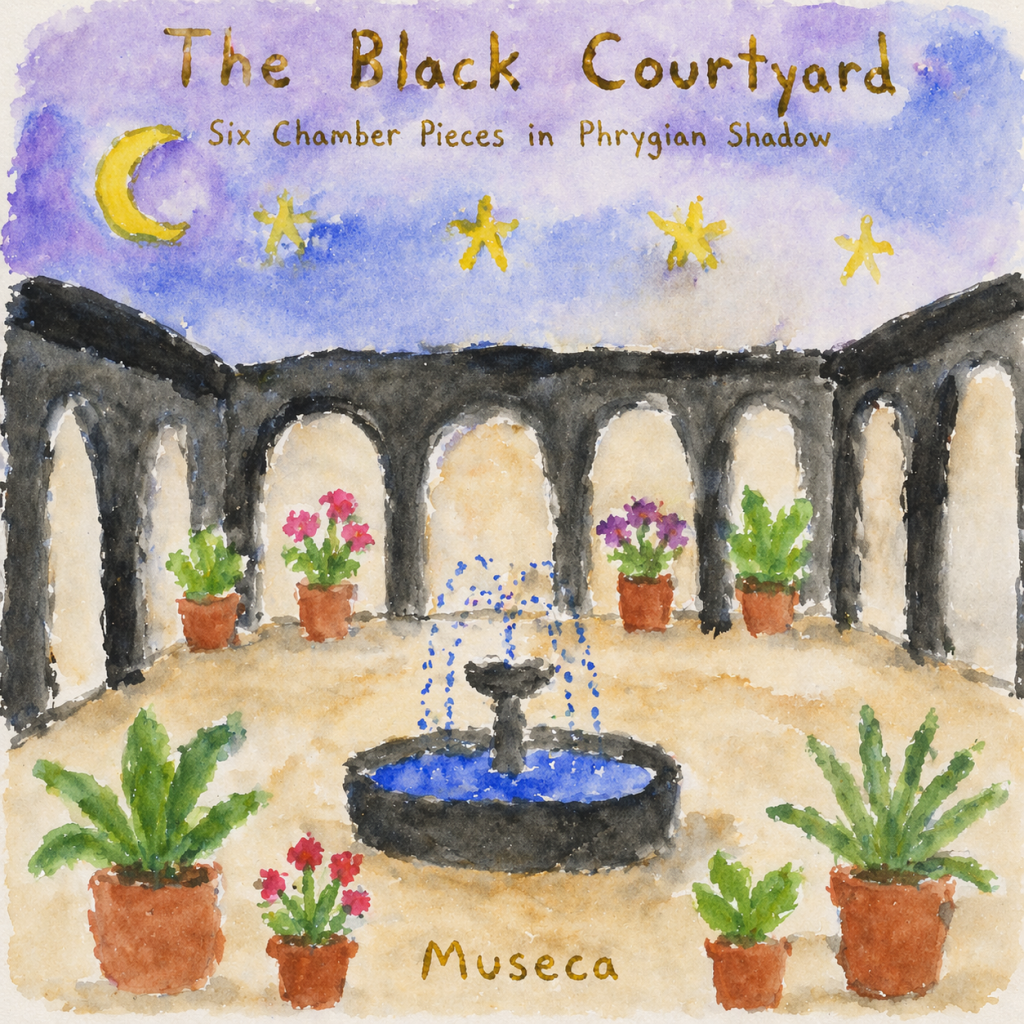
The Black Courtyard is a six-part chamber journey through the Phrygian mode, shaped by the shadowed language of flamenco but stripped of spectacle, ornament, and cliché. Its music does not seek the public stage. It inhabits an interior world of stone, breath, pulse, and ember—severe in outline, intimate in scale, and quietly dangerous.
At the center of the album is the unmistakable tension of Phrygian harmony: the narrow interval between the tonic and its flattened second, a sound that seems always to lean toward something unresolved. Nylon-string guitar gives that tension its architectural form, while viola, bass clarinet, cajón, and palmas create a chamber language of dark lyricism and ceremonial rhythm. Across the six pieces, muted trumpet, alto flute, cello, contrabass, and frame drum appear as carefully chosen colors, each opening a different chamber within the same enclosed musical space.
The flamenco influence is present not as imitation, but as discipline: dry compás, restrained heat, sharpened gesture, and the feeling that rhythm is carried by the body before it is understood by the mind. The music remains poised between stillness and movement, elegance and danger, closure and unrest.
Each track reveals a different aspect of the courtyard: threshold, midnight air, iron rhythm, brittle flame, formal procession, and final warmth. Together, they form a single inward passage through a world that is dark without being empty, severe without being cold, and unresolved without being incomplete.
The Black Courtyard is not a place the listener merely enters. It is a place that gradually closes around them—until the final note leaves only the warmth of the ember behind.
Liner Notes
Ash at the Threshold
The album opens with the permanent ensemble in its most essential form: nylon-string guitar, viola, bass clarinet, cajón, and palmas. Nothing is added because nothing else is yet needed. The guitar establishes the Phrygian field through dry, severe voicings, while the flattened second presses closely against the tonic like a shadow at the edge of a doorway.
Bass clarinet enters as low breath and smoke. Viola provides a rough-edged inner flame. Cajón and palmas do not simply mark time; they consecrate the pulse, giving the music the character of a private ritual already underway.
The threshold is not crossed dramatically. It is crossed through attention. The listener becomes aware that the surrounding air has changed.
Blue Patio at Midnight
The courtyard opens upward into night. Alto flute joins the core ensemble, introducing cool air and a pale blue distance above the darker instrumental foundation. Its presence does not brighten the music; instead, it gives the darkness more space in which to breathe.
The guitar retains the modal and rhythmic structure, but its gestures become more spacious. Bass clarinet moves in long, shadowed phrases, while the viola sustains a restrained lyric tension. Cajón and palmas remain exact but less insistent, suggesting compás as something felt beneath the surface rather than declared.
This is music of enclosure without confinement: open sky above stone walls, silence held inside architecture, and heat lingering after midnight.
Iron Veil Compás
Here the rhythmic body of the album hardens. The addition of frame drum gives the pulse an older and more ceremonial gravity. The compás becomes stricter, sharper, and less forgiving, as though rhythm itself has become a form of law.
The nylon-string guitar is increasingly percussive, cutting the Phrygian mode into clipped shapes. Viola becomes angular and biting, while bass clarinet darkens the lower register without softening it. Cajón, palmas, and frame drum interlock with disciplined force, producing urgency without celebration.
This is not dance as invitation. It is dance as endurance, restraint, and ritual precision. The veil is elegant, but it is made of iron.
Glass and Ember
The album turns toward fragility. Muted trumpet enters as a rare metallic color, distant and slightly bitter, its tone suggesting bronze seen through smoke. It is never allowed to become heroic or theatrical. Instead, it appears in short, exposed phrases, like a fine crack spreading across dark glass.
The guitar remains dry and exact, preserving the compás beneath the increasingly brittle texture. Viola carries the inward heat, while bass clarinet provides shadow and low resonance. Cajón and palmas continue with ceremonial restraint, preventing the piece from dissolving into atmosphere.
The title describes the music’s central contradiction: a surface that seems delicate enough to shatter, and an interior that continues to burn.
Black Silk Procession
The ensemble reaches its greatest weight. Cello and contrabass deepen the architecture, extending the sound downward into stone, earth, and slow-moving shadow. The muted trumpet returns only as a distant signal within the texture, less a voice than a flash of bronze hidden in black fabric.
The pulse becomes processional. Guitar, cajón, and palmas move with measured authority, while viola and cello form long, dark lines above the contrabass foundation. Bass clarinet fills the space between breath and gravity.
The Phrygian mode here feels sovereign rather than merely tense. The music advances without haste, spectacle, or need for approval. Its power lies in composure.
The Door Closes Warm
The final piece does not attempt to surpass the scale of the procession. Instead, the music contracts and becomes intimate again. Cello remains to provide warmth and gravity, while alto flute returns as a trace of night air and memory.
The guitar gathers the harmonic language of the album into restrained final gestures. Viola and bass clarinet carry the last remnants of shadow and flame. Cajón and palmas gradually lose their ceremonial force and become something closer to a fading pulse.
The ending offers no triumphant release. The cadence is closed in form but unresolved in spirit. The door does not slam; it settles into place. Beyond it, the courtyard remains unseen, and the ember continues to glow.
Taken together, these six pieces form a single interior journey through the Phrygian mode. The album does not seek variety through stylistic departure. Instead, it explores how much emotional, rhythmic, and architectural life can exist within one rigorously sustained musical language.
The Black Courtyard never leaves its central space. It changes the light, deepens the shadows, alters the temperature, and walks slowly through each chamber until the final door closes warm.
Playlist
- Track 1 - Ash at the Threshold Museca 3:14
- Track 2 - Blue Patio at Midnight Museca 3:25
- Track 3 - Iron Veil Compás Museca 3:08
- Track 4 - Glass and Ember Museca 3:29
- Track 5 - Black Silk Procession Museca 3:29
- Track 6 - The Door Closes Warm Museca 3:30