
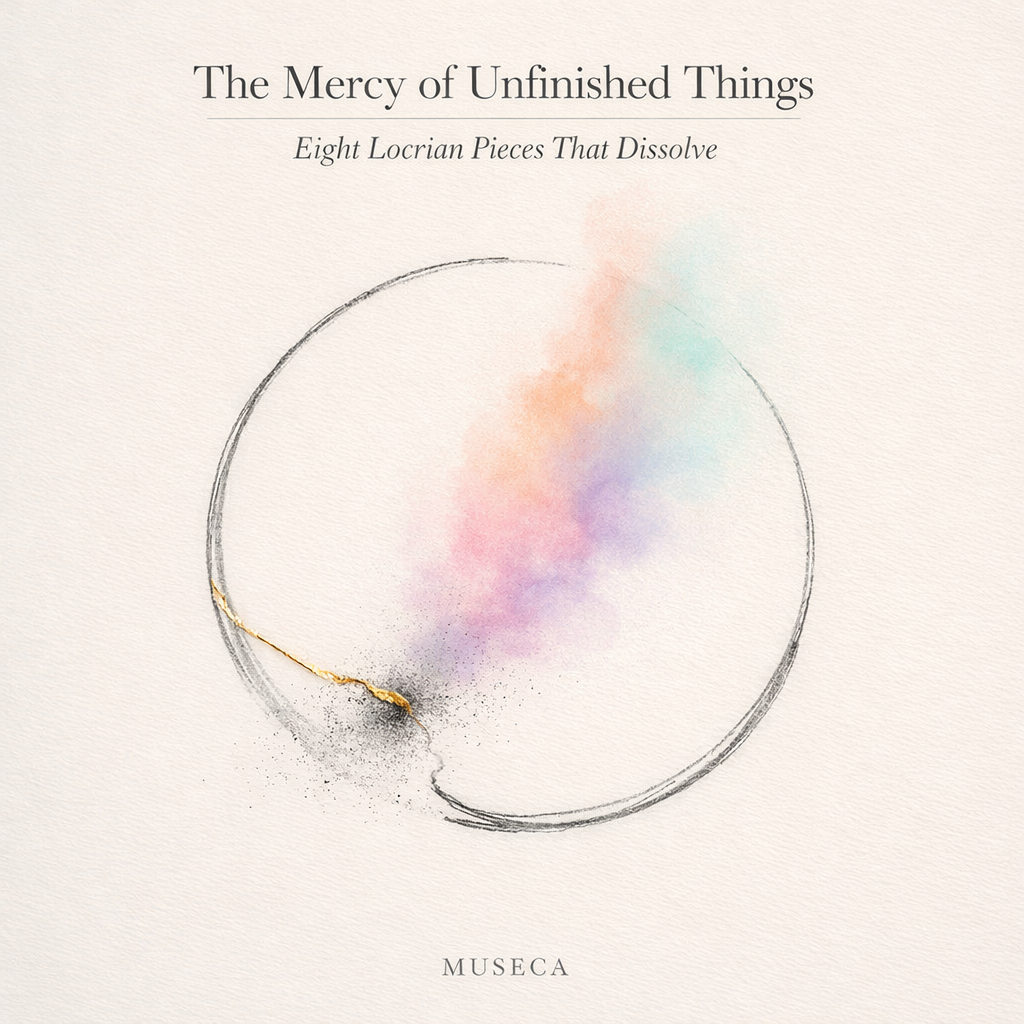
Introduction: The Mercy of Unfinished Things — Eight Locrian Pieces That Dissolve
The Mercy of Unfinished Things is an album built on a single premise: that a piece of music can be profoundly coherent without ever declaring itself “finished.” Technically, this coherence is achieved by treating C Locrian not as an exotic color laid over ordinary harmony, but as a pitch-gravity system—a stable field whose stability comes from constant, controlled friction rather than from resolution. Throughout the record, C is repeatedly affirmed as a center (often as pedal, register anchor, and motivic return), while Locrian’s defining tones—D♭ (♭2) and G♭ (♭5)—remain structurally present. D♭ functions as the nearest neighbor that never relaxes back into comfort; G♭ denies C the security of a perfect fifth. The result is not random dissonance, but a world in which beauty is inseparable from tension.
The album’s harmonic motion is deliberately non-teleological. Instead of progressing toward cadences, it circulates a boundary through a repeating engine: C half-diminished (Cø) oscillating with D♭ (♭II) color—often enriched with Romantic voicings—so the music moves without “arriving.” This is the continuum principle: harmony as orbit rather than destination. A short motif is treated as environment rather than theme in the traditional sense; development occurs by orchestration, register, density, and voicing, not by harmonic travel. Strings carry much of the theory in their timbre: sul tasto warmth and veil embody tenderness, while the faint sheen of sul ponticello suggests the spectral edge that Locrian cannot hide. Piano, pads, and soft pulses reinforce the sense of a living field—present, breathing, but never pushing the music into conventional climax.
A signature gesture binds the eight tracks: the midpoint violin door. Each piece withholds brightness long enough that, when high violins finally enter—often as the first truly bright register event—the effect feels like an inner opening rather than a new section. A late plateau sustains that opening as radiance held under pressure, not triumph. And the album ends the way its harmonic logic demands: not with a cadential “period,” but with dissolve codas—textures thinning, resonance lengthening, and the Locrian field remaining intact as the sound recedes. In this music, the unresolved is not a failure to conclude; it is the point. The mercy is that nothing is forced to become final.
Liner Notes
Ivory Gravity
The album’s foundational statement establishes Locrian gravity immediately: a C-centered floor held steady while D♭ and G♭ remain audible as permanent pressures. The motif repeats until it becomes atmosphere, and the first half stays deliberately underlit—inner strings, restrained pulse, and veiled harmony circling Cø↔D♭. At the midpoint, the first bright violins arrive as a true “door,” not a climax: a cantabile line blooms into a sustained plateau that never resolves, then dissolves back into the same field.
Canon at the Hinge
This piece introduces motion through imitation rather than harmonic travel. Piano and violas form a quiet canon beneath the surface, creating the sense of multiple voices orbiting the same center. The C pedal remains the floor, and the Cø↔D♭ engine continues to circle its boundary; the mode’s identity tones are not ornaments but pillars. When the midpoint door opens, the violins do not “solve” the canon—they expand it, turning tension into radiance before the texture recedes into suspension.
Iridescent Halo (Harmonics Door)
Here the Locrian paradox becomes timbral: warmth and spectral shimmer coexist. The first half is held in soft focus, but harmonics and light ponticello haze introduce an iridescent edge—brightness that is fragile, not triumphant. The midpoint violin entry is the first real high-register illumination, and the late plateau glows like a halo around the C center while D♭ and G♭ remain present. The ending refuses punctuation; it simply thins and fades, leaving the harmonic question intact.
Felt Prayer (Breath Door)
Felt piano changes the emotional temperature: the motif becomes confessional, less like an “idea” and more like a private vow. Attacks soften, and the early section breathes—minimal pulse, close strings, and the persistent C field held in quiet suspension. The midpoint door enters as a lyrical, warm sul tasto theme supported by an inner-string counterline, and the swell is Romantic in contour while Locrian in truth. The dissolve coda feels like the prayer continuing after the sound stops.
Silent Reactor (Heart-Pulse Door)
A subtle, internal pulse provides inevitability without genre percussion—more heartbeat than beat. The harmonic engine remains the same boundary orbit, and the motif’s repetition becomes a kind of slow machine that never reaches its “end state.” The midpoint violin door arrives as the first bright opening, widening the emotional bandwidth without abandoning the unresolved center. The plateau holds the tension at full radiance, then the pulse and layers peel away into a long fade, leaving the world still suspended.
D♭ Halo (Neighbor-Sigh Door)
This track foregrounds Locrian’s most intimate pressure: D♭ as the nearest neighbor that cannot be domesticated. The motif is shaped so the ♭2 feels like a recurring sigh—tender, insistent, and permanently close to C. The first half remains underlit so the midpoint violin entry reads as an inward opening rather than an external event. The late plateau intensifies the neighbor-tone glow, and the ending dissolves without letting the semitone tension “release.”
The Fifth Bell (G♭ Door)
G♭ (♭5) becomes emblematic here—a bell-like color that tolls inside the texture, reminding the ear that the tonic’s fifth is broken by design. The C pedal holds the floor while the tritone gravity remains audible even in warm voicings, keeping the harmony exquisitely unstable. The midpoint violin door rises as the first bright register event, and the plateau sustains radiance without granting closure. The final dissolve retreats from density, not from tension.
Cantabile at the Edge (Final Door)
The closing track allows the most openly Romantic expansion: a long-breathed cantabile violin line and a swelling section that feels like an emotional culmination. Yet the harmonic ethic does not change—C remains centered, D♭ and G♭ remain present, and the music refuses cadential punctuation. The midpoint door is the album’s final opening, the late plateau its widest sustained light, and the ending offers the record’s thesis in sound: not a conclusion, but a deliberate dissolve—unfinished, and therefore truthful.
Playlist
- Track 1 — Ivory Gravity (Rev C: midpoint door + inner romantic ache) Museca 2:52
- Track 2 — Canon at the Hinge (Rev D style) Museca 2:53
- Track 3 — Iridescent Halo (Harmonics Door) Museca 2:24
- Track 4 — Felt Prayer (Breath Door) Museca 3:04
- Track 5 — Silent Reactor (Heart-Pulse Door) Museca 2:59
- Track 6 — D♭ Halo (Neighbor-Sigh Door) Museca 3:19
- Track 7 — The Fifth Bell (G♭ Door) Museca 3:18
- Track 8 — Cantabile at the Edge (Final Door) Museca 2:34