
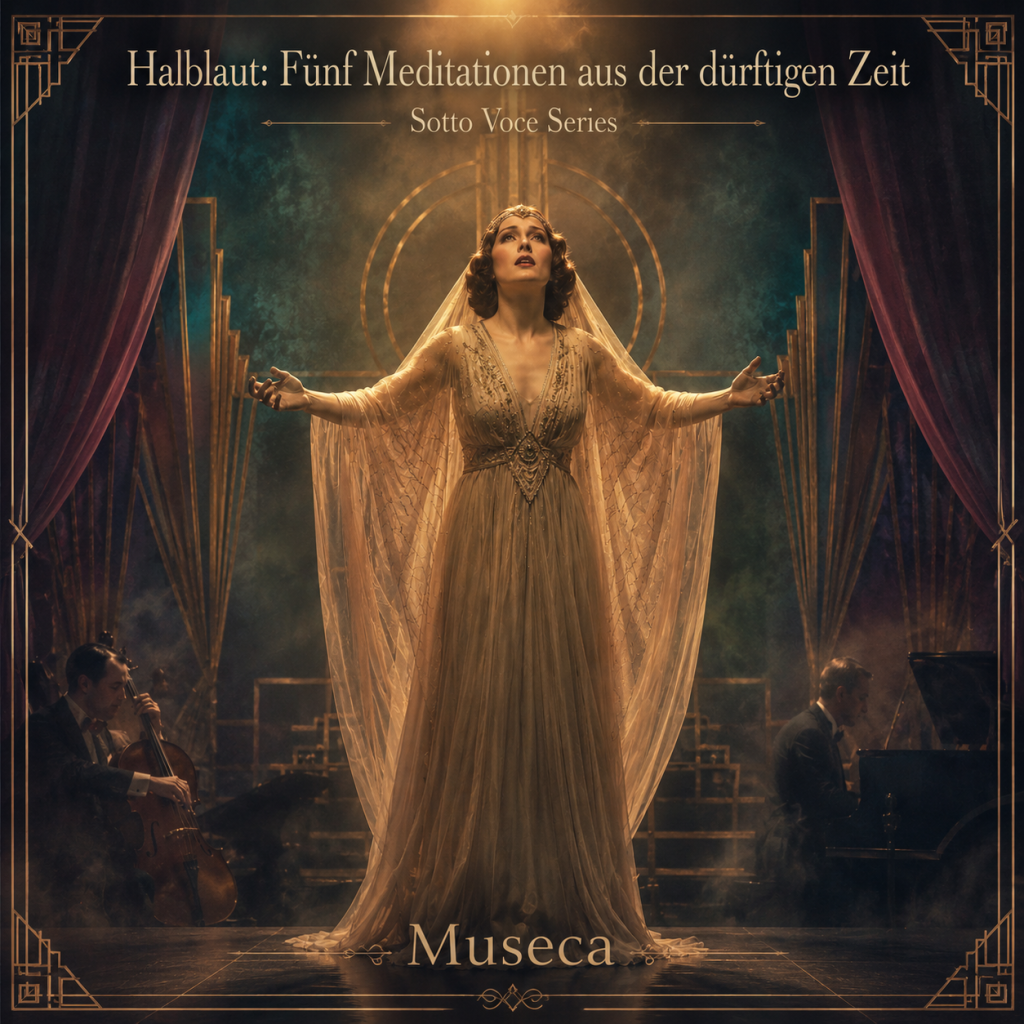
This album is the fourth single-language extension of the Sotto Voce series — a contemporary chillout-classical meditation drawing on the German lyric tradition’s deepest contemplative-philosophical voice. The album’s hidden architectural source is Friedrich Hölderlin’s great elegy Brod und Wein, written between 1800 and 1801, and in particular Hölderlin’s named historical condition: die dürftige Zeit, the destitute time, the time between divine presences in which the wakeful soul keeps its watch.
The German word halblaut — literally “half-loud” — is the German equivalent of the Italian sotto voce, the French en sourdine, the Spanish voz callada. Each language has its own untranslatable word for the half-voice; halblaut is the German one. The word is also a philosophical statement: the half-voice as the only honest register for meditation from the destitute time. To speak halblaut is to refuse the operatic, to refuse the declamatory, to refuse all rhetorical lift, and to speak instead with the contained dignity of what cannot be fully expressed.
The album’s nine-track architecture mirrors the nine strophes of Brod und Wein. Hölderlin’s elegy moves from evening descending on the city, through the holy night and the wakeful soul’s contemplative attention, through the memory of when the gods walked among men and the interior festival the soul holds in remembrance, through the gods’ withdrawal and the patient waiting in the destitute time, to bread and wine as signs of the holy that remains — the trace of the festival, grace arriving as what was waited for. Five vocal meditations alternate with four instrumental interludes: Die Zärtlichkeit, am sinkenden Abend (the world drawing near in evening tenderness), Vorspiel: Die heilige Nacht naht (the holy night arriving in Brahmsian piano), Die Wachsamkeit, im Herzen der Nacht (the wakeful soul attending), Zwischenspiel: Das Rufen aus der Ferne (the Waldhorn call from memory), Die Innigkeit, im stillen Herzen (the interior festival at the album’s heart), Zwischenspiel: Wenn das Fest verklingt (the cello voice of withdrawal), Die Sehnsucht, in der dürftigen Zeit (the patient waiting in the destitute time), Zwischenspiel: An der Schwelle der Gnade (the threshold of sacred minimalism), and Die Gnade, in dem, was bleibt (grace, in what remains).
The five vocal tracks each inhabit a single anchor word from the German contemplative-emotional vocabulary: nah (near) for the world drawing close in evening tenderness; wach (awake) for the wakeful soul attending the holy night; innig (intimate) for the soul’s interior recognition of presence still held within; bleib (stay) for the soul’s request that something remain in the destitute time; and Gnade (grace) for the closing recognition that everything has been grace.
The four instrumental interludes draw on specifically German contemplative-musical traditions. Brahms’ late Intermezzi from Op. 117 and Op. 118 supply the holy night’s piano voice in the second track — the Scottish-lullaby Op. 117 No. 1 and the famous flowing Op. 118 No. 2 translated to E minor and C-sharp minor. The German Romantic Waldhorn tradition of Brahms’ Horn Trio Op. 40 — particularly the Adagio mesto Brahms composed in memory of his mother — supplies the fourth track’s reaching toward memory in F-sharp minor. Schumann’s Hausmusik-intimate Fünf Stücke im Volkston Op. 102 and the Adagio affettuoso of Brahms’ Cello Sonata Op. 99 supply the sixth track’s cello voice of withdrawal in B-flat minor. Pärt’s Spiegel im Spiegel and Pari Intervallo joined to the German organ tradition (Reger’s contemplative sustained-organ writing, Bach’s quietest organ moments) supply the eighth track’s threshold to grace — solo viola over sustained organ pad in the album’s secular sacred turn.
Four cross-track instrumental memory threads weave the album’s lattice. The piano voice of the second track returns at the climactic passage of the fifth, the Brahms Op. 117 lullaby figure reappearing transposed to D-flat major as the soul tastes the interior festival. The French horn of the fourth track returns at the climactic passage of the seventh, the Sehnsucht voice of memory reappearing as the soul asks what should stay. The cello of the sixth track returns at the pivot of the eighth, continuity of contemplative weight carrying across the album’s sacred turn. The viola of the eighth track returns at the climactic passage of the ninth, the threshold instrument carrying its sacred stillness inside grace’s arrival. A fifth thread frames the album as a whole: the solo clarinet that opens the first track in Brahms late-clarinet warmth returns in the ninth track to close the album, the same companion voice held across the entire journey.
The album closes on Alles ist Gnade — everything is grace — the German articulation of the Bernanos tradition’s tout est grâce, the recognition that arrives precisely because everything has been withheld. At the climactic passage, each prior anchor word is retrospectively recognized as grace: die Nähe war Gnade, das Wachen war Gnade, die Innigkeit war Gnade, das Warten war Gnade, das Bleiben war Gnade — the nearness was grace, the wakefulness was grace, the intimacy was grace, the waiting was grace, the staying was grace. The closing refrain und ich, hier, noch immer — and I, here, still — carries the soul’s continuing presence into stillness as the album’s permanent sub-bass heartbeat releases for the first time since the opening track. The album ends in absolute silence.
I composed the album using the Sotto Voce style which synthesizes German Lied tradition (mezzo-soprano voice in the Anne Sofie von Otter contemplative register, the warmth and weight of Magdalena Kožená in her Lieder recordings), Café del Mar chillout production (sub-bass heartbeat pulse, atmospheric ground), Enigma and Delerium new-age electronic art music, Paul Schwartz’s Aria trilogy and Emma Shapplin’s Carmine Meo in their most restrained moments, and Arvo Pärt’s secular sacred minimalism. The vocal discipline is sotto voce throughout — never operatic, never declamatory; the warmth contained even at the climactic moments. The mezzo voice is a deliberate departure from the soprano voice of the previous albums in the series, chosen because the German contemplative-philosophical tradition rests in a lower, warmer, more interior vocal weight than the lyric traditions of Italian bel canto or Spanish mystical song.
This album is the fourth single-language extension in a series that has previously released Sotto Voce: Five Meditations in Five Tongues (the originating multilingual album), En sourdine: Cinq méditations dans le demi-jour (French), Sotto voce: Cinque meditazioni sul sentire italiano (Italian), Voz callada: Cinco meditaciones del alma callada (Spanish), and the Russian single-language album that preceded this one. Each album draws on its language’s instrumental and lyrical traditions specifically; each is its own contemplative architecture within the series’ permanent style.
For listening: I have designed the album to be heard whole, in sequence, in a quiet room or with attention. Each track flows directly into the next; the sub-bass heartbeat pulse threads through eight of the nine tracks, only fading to silence in the final coda. The journey is one continuous meditation in nine movements — evening to night to memory to interior festival to withdrawal to waiting to threshold to grace. Halblaut is the only register at which any of it can honestly be spoken.
Liner Notes
Die Zärtlichkeit, am sinkenden Abend (Tenderness, at the Descending Evening)
This is the album’s opening — the first strophe of Brod und Wein translated to the soul’s interior. Hölderlin’s evening descends on the city, the day’s work ends, the lamps come on at the windows, the carriages move homeward; the soul stands at the window and feels the world drawing near. I wanted the opening to inhabit the half-of-life contemplative stance from Hölderlin’s tiny perfect meditation Hälfte des Lebens — the awareness of being at a threshold without yet knowing what the threshold leads toward. The track’s coda lifts the half-of-life motif explicitly: mit halbem Leben, halbem Licht — with half a life, half a light.
The anchor word is nah — near. It arrives at the climactic passage with the same gestural weight that each anchor word will receive across the album: Nah, ganz nah. Near, completely near. The world is not entering the soul from outside; the soul is recognizing that the world has been near all along, that presence becomes attainable precisely as the day’s noise releases.
The lead instrumental companion is solo clarinet in the Brahms late-clarinet register — the Op. 115 Quintet and the Op. 120 Sonatas, the deepest contemplative-philosophical statements in late German Romanticism, written when Brahms thought he had stopped composing and then heard Richard Mühlfeld play. The clarinet’s breath-warmth pairs naturally with the mezzo voice, sitting in the same tessitura, breathing the same evening air. This clarinet voice will return in the closing track to frame the album whole — the warmth that opens Halblaut returning at the close.
The track sits in E major (the series’ permanent opening-key signature) at 70 BPM with Schubertian flickers toward C-sharp minor — the harmonic equivalent of evening light, warm and golden with the first hints of shadow at its edges.
Lyrics (German/English)
Die Zärtlichkeit, am sinkenden Abend Tenderness, at the Descending Evening
Verse 1
Der Abend kommt herab, — Evening descends,
ganz leise, wie Erinnerung. — very quietly, like remembrance.
Die Stadt wird still, — The city grows still,
die Stimmen, eine nach der andern, — the voices, one after another,
ziehen sich ins Haus zurück. — withdraw into the house.
Verse 2
Die Lampen gehen an, — The lamps come on,
in stillen Fenstern sammelt sich das Licht. — in quiet windows the light gathers.
Die Wagen ziehen heim, — The carriages move home,
der Tag legt seinen Lärm beiseite, — the day sets its noise aside,
und etwas in mir auch. — and something in me does too.
Climactic passage
Sieh — wie alles näher kommt, — See — how everything draws nearer,
wie der Atem näher kommt, — how breath draws nearer,
wie die Welt sich nicht entfernt, — how the world does not withdraw
sondern leise zu mir tritt. — but quietly steps toward me.
Nah, ganz nah. — Near, completely near.
Nah, ganz nah. — Near, completely near.
Coda
Und ich bleibe stehen, — And I remain standing,
mit halbem Leben, halbem Licht, — with half a life, half a light,
und höre, wie die Stille kommt, — and listen as the stillness comes,
die heilige, die wache, — the holy, the wakeful,
in der ich nun bei mir bin. — in which I am now with myself.
Vorspiel: Die heilige Nacht naht (Prelude: The Holy Night Draws Near)
The first of the four instrumental interludes. After the world drew near in the opening, now the night draws near — the verb naht (draws near) deliberately echoes the anchor word nah, threading the album’s opening pair linguistically.
I composed this as a Brahmsian piano meditation in two interlocking late-Intermezzi registers: Op. 117 No. 1 (the Scottish-lullaby Intermezzo, inscribed with the lullaby text Schlaf sanft mein Kind — sleep softly, my child) and Op. 118 No. 2 (the famous flowing-contemplative Intermezzo, the heart of late Brahms’ interior register). The lullaby quality matters: the world is being put gently to rest into the holy night, the contemplative space opening, the lamplit interior deepening toward sacred stillness.
The harmonic motion travels from E minor through C-sharp minor and back, the relative minor of the album’s opening E major now darkening into the night’s first deepening. The track is the album’s first sacred-stillness moment, but the deeper sacred turn is held in reserve until the eighth track.
The piano voice established here will return at the climactic passage of the fifth track, the Op. 117 No. 1 lullaby figure reappearing transposed to D-flat major as the soul tastes the interior festival. This is the first of the album’s four primary cross-track memory threads — the contemplative piano that establishes the night’s sanctity reappearing when the night’s gift becomes briefly tangible.
Die Wachsamkeit, im Herzen der Nacht (Wakefulness, in the Heart of the Night)
The album moves into the middle of the holy night with Hölderlin’s Strophe 3 question: what is given to the wakeful one? The soul does not yet know what it is wakeful for. The recognition of what the wakefulness is for comes later in the album — the memory of presences in the fourth track, the interior festival in the fifth. Here the wakefulness is held simply as posture toward what cannot yet be known.
The anchor word is wach — awake. It arrives at the climactic passage with the gestural weight: Wach. Ganz wach. Awake. Completely awake. The single-syllable elemental quality matches the album’s other anchor words; the wakefulness is what the soul is, not what it performs.
The lead instrumental companion is solo violin in the Brahms violin-sonata register joined to late-Bach contemplative quality — the Chaconne’s talking-to-God interior listening. The violin sits slightly above the mezzo’s tessitura, supplying the listening-from-above quality the wakeful soul wants: the voice on earth, the violin in the air above.
The harmonic language is A minor with Dorian inflections — the raised sixth creating ancient-modal sacred coloring that gestures toward Lutheran chorale heritage and Bach contemplative writing audible beneath the late-Romantic surface. This is the album’s first track to look slightly backward in harmonic time. Brief lifts to C major (relative major) at the climactic passage supply moments of attention’s clarity, and a brief wordless mezzo vocalise on sustained chord tones holds the soul’s listening-without-words for ten to twelve seconds before the closing returns to A minor.
The closing image — und die Nacht hält mich, wie ich die Nacht halte, und das Hören selbst wird zur Antwort, noch ohne Wort (and the night holds me as I hold the night, and the listening itself becomes the answer, still without word) — completes the track’s philosophical movement: the wakefulness has not yet received what it waits for, but the attentive listening is itself a form of devotion the destitute time permits.
Lyrics (German/English)
Die Wachsamkeit, im Herzen der Nacht Wakefulness, in the Heart of the Night
Verse 1
Die Nacht ist da, — The night is here,
und ich bin wach. — and I am awake.
Kein Geräusch, kein Flügelschlag, — No sound, no wingbeat,
nur das Atmen der Welt — only the world’s breathing
und das Atmen in mir. — and the breathing within me.
Verse 2
Was ist mir aufgetragen, — What is given to me
hier in der Mitte der Stunden, — here in the middle of the hours,
wo nichts mehr zu tun ist — where there is nothing to do
als zu hören, zu hören, — but to listen, to listen,
und still zu sein? — and to be still?
Climactic passage
Ich bin wach. — I am awake.
Wach in der Tiefe, — Awake in the depths,
wach am Rand des Schweigens. — awake at the edge of silence.
Etwas, das ich nicht kennen kann, — Something I cannot know
sammelt sich in der Stille, — gathers in the stillness,
und ich halte still. — and I hold still.
Wach. Ganz wach. — Awake. Completely awake.
Wordless vocalise
on sustained tones
Coda
Und die Nacht hält mich, — And the night holds me
wie ich die Nacht halte, — as I hold the night,
und das Hören selbst — and the listening itself
wird zur Antwort — — becomes the answer —
noch ohne Wort. — still without word.
Zwischenspiel: Das Rufen aus der Ferne (Interlude: The Calling from Afar)
The second instrumental interlude reaches toward Hölderlin’s Strophe 4 — the memory of when the gods walked among men, the soul’s reaching toward what was once present. I composed this as a Brahmsian Waldhorn meditation, drawing primarily on the Adagio mesto third movement of Brahms’ Horn Trio Op. 40 — the elegiac slow movement Brahms wrote in memory of his mother, scored for natural horn (Waldhorn) by his specification, one of the deepest contemplative-elegiac horn statements in the literature.
The track translates the Adagio mesto‘s E-flat major register to F-sharp minor — the Sehnsucht key of German Romanticism. The structural arc moves from F-sharp minor through Schubertian tertian modulation to a luminous A major central passage (the memory of presences becoming briefly tangible) and through D major (further memory-color) before returning to F-sharp minor with deeper harmonic shadow. The central A major passage is the album’s first sustained moment of harmonic luminosity, the only place so far where the Sotto Voce contained discipline opens briefly toward warmth — but the warmth is held as memory, not as presence, and the track returns to F-sharp minor to preserve the dürftige Zeit register the album inhabits.
The French horn voice established here will return at the climactic passage of the seventh track, the Sehnsucht horn of memory-of-presences reappearing as the soul asks what should stay. This is the second of the album’s primary cross-track memory threads — the calling from afar becoming the answer to the soul’s eventual request.
The horn-call comes from afar because divine presence has receded; the soul hears the call because the memory remains audible even when the presence has withdrawn.
Die Innigkeit, im stillen Herzen (Intimacy, in the Still Heart)
The album’s most intimate vocal moment and its exact emotional center — Hölderlin’s Strophe 5 condensed entirely to interior register. Not the literal festival of the gods, but the soul’s inward recognition that what was sacred still breathes within. I wanted the texture here to be the bare Lied ideal: voice and piano alone, no other solo instrument, the German Lied tradition at its purest — Schubert’s Winterreise, Schumann’s Dichterliebe, Brahms’ Vier ernste Gesänge.
The track sits in D-flat major (six flats, Schubert’s warmest key, the warmest in the Romantic vocabulary) at the album’s slowest tempo so far, 62 BPM. The harmonic motion uses modal mixture to B-flat minor at moments of contemplative depth; the album’s harmonic heart at its glow. Die Brust wird Tempel, das Atmen wird Feier. The breast becomes temple. The breathing becomes celebration. The small world that I am gathers the light that was, here, in this moment.
The anchor word is innig — intimate, heartfelt, inwardly devoted. It arrives at the climactic passage paired with the cross-album resonance word noch (still, yet): was war, ist noch / Noch ist es. Noch. What was, still is. Still it is. Still. The recognition that the sacred has not departed completely; it has only become interior.
The Brahms Op. 117 No. 1 Scottish-lullaby figure from the second track returns recognizably in the piano part at the climactic passage, transposed to D-flat major — the album’s first cross-track memory thread arriving, motivic rather than instrumental, recognizable to attentive listening as the piano voice from the holy night returning at the interior festival. The contemplative piano that established the night’s sanctity reappears as the soul tastes the night’s gift.
The closing image carries the festival forward into the night not yet ended — the interior fullness held against what comes, the album’s exact center serving as the source the rest of the journey will return to.
Lyrics (German/English)
Die Innigkeit, im stillen Herzen Intimacy, in the Still Heart
Verse 1
Hier in der Stille, ganz tief in mir, — Here in the stillness, deep within me,
sammelt sich etwas Warmes, etwas Helles. — something warm gathers, something bright.
Was einst geatmet hat, — What once breathed,
in einem helleren Licht, — in a brighter light,
atmet noch immer hier. — still breathes here.
Verse 2
Die Brust wird Tempel, — The breast becomes temple,
das Atmen wird Feier, — the breathing becomes celebration,
und die kleine Welt, die ich bin, — and the small world that I am
sammelt das Licht, das war, — gathers the light that was,
hier, in diesem Augenblick. — here, in this moment.
Climactic passage
Innig — innig in mir, — Intimate — intimate within me,
und noch da, noch hier, — and still here, still here,
was nie ganz fort war. — what was never quite gone.
Innig, innig im Herzen, — Intimate, intimate in the heart,
was war, ist noch. — what was, still is.
Noch ist es. Noch. — Still it is. Still.
Coda
Und ich trage es weiter, — And I carry it further,
das stille Fest in mir, — the still festival within me,
in das, was noch kommt, — into what is still to come,
in die Nacht, die noch — into the night that is
nicht zu Ende ist. — not yet at its end.
Zwischenspiel: Wenn das Fest verklingt (Interlude: When the Festival Fades)
The third instrumental interlude — Hölderlin’s Strophe 6, the festival fading, the withdrawal beginning. I composed this as a Schumann/Brahms cello meditation, drawing primarily on Schumann’s Fünf Stücke im Volkston Op. 102 No. 2 (Langsam) — the Hausmusik-intimate contemplative-melancholy cello at chamber scale, German Romantic interiority at its most pared down. The deeper contemplative weight comes from the Adagio affettuoso of Brahms’ Cello Sonata No. 2 Op. 99. The Mahler Adagietto register is referenced as quality — held-melancholic warmth at chamber scale — rather than literal scoring.
The German word verklingen is the specific word for what happens here: the fading-away of sound, the dying out into silence. It captures both the withdrawal dimension and the musical-acoustic dimension simultaneously.
The track inherits the fifth track’s key signature (five flats) but turns it minor — the same harmonic territory now darkened, the festival fading into past tense. A brief harmonic back-glance to D-flat major in the middle section recalls the fifth track’s warmth fleetingly before the withdrawal completes itself. This is the album’s first deliberate harmonic memory across an instrumental seam, a sub-tier thread that does not require its own line in the cross-track lattice but contributes to the album’s emotional continuity.
The cello voice established here will return at the pivot moment of the eighth track, continuity of contemplative weight carrying across the album’s sacred turn. The cello that voiced the withdrawal will return at the threshold to grace — the same instrument speaking the album’s two darkest moments and the path between them.
This is the album’s structural pivot: the bridge from the fullness register of the first five tracks into the dürftige Zeit register of the seventh and eighth tracks that the closing grace will redeem.
Die Sehnsucht, in der dürftigen Zeit (Longing, in the Destitute Time)
The album’s deepest philosophical track — Hölderlin’s Strophes 7 and 8 condensed: the gods have withdrawn, the festival has faded, and the soul still keeps its watch. The room is empty. The lamp is still burning. The soul, who was waiting, no longer sees what comes.
The anchor word is bleib — stay. It arrives at the climactic passage repeated four times with held weight: bleib, bleib bei mir, bleib was du noch bist, bleib ganz nah. Stay. Stay with me. Stay, what you still are. Stay, completely near. The closing bleib, ganz nah carries direct cross-track echo to the first track’s nah, ganz nah — the world drew near in the opening, and now the soul asks what should stay near. The two anchor words of the album’s opening and middle finally meet at the album’s philosophical center.
The lead instrumental companion is solo English horn (cor anglais) in the canonical late-Romantic register of distant-melancholic Sehnsucht — Dvořák’s New World Largo, Wagner’s Tristan Act III shepherd’s piping, Sibelius’ Swan of Tuonela. The cor anglais carries the dürftige Zeit register precisely: the lonely voice in the emptied world, the sound of presence-now-receded. At the climactic passage, the French horn from the fourth track returns recognizably alongside the cor anglais — two wind voices briefly meeting, the album’s second cross-track memory thread arriving. The Sehnsucht horn of memory reappears when the soul asks for memory to remain.
The harmonic language is G minor (the canonical German Romantic melancholy key — Brahms’ Op. 117 No. 3 Intermezzo, the opening of his First Symphony) with Phrygian inflections (lowered second, A-flat in G minor) supplying ancient-modal coloring. The sacred has receded into a register older than late Romanticism; the soul waits in a time that feels older than Brahms. Brief lifts to B-flat major at moments of memory rising supply the climactic luminosity for the horn return.
The closing image — und ist nicht ganz leer, solange ich höre, and is not entirely empty as long as I listen — echoes the wakeful attention of the third track. The soul’s listening still constitutes the form of devotion the destitute time allows. The half-of-life motif from the opening (mit halbem Licht, mit halber Antwort) returns in the coda, threading the album’s lattice tight.
The track holds the album’s philosophical center of gravity: the patient waiting that neither despairs nor consoles, the wakefulness from the third track carried forward through the withdrawal of the sixth into the bare watching the destitute time requires before the threshold and the grace can arrive.
Lyrics (German/English)
Die Sehnsucht, in der dürftigen Zeit Longing, in the Destitute Time
Verse 1
Das Zimmer ist leer geworden, — The room has become empty,
nur die Lampe brennt noch. — only the lamp is still burning.
Etwas ist gegangen, — Something has departed,
und ich, der ich noch warte, — and I, who am still waiting,
sehe nicht, was kommt. — do not see what comes.
Verse 2
So ist die Zeit: — So is the time:
dürftig, sagt das alte Wort. — destitute, says the old word.
Nichts mehr ruft, — Nothing more calls,
nichts mehr antwortet — — nothing more answers —
nur das Warten selbst — only the waiting itself
ist mir geblieben. — has remained to me.
Climactic passage
Was kann noch bleiben? — What can still remain?
Du Fernes, du Vergangenes, — You distant one, you bygone one,
du, was einst mit mir war — — you, who once were with me —
bleib. — stay.
Bleib bei mir. — Stay with me.
Bleib, was du noch bist. — Stay, what you still are.
Bleib, ganz nah. — Stay, completely near.
Coda
Und ich bleibe stehen, — And I remain standing,
mit halbem Licht, mit halber Antwort, — with half a light, with half an answer,
und höre, was noch klingt — and listen to what still sounds
im Zimmer, das leer ist — — in the room that is empty —
und ist nicht ganz leer, — and is not entirely empty,
solange ich höre. — as long as I listen.
Zwischenspiel: An der Schwelle der Gnade (Interlude: At the Threshold of Grace)
The album’s secular sacred turn — the threshold before grace, the Pärt-tradition sacred-minimalism moment paralleling the eighth track of En sourdine in the series’ permanent architecture. This is the album’s stillest moment: 54 BPM (the slowest tempo on the album), solo viola over sustained organ pad, no piano (the album’s first track without piano), soft kick and hi-hat suspended entirely, sub-bass heartbeat pulse continuing only at near-imperceptible amplitude. The texture is the most pared down on the album.
I composed this drawing primarily on Arvo Pärt’s Spiegel im Spiegel (1978) — the canonical secular-sacred meditation, sustained sacred chords with slow descending melodic motion in solo string voice over sustained pad. The original is for violin and piano; here the voicing is solo viola over organ. Pärt’s Pari Intervallo (1976) supplies the specifically organ-Pärt register. The German organ tradition — Reger’s contemplative sustained-organ writing, Bach’s quietest organ moments like Vor deinen Thron tret ich BWV 668, Bach’s last composition — supplies the coloring beneath the Pärt structural primacy. The album’s secular sacred turn is translated through specifically German organ heritage rather than bare Pärt minimalism.
The organ is held in reserve until this track — its first appearance in the album. The pattern follows the series’ principle that reserved elements carry more weight precisely because they have been withheld. The organ when it arrives must carry the threshold’s full sacred weight; it does.
At the pivot moment, the cello from the sixth track returns recognizably with the Schumann Op. 102 Langsam figure now appearing at the threshold. Cello and viola briefly meet — the album’s third cross-track memory thread arriving. The cello that voiced the withdrawal returns at the threshold to grace, continuity of contemplative weight carrying across the album’s sacred pivot.
The harmonic journey moves from B-flat minor (continuing the withdrawal’s key) through F minor toward F major preparation. The viola voice established here will return at the climactic passage of the closing track — the threshold instrument carrying its sacred stillness inside grace’s arrival. This is the album’s most architecturally consequential moment: the held-still before what arrives.
Die Gnade, in dem, was bleibt (Grace, in What Remains)
The album’s closing meditation — Hölderlin’s Strophe 9: bread and wine remain as signs of the holy, the trace of the festival, grace as the gift that arrives precisely because it has been withheld. The night is over. The soul who waited now knows: es ist nichts fortgegangen, was nicht hier geblieben wäre — nur anders, nur leiser, nur näher als ich dachte. Nothing has gone away that would not have stayed here — only differently, only quieter, only nearer than I thought. The bread on the table. The wine, the simple water. The light through the window. My breath in the stillness. Everything carries the trace of what I was seeking.
The anchor word is Gnade — grace — and at the climactic passage each prior emotional register of the album is retrospectively recognized as grace: die Nähe war Gnade, das Wachen war Gnade, die Innigkeit war Gnade, das Warten war Gnade, das Bleiben war Gnade. The nearness was grace. The wakefulness was grace. The intimacy was grace. The waiting was grace. The staying was grace. The five anchor words of the five vocal tracks weave together into the central revelation: Alles ist Gnade. Everything is grace. This is the German articulation of the Bernanos tradition’s tout est grâce — the recognition that arrives precisely because everything has been withheld.
The closing refrain und ich, hier, noch immer — and I, here, still — carries the soul’s continuing presence into final stillness. The ich is the I of all the vocal tracks; the hier is the soul’s locatedness; the noch immer carries both the noch from the fifth track and the still-yet of perpetual presence into the album’s last words.
The texture is the richest on the album. Solo clarinet returns from the opening track in Brahms late-clarinet register — the warmth that opened the album returning to close it, cross-album frame as a fifth memory thread complementing the four established. Solo piano returns to the texture in Schubertian F major voicing (the album’s first piano since the seventh track). Sustained organ pad continues from the eighth track then fades. The sub-bass heartbeat pulse returns at full amplitude after the eighth track’s near-silence, then fades gradually at the coda — the album’s only pulse-fade, the heartbeat releasing after nine tracks of continuous presence.
At the climactic passage, the viola from the eighth track returns recognizably with specific Spiegel im Spiegel material. Clarinet and viola briefly meet — the album’s first and last instrumental memory threads converging in real time, the cross-album frame closing as the central revelation arrives.
The harmonic motion arrives in F major (the series’ permanent closing-key signature) with plagal lift to B-flat major (the IV chord) at Alles ist Gnade — the church-like sacred resolution without any chromatic complication. Closure that is diatonic and warm and final.
The album ends in absolute silence. The holy is now everywhere because it has been waited for everywhere.
Lyrics (German/English)
Die Gnade, in dem, was bleibt Grace, in What Remains
Verse 1
Nun ist die Nacht vorbei, — Now the night is over,
und ich, der wartete, weiß: — and I, who waited, know:
es ist nichts fortgegangen, — nothing has gone away
was nicht hier geblieben wäre — — that would not have stayed here —
nur anders, nur leiser, — only differently, only quieter,
nur näher als ich dachte. — only nearer than I thought.
Verse 2
Das Brot, das auf dem Tisch liegt, — The bread that lies on the table,
der Wein, das einfache Wasser, — the wine, the simple water,
das Licht, das durch das Fenster kommt, — the light that comes through the window,
mein Atem in der Stille — — my breath in the stillness —
alles trägt die Spur dessen, — everything carries the trace
was ich gesucht habe. — of what I was seeking.
Climactic passage
Gnade. — Grace.
Gnade ist hier, in dem, was bleibt. — Grace is here, in what remains.
Alles ist Gnade — — Everything is grace —
die Nähe war Gnade, — the nearness was grace,
das Wachen war Gnade, — the wakefulness was grace,
die Innigkeit war Gnade, — the intimacy was grace,
das Warten war Gnade, — the waiting was grace,
das Bleiben war Gnade. — the staying was grace.
Alles ist Gnade. — Everything is grace.
Alles ist Gnade. — Everything is grace.
Coda
Und ich, hier, noch immer. — And I, here, still.
Und du, nah, noch immer. — And you, near, still.
Und das Licht, das durch alles geht, — And the light that goes through everything,
und das Atmen, das nicht aufhört, — and the breathing that does not stop,
und die Stille, die alles trägt — — and the stillness that carries all —
alles ist Gnade. — everything is grace.
Und ich, hier, noch immer. — And I, here, still.
Playlist
- Track 1 title: Die Zärtlichkeit, am sinkenden Abend Museca 3:39
- Track 2 title: Vorspiel: Die heilige Nacht naht Museca 4:14
- Track 3 title: Die Wachsamkeit, im Herzen der Nacht Museca 3:40
- Track 4 title: Zwischenspiel: Das Rufen aus der Ferne Museca 2:33
- Track 5 title: Die Innigkeit, im stillen Herzen Museca 3:08
- Track 6 title: Zwischenspiel: Wenn das Fest verklingt Museca 3:17
- Track 7 title: Die Sehnsucht, in der dürftigen Zeit Museca 4:00
- Track 8 title: Zwischenspiel: An der Schwelle der Gnade Museca 3:35
- Track 9 title: Die Gnade, in dem, was bleibt Museca 5:00