
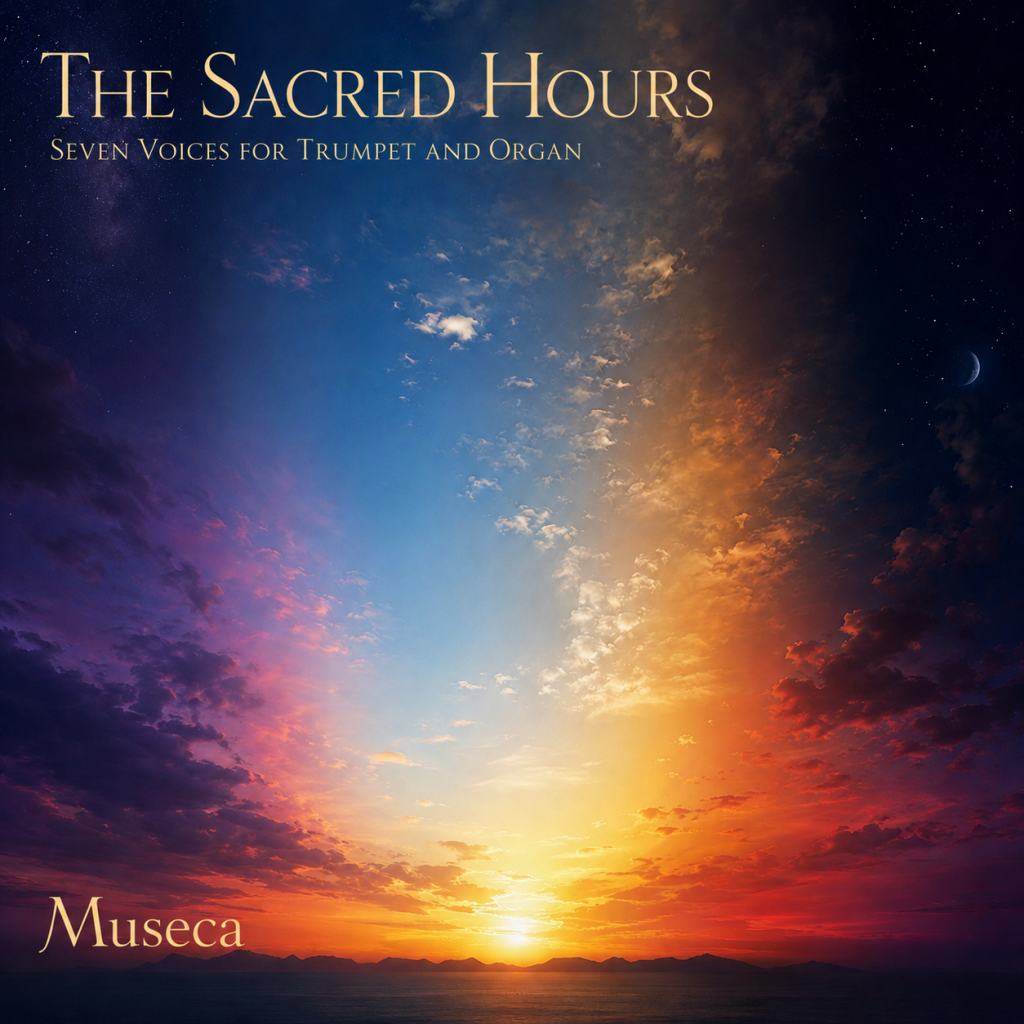
The Sacred Hours is a contemplative day in seven movements, scored for trumpet and pipe organ over a soft chillout bed. Each movement is one of the canonical hours from the monastic Liturgy of the Hours — Vigils before dawn, Lauds at dawn, Terce mid-morning, Sext at midday, None mid-afternoon, Vespers at sunset, Compline at night before sleep — and in each, the trumpet sings in a different voice, a different character, a different color of brass. There are seven hours and seven voices: a Harmon-muted intimacy before dawn, a piccolo brilliance at sunrise, an open singing trumpet at mid-morning, a warm flugelhorn at noon, a Spanish-Andalusian ache in the afternoon, a cup-muted softness at sunset, and the bugler’s solitary Last Post farewell at night.
The trumpet is the closest brass instrument to the human singing voice, and it has more characters than almost any other instrument. The cinematic pipe organ — the same instrument that has been the protagonist of the two prior albums in this cycle, Slow Light and The Prism — joins it here as a true conversational partner: not accompaniment, not backdrop, but the cathedral that holds the voice and a polyphonic voice in its own right, weaving counter-lines beneath the trumpet, answering it in the spaces between phrases, taking moments of its own. Beneath both, a soft Café del Mar chillout bed — gentle processed pulse, warm moving bass, atmospheric percussion at the smoothest end of the Ibiza tradition — gives the day its body. Sacred and chillout are not opposites here. They are the same thing seen from two angles: the contemplative and the sensual, the cathedral and the sunset, the hour and the warmth.
The monastic Liturgy of the Hours has shaped the rhythm of the contemplative day for fourteen hundred years. Each hour is a particular angle of light — pre-dawn watchfulness, dawn praise, mid-morning work, midday stillness, mid-afternoon turn, evening prayer, night farewell — and each carries its own emotional character. The Sacred Hours maps these characters onto seven trumpet voicings and seven modes (Aeolian, Lydian, Ionian, Mixolydian, Phrygian, Dorian, returning to Aeolian), so that the album’s modal arc is itself a day-arc: the listener moves from inward Aeolian through the bright daytime modes, deepens through the Spanish afternoon and the noble-sad evening, and returns to inward Aeolian at the close. The album opens and ends in the same mode at the day’s two threshold hours, but in different trumpet voices — Harmon-muted intimacy at Vigils, Last Post dignity at Compline — same stillness, different lives inside it.
The album’s biggest moment lives at midday. Sext is the only track on the album where the organ reaches its full plenum: every stop drawn, all registers sounding at once, the cathedral at maximum radiance. It is the noon-bell moment, the sun at zenith, the album’s brightest single moment — and the warmest, because of the flugelhorn singing over it. The plenum is reserved for this single moment across all seven hours; everywhere else, the organ stays restrained. A single small recurring gesture threads through the entire work: a three-note descending figure, dominant-mediant-tonic of each hour’s mode, sounded in distant bells at the threshold of every hour and echoed by the trumpet and the organ within each. The album’s quiet signature call — the bell that names the hour.
A wordless voice opens the album. Before the first hour, before the first bell, a single low human voice hums a sustained tone — emerging from silence, sustaining the tone, dissolving back into silence. There are no words, no instruments, no other voices: just the breath sustaining the tone and returning to stillness. It is the sound of the day before the day, the voice of stillness from which the seven hours arise.
The Sacred Hours is the third album in a cinematic-organ cycle that began with Slow Light: Seven Organ Contemplations and continued with The Prism: Thirteen Organ Refractions. The cycle’s working principle is constant: the organ as predominant melodic voice, voiced cinematically rather than liturgically, supported by a non-melodic produced bed and minimal companion instruments. Slow Light was organ alone; Prism added a cinematic shimmer to the bed; The Sacred Hours introduces the trumpet as a true second voice and the chillout bed as warm sensual body. The third album is the most sensual of the three, the most “in the world” — but it remains contemplative, restrained, sacred-secular. The day in seven voices.
The album is meant to be heard in order. It opens on the wordless voice from silence. It moves from pre-dawn watchfulness through the brightening hours into the noon’s radiance, then turns through Spanish afternoon, soft sunset, and the bugler’s solitary night. By the end, the day has been lived. The light has crossed the sky and returned to stillness. The voice from silence is also the voice that closes — the wordless hum still implied beneath the Last Post’s final breath. Seven hours. Seven voices. One contemplative day.
Liner Notes
Vigils Pre-dawn · Aeolian · Harmon-muted trumpet · ~60 BPM
The first hour. Pre-dawn, the watching hour, before the light. The cathedral fills in stillness — soft deep flutes on the cinematic pipe organ, a faint distant low-resonance bell sounding the Hour-Bell motif (A–F–D descending) — and then a Harmon-muted trumpet enters, intimate and breath-close, the dark inward tone of the bugler hushed against the dawn. The trumpet picks up the bell’s three notes and develops them into the Vigils song — slow, sighing, the watching voice in the pre-dawn dark. Beneath, the album’s softest chillout groove: a single gentle processed kick on beat 1 only, deep warm sub-bass with subtle slow pulsing, subliminal body felt more than heard. The climax is subdued — not a peak in volume but a deeper inwardness, the deepest watching. The album’s most hushed track. D Aeolian, the inward minor mode — the album opens here and will close in this mode at Compline, the day’s two threshold hours sharing the same stillness in different voices.
Lauds Dawn · Lydian · Piccolo trumpet · ~72 BPM
The dawn-call. Lauds, the praising hour, the first light arriving. The cinematic pipe organ wakes the cathedral with bright principal stops — multiple voices at once, a melodic inner line, moving pedal bass, the organ no longer holding but actively present. A clear bright bell sounds A–F#–D descending, and a piccolo trumpet enters — brilliant, crystalline, heraldic but contemplative, the dawn-call carried at the brightest end of the trumpet’s range. The Lydian mode’s raised fourth lifts the melody with edgeless brightness, the radiance of first light. The trumpet sings, the organ answers in the spaces between trumpet phrases, and at one moment in the middle the trumpet pauses entirely and the organ steps forward to speak alone before the trumpet returns. The climax is bright — the organ adds mixture stops for added brilliance — but stops short of the full plenum, which the album reserves for the noon hour. Beneath, the soft Café del Mar chillout body has arrived with the daylight. Sacred chillout at sunrise.
Terce Mid-morning · Ionian · Open Bb trumpet, singing register · ~80 BPM
The working hour. Mid-morning, the day in motion, the most active pulse of the album. The cinematic pipe organ establishes F Ionian on clear singing principal stops — polyphonic, with moving inner voices — a warm bell sounding C–A–F descending. An open Bb trumpet enters in its most natural lyrical singing register, no mute, the trumpet’s most baritone-like voice — a wordless aria for the working hour. The Ionian mode (pure major) is the day’s most direct mode, clear and declarative, with none of the modal flavors that will color the afternoon. Beneath, the album’s first fully present chillout groove: gentle processed kick on beats 1 and 3, warm moving bass, atmospheric percussion — the smooth Ibiza-end of the Café del Mar lineage giving the morning its body. The organ is an active conversational partner throughout, with a brief organ-alone passage in the middle where the trumpet pauses and the organ takes the air. The climax is full but not the plenum: bright, warm, the day at its most productive forward breath. The work of the day, sung.
Sext Midday · Mixolydian · Flugelhorn · ~75 BPM · the album’s only plenum
The album’s biggest single track. Midday, the still hour, the sun at zenith, the cathedral at maximum radiance. The longest track on the album — the noon hour earns its extended weight. The cinematic pipe organ opens on warm flute and earthy reed stops, fully polyphonic, the day at its golden middle. A warm midday bell sounds G–E–C descending, and a flugelhorn enters in its warmest, most golden, most rounded register — the human-voice of brass, the warmest sound the trumpet family can make. The Mixolydian mode is the warm major, earthy with its flattened seventh, full and unhurried. Beneath, the chillout groove at the album’s fullest intensity — still smooth, still unhurried, still never club, but at its most present.
And at the climax — the plenum. The organ gradually adds stops as the flugelhorn builds: more flutes, then reeds, then principals, then mixtures, then trumpets and cornets, all the way to every stop drawn, all registers sounding at once. The album’s only full plenum moment. The noon-bell at maximum, the sun at zenith, the album’s brightest single moment — and the warmest, because of the flugelhorn singing over it. The plenum is briefly held, then the organ pulls back stop by stop. Sacred chillout at full noon.
None Mid-afternoon · Phrygian · Open Bb trumpet with Spanish/Andalusian vibrato · ~70 BPM
The day’s first turn. None, the afternoon hour, the light beginning to slant toward evening. The album’s Spanish hour. The cinematic pipe organ opens on reed-forward Spanish-coded stops — krummhorn, regal, the slightly nasal modal reeds of the Spanish baroque tradition — a Mediterranean-warm bell sounding B–G–E descending. An open Bb trumpet enters in the Spanish/Andalusian voicing: wide warm vibrato, long breath, breath at the edges of the tone — the Aranjuez Adagio aesthetic, Miles Davis Sketches of Spain, the trumpet at its most aching and most ornamented. The Phrygian mode (with its flattened second) gives the track its flamenco color, the modal Spanishness that distinguishes it from the more neutral hours of the day. At the climax, the organ adds the trompeta real — the Spanish “royal trumpet” reed stop, a fitting voice to meet the trumpet at full ache. The chillout groove takes a subtle Mediterranean inflection in the bassline. The afternoon’s first sweep of melancholy — sorrow that is also warmth, ache that is also gold. The day turning.
Vespers Sunset · Dorian · Cup-muted trumpet · ~66 BPM
The evening prayer. Vespers, the sunset hour, the dimming light. The cinematic pipe organ opens on soft flute and mild celeste stops — the celeste’s gentle slightly-detuned shimmer giving the cathedral an evening softness — a deep evening bell sounding D–Bb–G descending. A cup-muted trumpet enters in its warmest veiled register: softer than open trumpet, more focused than Harmon mute, the warm intimate sacred-evening voice. The Dorian mode (minor with raised sixth) is the “noble sad” mode — minor grief held together with a thread of warmth from the raised sixth, sorrow that has not lost its grace. The climax stays soft: the trumpet at its most tender, the organ adding gentle flutes and soft principal touches but never adding mixtures, never reaching brightness. This is sorrow held within warmth, not radiance. The chillout groove provides sunset body, very gentle. The album’s most tender peak — the evening prayer at its most inward. The light is dimming, but it is still warm.
Compline Night · Aeolian · Open Bb trumpet, Last Post register · ~58 BPM
The day’s final breath. Compline, the night prayer, before sleep. The cinematic pipe organ opens on the album’s simplest registration — a single soft foundation stop, exposed and sparse but actively played — Bb Aeolian, the bugler’s mournful key. A solemn final bell sounds F–Db–Bb descending. An open Bb trumpet enters in the Last Post / Taps register: slow, exposed, processional, dignified, the bugler’s solitary voice — the same trumpet, no mute, but in the most ancient and most reserved of its traditions, the farewell. The organ holds quietly beneath, exposed pedal bass moving, giving the trumpet space — this is the trumpet’s solo moment, the bugler alone at the day’s end. The chillout groove is at the album’s softest, matching Vigils — gentle kick on beat 1 only, subliminal body. The climax is the album’s most subdued — not loud, but the most aching dignified moment. The closing is extended, organ alone, settling into night. The day is done. The album opens and closes in Aeolian, but the threshold hours hold different voices inside their stillness — Harmon-muted intimacy at Vigils, Last Post dignity at Compline. Same hour-of-stillness, different lives inside it. The wordless voice from silence at the album’s opening is implied here too, beneath the Last Post’s final breath — the day returning to where the day began.
Playlist
- TRACK 1: VIGILS Museca 4:27
- TRACK 2: LAUDS Museca 2:45
- TRACK 3: TERCE (Café del Mar version — test pass) Museca 4:05
- TRACK 4: SEXT (Café del Mar version, with the album's only full plenum) Museca 4:35
- TRACK 5: NONE (Café del Mar version, Spanish/Andalusian voicing) Museca 5:10
- TRACK 6: VESPERS (Café del Mar version, soft cup-muted) Museca 3:45
- TRACK 7: COMPLINE Museca 5:05