
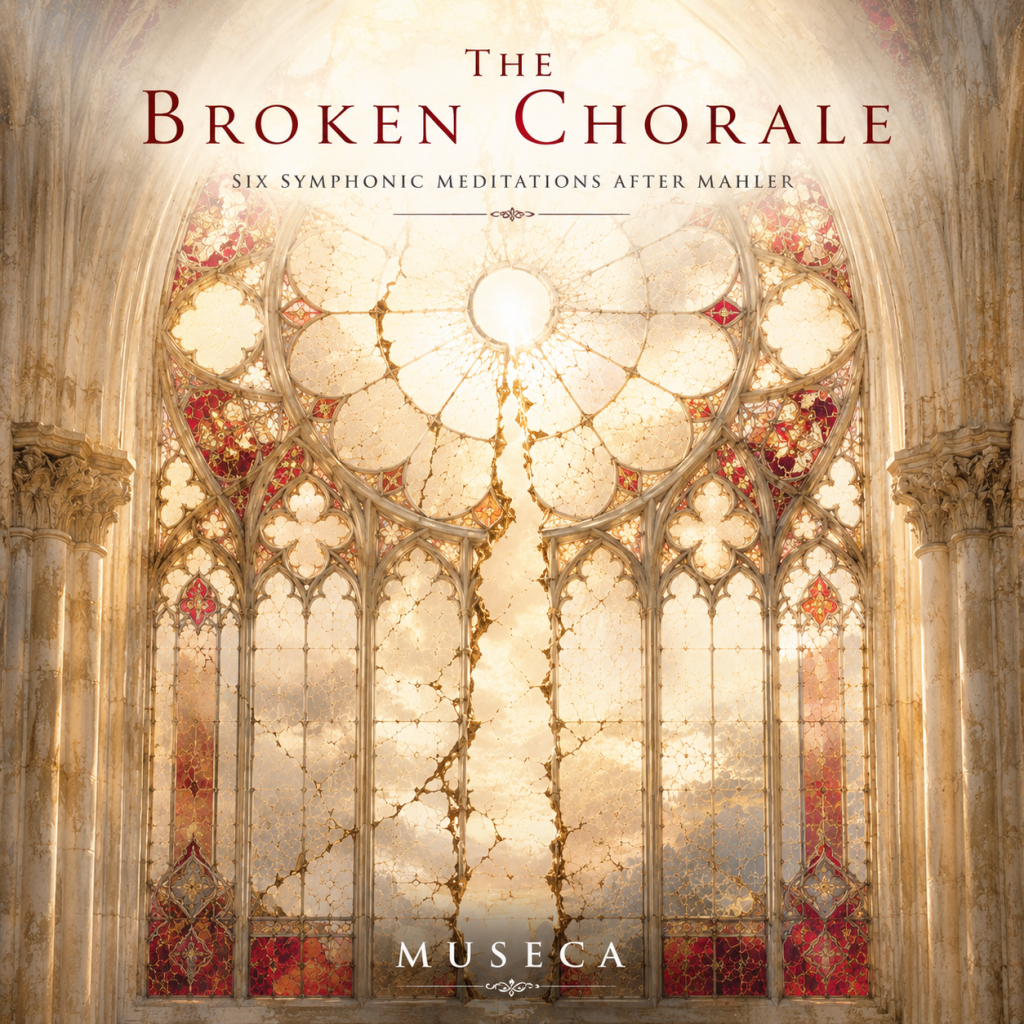
The Broken Chorale is a six-part symphonic meditation on one of Mahler’s most powerful musical signatures: the moment when music opens toward transcendence, only to reveal fracture inside the revelation. Unlike Rachmaninoff’s signature use of the lowered sixth or Ravel’s chromatic-mediant shifts of color, Mahler’s signature is not a single chord. It is a dramatic event: a chorale, fanfare, march, or dance that seems to promise meaning, then bends under the pressure of memory, irony, grief, or doubt.
Mahler stands at a pivotal place in music history. He inherited the vast Romantic symphonic tradition from Beethoven, Schubert, Bruckner, Brahms, and Wagner, yet his music also pointed forward toward the psychological fragmentation and expanded orchestral language of the twentieth century. Britannica describes him as a composer of ten symphonies and orchestral songs that drew together many strands of Romanticism, and notes that although his music was long neglected after his death, he later came to be regarded as an important forerunner of twentieth-century composition.
His music is built from contradictions. It can be monumental and intimate, sacred and grotesque, childlike and terrifying, rustic and cosmic. Leonard Bernstein famously emphasized this doubleness: Mahler wrote for enormous orchestral forces, yet he could also create chamber-like delicacy with only a few instruments; Bernstein called Mahler both “the end” of the nineteenth-century Romantic tradition and “the beginning” of modern music.
That doubleness is the center of this album.
The “Mahler signature” explored here is the broken chorale: a noble, hymn-like, brass-centered gesture that seems to open a path toward redemption, but does not remain whole. In Mahler, the chorale is rarely just a stable statement of faith. It may arise out of a funeral march, appear after a crisis, blaze for a moment above the orchestra, or dissolve into uncertainty. It can feel like heaven opening—but also like the human soul questioning whether heaven can be trusted.
This is closely related to what analysts often call Mahler’s breakthrough principle: the sudden arrival of a large-scale revelation, often in brass or full orchestra, where the music seems to burst through its own suffering into a wider world. But in Mahler, breakthrough is never simple. The arrival may be radiant, but it is surrounded by marches, distortions, folk fragments, bitter irony, and sudden collapses into exposed chamber textures. The revelation is real, but it is not secure.
The Broken Chorale translates that principle into six original meditations. The album does not quote Mahler. Instead, it builds a new symphonic world from his recurring emotional and structural materials: brass chorales, funeral marches, Ländler rhythms, distant fanfares, long adagios, major/minor contradiction, and climaxes that open toward transcendence but refuse easy triumph.
The first meditation introduces the broken chorale itself: a noble brass idea emerging from distant horns and quiet strings, then fracturing through major/minor shifts. The second turns toward the Mahlerian funeral march, where innocence becomes unbearable by being placed inside procession, parody, and grief. Mahler’s own First Symphony famously transforms the familiar “Frère Jacques” into a funeral march, marked by irony and theatrical strangeness.
The third meditation enters the world of the Ländler, the rustic Austrian dance that Mahler often uses not as simple charm, but as memory, earthiness, awkward grace, or grotesque displacement. In Mahler’s First Symphony, the second movement is explicitly a Ländler, while the trio evokes a rustic oom-pah-pah character. The fourth meditation turns to the distant fanfare: the call from somewhere beyond the visible landscape. Mahler often uses fanfare-like gestures, distant brass, and spatial effects to make the orchestra feel as though it is sounding from another world, not merely from the stage.
The fifth meditation is the album’s slow heart: an adagio of farewell, suspension, and vanishing. Here the Mahler signature becomes less public and more private. The vast orchestra thins into exposed strings, solo lines, and unresolved suspensions. This follows one of Mahler’s most characteristic contrasts: huge symphonic scale interrupted by chamber-like vulnerability. The sixth and final meditation gathers the album’s materials into a final attempted breakthrough. March, chorale, fanfare, and adagio memory converge; the music rises toward a major-key revelation; then the breakthrough fractures and dissolves.
This is the album’s central meaning: transcendence is attempted, glimpsed, and questioned. The music does not deny the possibility of light, but it refuses to make light easy.
Mahler’s historical significance lies partly in this refusal. The nineteenth-century symphony often carried an expectation of final affirmation: conflict would lead to resolution, and the finale would justify the journey. Mahler inherited that expectation but complicated it. In the First Symphony, commentators have noted how closure and summation were central to his thinking; yet even there, optimism is undercut by irony, funeral music, and theatrical interruption. In the Sixth Symphony, the problem becomes more severe: Utah Symphony’s program notes describe the work as one that does not end with classical catharsis, and its final brass chorale cannot prevent the sense that fate has prevailed.
For this reason, Mahler’s music feels strikingly modern. It does not present the self as unified. It presents the self as divided: between faith and doubt, folk memory and urban anxiety, childhood and death, comedy and apocalypse. A trumpet call may become a funeral march. A dance may become grotesque. A chorale may appear as salvation, then crack. A major chord may arrive, but the listener may no longer know whether it is victory, irony, or a final fragile hope.
The Broken Chorale is built from that divided world. Its six movements are not meant to imitate Mahler’s symphonies in scale, but to concentrate their emotional grammar. The album asks one question again and again:
What happens when music reaches for heaven, and the human heart cannot fully believe what it sees?
The answer is not despair. It is something more complex: a tragic grandeur in which the attempted breakthrough matters even if it cannot remain. The chorale may break, but for one moment it still opened.
Liner Notes
The Broken Chorale
The opening meditation introduces the central Mahlerian idea of the album: a chorale that reaches toward transcendence but cannot remain whole. The music begins from distance rather than certainty — quiet strings, exposed horn calls, and a sense of space before form fully gathers. Out of this atmosphere, a brass chorale gradually emerges, noble and almost redemptive, as if the orchestra has found a path upward.
But the chorale is not allowed to stand untouched. Its major-key promise is disturbed by minor-mode shadows, unstable bass motion, and sudden thinning of the orchestral texture. What first appears as affirmation becomes psychologically vulnerable. The music opens toward light, then reveals stress within the light itself.
This is the essential Mahler signature explored throughout the album: not simply sadness, not simply triumph, but the fracture inside attempted transcendence. The chorale matters because it tries to believe. Its breaking matters because the belief is human, not absolute.
The orchestration should move between symphonic breadth and chamber-like exposure. Brass and horns carry the public, visionary element; strings and woodwinds reveal the private uncertainty underneath. The track does not seek a definitive resolution. It ends as an opening — a door glimpsed, not crossed.
March for a Child’s Funeral
This meditation enters one of Mahler’s most disturbing emotional worlds: the funeral march that carries traces of innocence. The music should begin with a simple, almost childlike melodic fragment, perhaps in clarinet, bassoon, or muted trumpet. The tune itself should not sound tragic at first. Its tragedy comes from what the orchestra does to it.
As the melody is placed over a slow procession, the innocence becomes uncanny. Pizzicato bass, low strings, muted brass, and a restrained drum pulse turn the small tune into a march. The effect is not ordinary mourning; it is memory made unbearable. A simple musical object is forced to walk through death.
The technique here is transformation through context. Mahler often takes material that might otherwise sound rustic, naïve, or familiar and re-situates it inside a darker frame. This produces a particular kind of irony: the music does not mock grief, but it refuses to present grief in a clean, dignified way. It allows tenderness, awkwardness, grotesquerie, and sorrow to coexist.
The track should remain restrained. Its power lies in unease rather than volume. The final image is a procession receding into distance, leaving behind the question of whether the innocence was remembered, lost, or never truly innocent at all.
Ländler at the Edge of the World
The Ländler is the album’s dance of memory. It begins with rustic grace: a 3/4 pulse, folk-like wind colors, clarinet and bassoon gestures, drone-like bass, and strings that suggest village music rather than polished ballroom elegance. The rhythm should feel earthy, slightly awkward, and human.
But in Mahlerian fashion, the dance slowly tilts. Major turns toward minor. Accents become slightly exaggerated. The harmony shifts in ways that make the floor feel unstable. What began as a memory of communal dance becomes something stranger: nostalgia viewed from too great a distance.
The musical technique is one of gentle distortion. The dance remains recognizable, but its emotional meaning changes. Instead of a simple pastoral episode, the Ländler becomes a place where memory and irony meet. It is affectionate and unsettling at once.
This track should avoid elegance that is too polished. It should not become a Viennese waltz. The sound world is more rural, more physical, more vulnerable. The music should feel as though it comes from a village at the edge of a vast landscape — close enough to remember, too far away to return to.
The Distant Fanfare
This meditation is built around musical distance. A fanfare is usually a call of arrival, announcement, or command, but here it is heard from afar. Horns and trumpets do not dominate the stage; they sound across space, as if from a mountain valley, a military procession, or another life.
The track should begin with tremolo strings, long pedal tones, and quiet orchestral suspension. The fanfare appears gradually, not as a heroic statement but as a summons. It approaches, brightens, and then recedes. Its meaning remains ambiguous: it may be hope, fate, memory, warning, or transcendence calling from beyond the visible world.
The technique is spatial orchestration. Mahler’s world often feels larger than the concert hall because certain sounds seem to come from elsewhere. This can be suggested through distant brass, soft timpani, long-held string textures, and exposed woodwind answers. The listener should feel depth, not just volume.
The fanfare never becomes a full victory theme. Its nobility is real, but it is unreachable. The track ends by letting the call disappear, leaving the silence changed by what passed through it.
Adagio of the Vanishing World
This is the album’s slow inner heart. After chorale, march, dance, and fanfare, the music turns inward. The adagio should feel like farewell without finality: long string lines, unresolved suspensions, slow harmonic motion, and solo voices emerging briefly from the orchestral mass.
The Mahlerian signature here is not irony but exposure. The orchestra may be large in implication, yet the emotional focus becomes intimate: solo violin, solo cello, English horn, or a fragile woodwind line suspended above quiet strings. The listener should feel the vastness of the world and the loneliness of a single voice within it.
Harmonically, the track should avoid hard cadences. Suspensions should resolve into new suspensions. Major and minor should touch without one conquering the other. The music should seem always near rest, yet never fully at rest. This creates a sense of leave-taking: not dramatic collapse, but gradual disappearance.
The adagio should not become sentimental. Its strength lies in patience and restraint. It is the moment in the album where the broken chorale is no longer public or ceremonial. It becomes inward: a private attempt to bless a vanishing world.
Breakthrough Without Heaven
The final meditation gathers the album’s materials into one large attempted revelation. Fragments of march, Ländler, fanfare, and adagio memory return, as if the whole album is trying to assemble itself into meaning. The brass chorale rises again, broader now, and the orchestra moves toward a major-key breakthrough.
For a moment, the music should feel as though transcendence is possible. The chorale expands. The brass opens. The strings lift. The fanfare returns. The march beneath it may even seem to have been redeemed.
But the breakthrough does not become simple victory. Minor shadows enter the bass. The chorale bends. The orchestral surface fractures. What looked like heaven becomes unstable, not because it was false, but because the human heart cannot hold it without doubt.
This is the album’s final Mahlerian gesture: the revelation appears, but it cannot be possessed. The music does not reject transcendence; it questions the permanence of transcendence within human experience.
The ending should dissolve rather than conquer. A distant horn, a thinning string texture, a final unresolved chord, or a chamber-like afterimage may remain. The chorale has broken, but its attempt still matters. For one moment, the music opened toward something beyond itself — and even in its failure to remain, that opening becomes the album’s final truth.
Playlist
- Track 1 – The Broken Chorale Museca 3:05
- Track 2 – March for a Child’s Funeral Museca 2:18
- Track 3 – Ländler at the Edge of the World Museca 2:03
- Track 4 – The Distant Fanfare Museca 2:49
- Track 5 – Adagio of the Vanishing World Museca 3:55
- Track 6 – Breakthrough Without Heaven Museca 2:58