
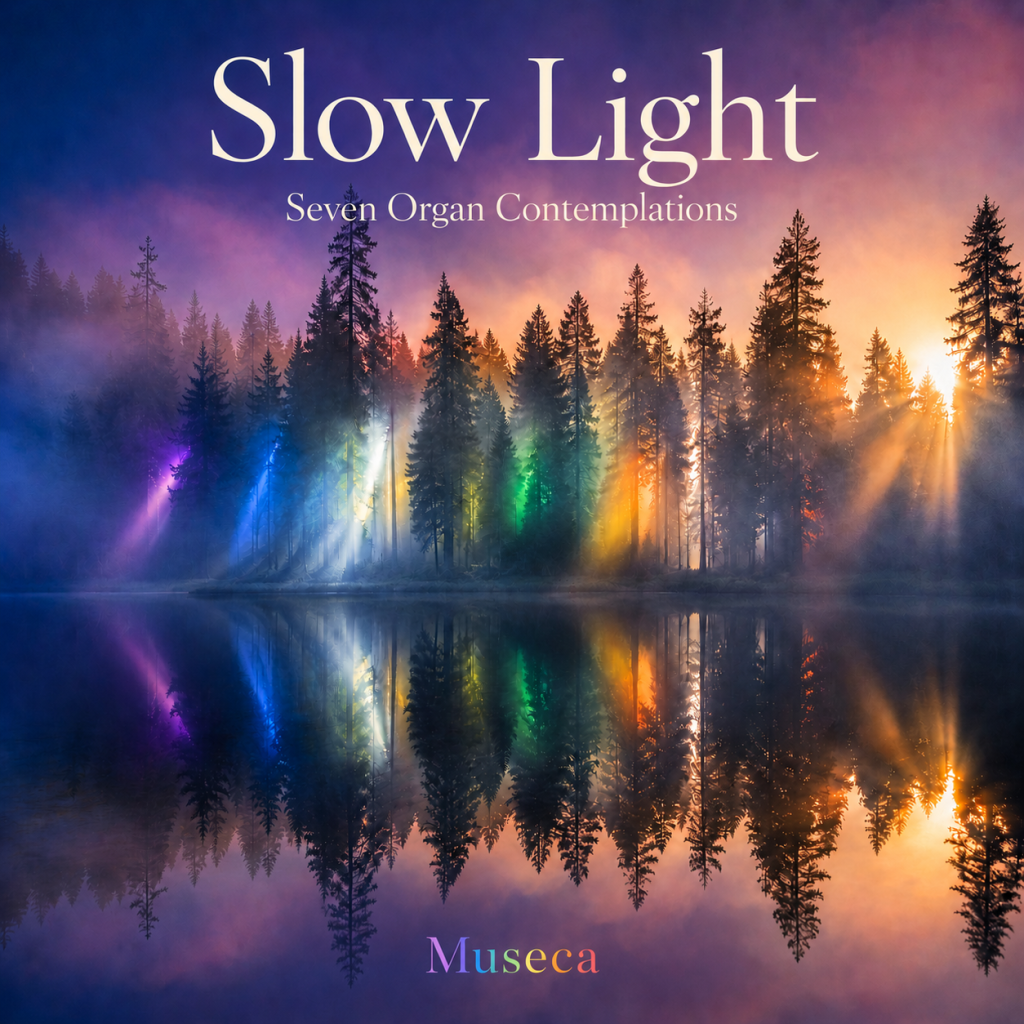
Slow Light: Seven Organ Contemplations
For most listeners, the organ is the sound of a building. A pipe organ in a vast stone cathedral, the foundation of Sunday worship. A church organ at full force, declaring, summoning, exhorting. The organ as instrument of public ritual, of high ceiling and held tradition.
But the organ has many other voices, and not all of them belong in churches.
Slow Light is a collection of seven contemplative pieces built around the organ — the organ heard quietly, characterfully, intimately, in seven different forms across seven different states of inner attention. The album moves like late afternoon sun moving slowly across a room: warm, sustained, unhurried, illuminating different surfaces as it passes through the hours. None of these tracks belongs in a cathedral. None of them sounds like Bach. The organ here is something the listener can sit beside, not stand under.
The Organ Outside the Church
The organ is older than Christianity. It begins in third-century Alexandria with Ctesibius’s hydraulis, the water-regulated wind organ used at Roman games and imperial ceremonies. For its first thousand years, the organ was an instrument of public spectacle — civic, theatrical, secular. Its association with Christian worship is an accident of medieval history, not the instrument’s nature.
In the twentieth and twenty-first centuries, composers and producers have steadily reclaimed the organ from the church. Brian Eno’s sustained pads on Music for Airports. The chillout tradition of Café del Mar, where Hammond and pipe organ sounds anchor sunset music in Ibiza. Arvo Pärt’s sparse held chords in pieces like Pari Intervallo and Spiegel im Spiegel. Paul Schwartz’s classical-crossover hybrid synth-organ on State of Grace. Kali Malone’s The Sacrificial Code, where pipe organ at quiet volume produces music that is unmistakably organ and unmistakably not church music. Nils Frahm’s Spaces and All Melody. Chicane’s Saltwater. The organ in these contexts is contemplative rather than declarative, intimate rather than ceremonial, characterful rather than overwhelming. It is the organ as inward voice, not as proclamation.
Slow Light sits in this contemporary tradition. The album’s framing reference is the chillout neoclassical territory of Café del Mar, Air, Zero 7, Schiller, Nils Frahm — where slow grooves and sustained atmospheric sound coexist with classical instruments and modal harmony. Within that framing, the organ is the album’s constant voice, the through-line across seven different inner states, the slow light moving through the album’s hours.
Seven Voices of the Organ
The album moves through seven distinct organ sounds across its seven tracks. Each contemplative state — Stillness, Vigil, Threshold, Longing, Surrender, Grace, Repose — is rendered through a different organ voice, chosen for its specific character and never for its volume.
The album opens with the Hammond B-3 organ at slow Leslie speed — the warm, swirling, electromechanical sound made famous by Procol Harum’s A Whiter Shade of Pale and inseparable from the chillout tradition. Then a pipe organ’s Voix Céleste stop, with its slow trembling shimmer of two ranks of pipes tuned slightly different from each other. Then the eerie, vocal-like Vox Humana stop — the organ pretending to be a human voice. Then the layered French Romantic stops of Cavaillé-Coll’s Récit registration, breathing through its swell box. Then the audible swell pedal expression of a pipe organ inhaling and exhaling, dynamic by way of physics. Then the sparse, crystalline pure pipe organ chords of Arvo Pärt’s tintinnabuli tradition. And finally, the soft analog-synth-flavored hybrid organ of Paul Schwartz — the synth-organ pad of State of Grace and the original Umbra sound that first inspired this album.
Seven different organs. Seven different colors of the same instrumental family. The listener finishes the album having heard the organ from seven angles without ever hearing it traditionally — without a single moment of cathedral organ at force, without a single line of Bach-style counterpoint, without ever being called to worship.
Companions to the Organ
Six of the seven tracks pair the organ with a single accompanying voice — English horn, violin, cello, bass clarinet, cello again, and alto flute — chosen for the contemplative character of each track. Stillness opens the album with no accompaniment at all, pure organ alone, establishing the album’s central voice. Grace, at the album’s emotional peak, breaks the rules: pipe organ, cello, and a wordless soprano in trio for ninety seconds in the middle of the track — the only time on the album that a human voice is heard at all.
The accompanying instruments never lead. They color, support, and respond. The organ remains the constant foreground voice across every track, the album’s central subject from first chord to last.
On Listening
Slow Light is meant to be heard whole, in order, without interruption. The contemplative states unfold in sequence: settling in, becoming attentive, crossing the threshold, the heart reaching, the heart releasing, the moment of receiving, the final rest. Each track is a single contemplation; together they form an arc that begins and ends in the same harmonic home — D Aeolian, the album’s tonal anchor — but transformed by everything between.
The album rewards quiet listening. Headphones reveal the organ’s character more fully than speakers; low ambient noise reveals the slow harmonic motion that the chillout groove and sub-bass pulse keep alive beneath the held atmosphere.
This is not background music for productivity or sleep. It is slow light — the kind of light that comes through windows in the late afternoon, that warms a room without filling it, that lets the listener watch the day soften without anything being demanded in return.
Liner Notes
Slow light moves slowly. It does not announce itself. It enters a room through whatever windows are open, warms whatever surfaces it touches, and leaves without ceremony when the day ends. This album is built in the image of that movement — seven contemplations heard quietly through the slow voice of an organ, each one a different surface that the same light passes across.
Stillness
The album opens at slow Leslie. A Hammond B-3 enters in D Aeolian — warm, swirling, immediately and unmistakably organ. This is the only track where the organ is alone; no wind instrument, no string, no voice. The album establishes its central voice first, before letting any other voice in. Stillness is the album’s foundation: settled inwardness, gathered attention, the contemplative ground from which every other state will be heard. The chillout groove enters at thirty seconds — soft kick, closed hi-hat, moving bassline — and from that point the album’s rhythmic identity is settled. Anyone listening past the first minute knows what kind of record this is.
Vigil
The album moves one whole step up in pitch space (A Aeolian) and one degree more alert in tempo. The Voix Céleste’s slow trembling shimmer — two ranks of pipes tuned slightly different from each other, creating a natural slow beat — is one of the most characterful sounds in the pipe organ’s vocabulary, and is heard nowhere else on the album. The English horn enters here as the album’s first accompanying voice: plaintive, breath-based, the lonely shepherd quality of the cor anglais carrying the contemplative state of watchful attention. The English horn appears on no other track. Vigil is the watcher’s state, sustained attention without effort, the practice of staying awake.
Threshold
The album’s structural center. Threshold is built around the Vox Humana, the pipe organ stop designed to imitate the human voice — uncanny, vocal, supernatural-sounding, immediately recognizable as organ but uncomfortably alive. The track sits in F♯ Aeolian until a moment in the middle when the harmonic ground shifts into whole-tone shimmer: suspended timeless harmony with no clear tonic, the music’s geometric heart, the held breath of the album. The violin emerges only during this pivot — its uncanny ethereal floating quality marking the suspended moment in instrumental form. After the pivot the harmony resolves back to F♯ Aeolian and the violin recedes. Threshold is the in-between state, the moment of standing at the doorway, neither one place nor another.
Longing
The fastest track on the album and also the most lush. The Cavaillé-Coll Récit registration layers three pipe organ stops — Gambe (string-like), Voix Céleste (trembling celestial), and soft Flûte — into a single breathing French Romantic atmosphere from the swell-enclosed expressive division. B Dorian provides the harmonic character: the raised 6th degree is the mode’s signature, the note that makes the music sound like reaching, yearning toward something the mode itself cannot quite name. The cello enters as the warm yearning voice, the most vocal of strings, the instrument most often called upon when music needs to ache. Longing is the heart’s reach, desire as contemplative state, the soul straining beyond its current containment.
Surrender
Surrender shares its tonic note (B) with Longing, but moves into Phrygian — the mode whose flat 2nd degree creates the characteristic austere descending quality, the harmonic figure of release. The heart that reached on Longing now lets go on the same harmonic ground. The organ here is heard at its most physically present: audible swell pedal expression makes the instrument breathe — louvered shutters around a division of pipes opening and closing, the volume rising and falling continuously, the organ inhaling and exhaling through dynamic physics. The bass clarinet enters as accompaniment: deep, woody, mysterious, the deepest “release” voice in the wind family. The same harmonic ground as Longing read through a different modal light. Surrender is the heart’s release, the unclenching that follows the reach.
Grace
The album’s emotional peak and only multi-instrument track. Grace is the moment the album breaks its own rules. The Pärt-tradition pipe organ is the most stripped-down voice anywhere on the album — sparse austere held chords with single-note punctuations, crystalline transparent pipe organ in the tintinnabuli style of Spiegel im Spiegel. D Lydian is the album’s only major mode: the raised 4th creates a floating luminous quality, the harmonic figure of light entering. The cello returns from Longing — the same warm voice that reached on the previous-but-one track now appears in receiving mode, the album’s central architectural rhyme. And for ninety seconds in the middle of the track, the wordless soprano emerges and steps forward melodically — the only vocal sound anywhere in the album. She sings pure vowel tones, no words, no language, and then she is gone. Grace is the gift, the receiving, the moment when what was reached for arrives.
Repose
The album closes in D Aeolian — the same key where Stillness opened. The harmonic loop completes. The organ here is the soft analog-synth-flavored hybrid pad of Paul Schwartz’s State of Grace tradition, the same dimensionless suspended organ tone that originally inspired this album in an earlier piece called Umbra. The seed becomes the harvest; the inspiration becomes the closing voice. The alto flute appears as accompaniment, peaceful and breath-based, present on no other track. Repose is the final rest after the gift has been received — not the absence of motion (the chillout groove continues to the end) but the settling of motion into its proper place. The album ends in its home key, in slow light at the close of day.
On the Architecture
Several structural rhymes hold the album together beneath the surface variety of its seven different organ voices.
The album opens and closes in D Aeolian, the harmonic home. Stillness and Repose speak the same harmonic language; the album returns to where it began, but transformed by everything between.
The cello appears on exactly two tracks — Longing and Grace. The same instrument, two different harmonic and emotional states: the heart that reached on the earlier track now receives on the later one. The listener may not consciously notice the connection, but it is felt.
B as tonic appears on two consecutive tracks in two different modes: Longing in Dorian (yearning), Surrender in Phrygian (release). Same harmonic floor, two different colors of light, the album’s central emotional move articulated as harmony rather than as language.
The Umbra organ sound returns on the final track. The album that began in conversation with that earlier piece ends with its voice, completing a circle that listeners who know Umbra will recognize and those who don’t will simply feel as quiet rightness.
Grace is the album’s exception — the only track with two accompanying instruments, the only track with any vocal presence, the only major-mode track. Everything that has been withheld for six tracks is released here. The album earns this moment by reservation.
Companions to the Organ
Across the album, the accompanying instruments are these: English horn on Vigil; violin on Threshold; cello on Longing and again on Grace; bass clarinet on Surrender; wordless soprano on Grace alone; alto flute on Repose. Each is heard on at most two tracks, most on only one. The organ is the constant; the accompanying voices are colors that pass through.
Coda
Slow Light is the organ heard quietly, slowly, intimately — the organ as a voice that can sit beside the listener rather than over them. Seven contemplative states, seven different colors of the same instrument family, one slow light moving through the hours.
Playlist
- TRACK 1: STILLNESS Museca 4:10
- TRACK 2: VIGIL Museca 3:59
- TRACK 3: THRESHOLD Museca 3:41
- TRACK 4: LONGING Museca 3:34
- TRACK 5: SURRENDER Museca 3:34
- TRACK 6: GRACE Museca 4:50
- TRACK 7: REPOSE Museca 3:50