
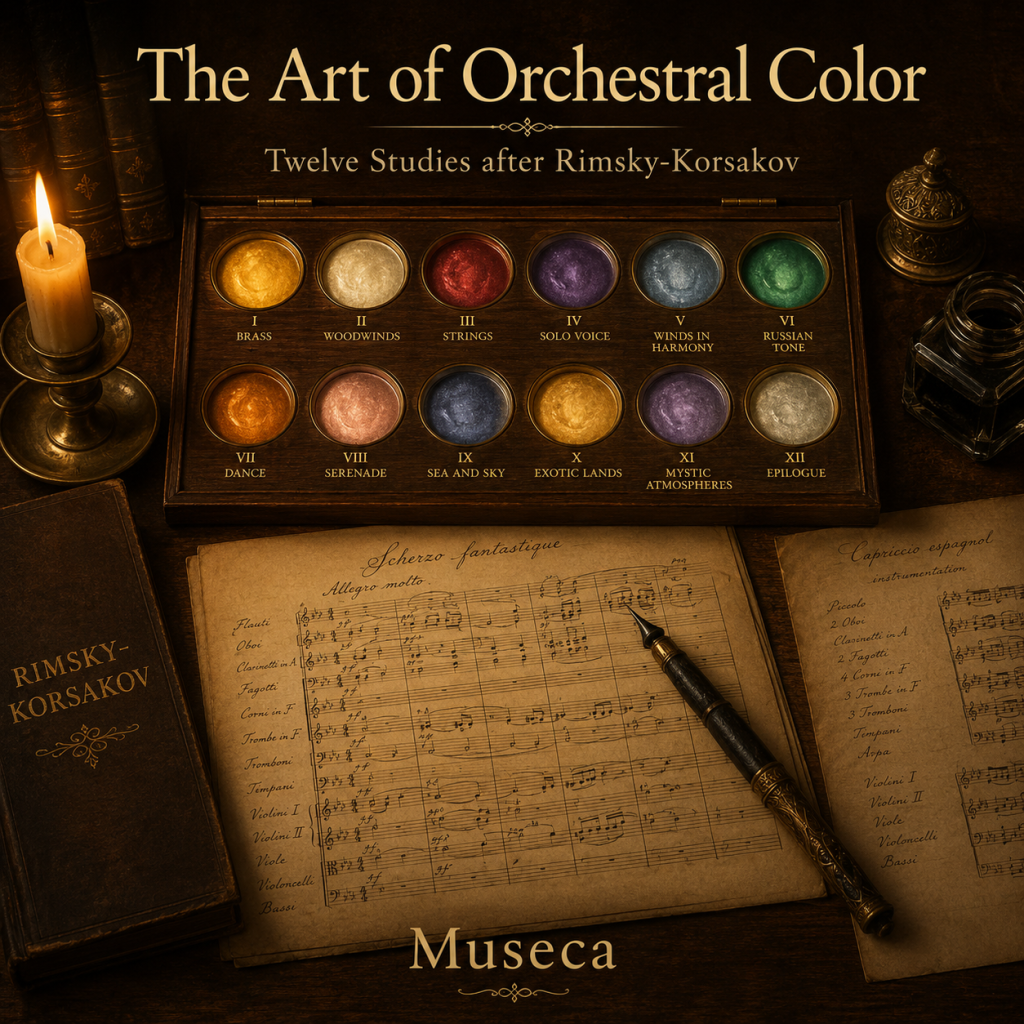
The Art of Orchestral Color began as a study of Nikolai Rimsky-Korsakov’s great textbook Principles of Orchestration, one of the essential works on how an orchestra thinks, breathes, balances, and shines. Rather than treating the book as a historical manual only, we reviewed its central ideas as living compositional principles: how melody rises out of accompaniment, how instrumental families blend or resist one another, how harmony must be voiced before it can be colored, and how orchestral power depends as much on restraint as on fullness.
From that study, the album was shaped into twelve musical reflections. Each track focuses on a specific orchestral principle drawn from Rimsky-Korsakov’s teaching: the expressive supremacy of the string family, the individual character of woodwind instruments, the noble warmth of cello and horn, the transparency of woodwind harmony, the delicate resonance of harp and celesta, the special world of pizzicato, the dramatic force of brass after silence, the architecture of hidden harmony, the transformation of melody through orchestral echo, the disciplined use of tutti, and finally the wisdom of economy.
The album does not use the full orchestra constantly. Instead, it treats the orchestra as Rimsky-Korsakov did: as a living palette of distinct forces. Some pieces are written only for strings. Others feature oboe, clarinet, cello, horn, harp, woodwind choir, or plucked textures. The full orchestra appears only when the musical structure has earned it. This allows each color to enter with purpose, each instrumental family to reveal its nature, and each return of sound to feel meaningful.
Several core techniques shape the album. Divisi strings create warmth, depth, and inner movement. Muted strings provide veiled, spiritual color. Solo woodwinds act almost like characters: oboe as human tenderness, clarinet as memory, flute as distance, bassoon as shadow. Horn and cello blending creates one of the album’s central emotional colors. Harp arpeggiation, celesta shimmer, pizzicato strings, and string harmonics explore instruments of lighter sustaining power. Brass is withheld until it can function as revelation rather than spectacle. Tutti is treated not as noise or excess, but as balance, proportion, and radiance.
At its heart, this album is a journey from simplicity to fullness and back again. It begins with strings alone, moves through individual colors and blended chamber textures, expands into brass and full orchestra, and then returns to restraint. The final lesson is perhaps Rimsky-Korsakov’s most profound: orchestration is not the art of using everything. It is the art of knowing what must sound, what must remain silent, and when color itself becomes meaning.
Liner Notes
Strings as the Soul
The album opens with strings alone because, for Rimsky-Korsakov, the string family is the most complete and expressive body of the orchestra. Here the strings are not accompaniment; they are the whole world. Muted violins, warm violas, lyrical cellos, and a grounded double bass foundation create a single breathing organism.
The piece begins inwardly, almost as if the orchestra is waking from silence. Divisi writing allows the harmony to widen without becoming heavy, while the cello line gives the music its human center. The study is built on legato motion, restrained swelling, and noble warmth. It establishes the album’s first principle: before orchestration becomes color, it must first become song.
The Oboe in the Half-Light
The oboe enters as a solitary human voice. Its sound is direct, plaintive, and exposed, capable of suggesting innocence, tenderness, and melancholy with very little ornament. Around it, muted strings and harp create a twilight atmosphere, careful never to overpower the reed tone.
This piece is about transparency. The oboe melody must remain in relief, floating above the accompaniment like a small flame in a dim room. The harp adds resonance, the strings provide breath, and the inner woodwind shadows deepen the emotional color. Nothing is excessive; the feeling comes from the vulnerability of one tone placed in the right light.
The Clarinet Remembers
The clarinet is treated here as memory. Beginning in its low chalumeau register, it speaks from a darker place than the oboe. The sound is intimate, reflective, and slightly veiled, as though the melody is being recalled rather than announced.
Muted violas and cellos create a soft interior space, while the bassoon adds a shadow beneath the line. As the clarinet rises into a warmer register, the music gently blooms, but it never becomes grandiose. The piece is not about climax; it is about recollection. The clarinet remembers, but the memory remains incomplete.
Cello and Horn at Dusk
This study explores one of the most beautiful blended colors in orchestration: cello and French horn. The cello carries human longing; the horn gives that longing nobility and distance. Together they create a dusk-colored sonority, intimate yet expansive.
The cello begins alone, close to the listener. The horn answers from farther away, as if calling across a landscape. Gradually the two voices approach one another until they seem to share the same emotional breath. Low strings, bassoon, and harp support the duet with warmth and restraint. The effect is romantic, but not sentimental: a private feeling enlarged into dignity.
The Wind Choir
This piece removes the strings and brass so the woodwinds can be heard as a complete harmonic body. Flutes, oboes, English horn, clarinets, bass clarinet, bassoons, and contrabassoon form a choir made entirely of breath.
The study is built on careful voicing and register. Flutes bring pale light, oboes and English horn bring human reed color, clarinets give warmth and flexibility, and bassoons provide grounding. The harmony moves slowly, almost ceremonially. The music suggests a chapel without voices, where the air itself sings.
The Harp Is Not a Piano
The harp is given its own world: diatonic, resonant, delicate, and luminous. This study avoids treating the harp like a keyboard instrument. Instead, it allows the harp to do what it does naturally: arpeggiate, shimmer, resonate, and let harmony glow rather than strike.
Celesta enters like distant starlight, while flute and string harmonics create a translucent upper halo. Pizzicato strings provide only the gentlest pulse. The piece is crystalline and weightless, built from resonance rather than force. It is a study in lightness: music as reflection, refraction, and afterglow.
Pizzicato Palace
Here the bowed string orchestra transforms into a plucked ensemble. Pizzicato strings, harp, celesta, and light woodwind staccatos create an elegant miniature, playful but never comic. The atmosphere is closer to a fairy-tale ballet than a joke.
The pulse comes from pizzicato cellos and basses, while violins and violas add delicate rhythmic figures. Woodwinds respond with brief gestures, and the celesta adds a refined sparkle. The piece explores instruments of little sustaining power: sounds that do not hold long, but leave bright traces in the air. It is a palace built from plucked light.
Brass After Silence
The brass is powerful because it has been withheld. This study begins in near darkness, with low strings, bassoons, and distant timpani. The absence of brass creates expectation. When the horns finally enter, they do so softly, not as conquest but as emergence.
Trumpets are saved for the first true ceremonial arrival. Trombones and tuba appear only at the central climax, giving the music mass and authority without becoming bombastic. This is brass as revelation, not noise. The lesson is restraint: an orchestral color becomes dramatic when the ear has had time to miss it.
The Hidden Harmony
This piece focuses on harmony as architecture. A simple four-part harmonic idea is passed through different orchestral bodies: strings, woodwinds, and horns. Each version reveals a different surface of the same structure.
The study emphasizes spacing, balance, and voicing. Low notes remain open and grounded; upper voices are closer and more luminous. Horns warm the inner harmony without overpowering it. The music grows not by adding spectacle, but by revealing how the same chordal skeleton can change color. The hidden harmony becomes visible through orchestration.
Echoes Across the Orchestra
One melody travels through the orchestra and changes identity each time it is heard. The flute states it first, pale and distant. The oboe makes it warmer and more human. The clarinet darkens it into memory. Violin gives it brightness, cello gives it tenderness, and horn gives it nobility.
This is a study in repetition without redundancy. The theme remains recognizable, but every instrumental color alters its meaning. By the time the orchestra recalls fragments of the melody together, the phrase has accumulated a history. The echo is no longer merely an echo; it has become transformation.
Tutti Without Excess
This is the album’s full-orchestra statement, but it is deliberately disciplined. The purpose is not to use every instrument at maximum force. The purpose is balance: strings, woodwinds, brass, timpani, and harp entering with clarity and proportion.
The piece builds gradually. Low strings establish the foundation, woodwinds add transparency, horns provide warmth, and trumpets enter only at a true point of arrival. Trombones and tuba join for the central tutti, but the texture remains controlled. The climax is radiant rather than crowded. The full orchestra becomes powerful because each section has a reason to be there.
Economy of Color
After the fullness of the previous track, the album ends with restraint. Solo violin, solo cello, clarinet, horn, harp, and muted strings create a chamber-like final meditation. Every instrument speaks briefly, then withdraws.
This closing study embodies the album’s final lesson: orchestration is not the art of using everything, but the art of choosing exactly what must sound. The music does not seek a grand conclusion. It dissolves. The cello and clarinet fade, the horn recedes, the muted strings become a halo, and the harp leaves only a final trace of resonance.
The orchestra has revealed its colors. At the end, it returns to silence.
Playlist
- Track 1 - Strings as the Soul Museca 3:50
- Track 2 - The Oboe in the Half-Light Museca 3:05
- Track 3 - The Clarinet Remembers Museca 2:32
- Track 4 - Cello and Horn at Dusk Museca 3:00
- Track 5 - The Wind Choir Museca 3:07
- Track 6 - The Harp Is Not a Piano Museca 2:44
- Track 7 - Pizzicato Palace Museca 1:33
- Track 8 - Brass After Silence Museca 2:59
- Track 9 - The Hidden Harmony Museca 2:50
- Track 10 - Echoes Across the Orchestra Museca 3:24
- Track 11 - Tutti Without Excess Museca 2:45
- Track 12 - Economy of Color Museca 3:25