
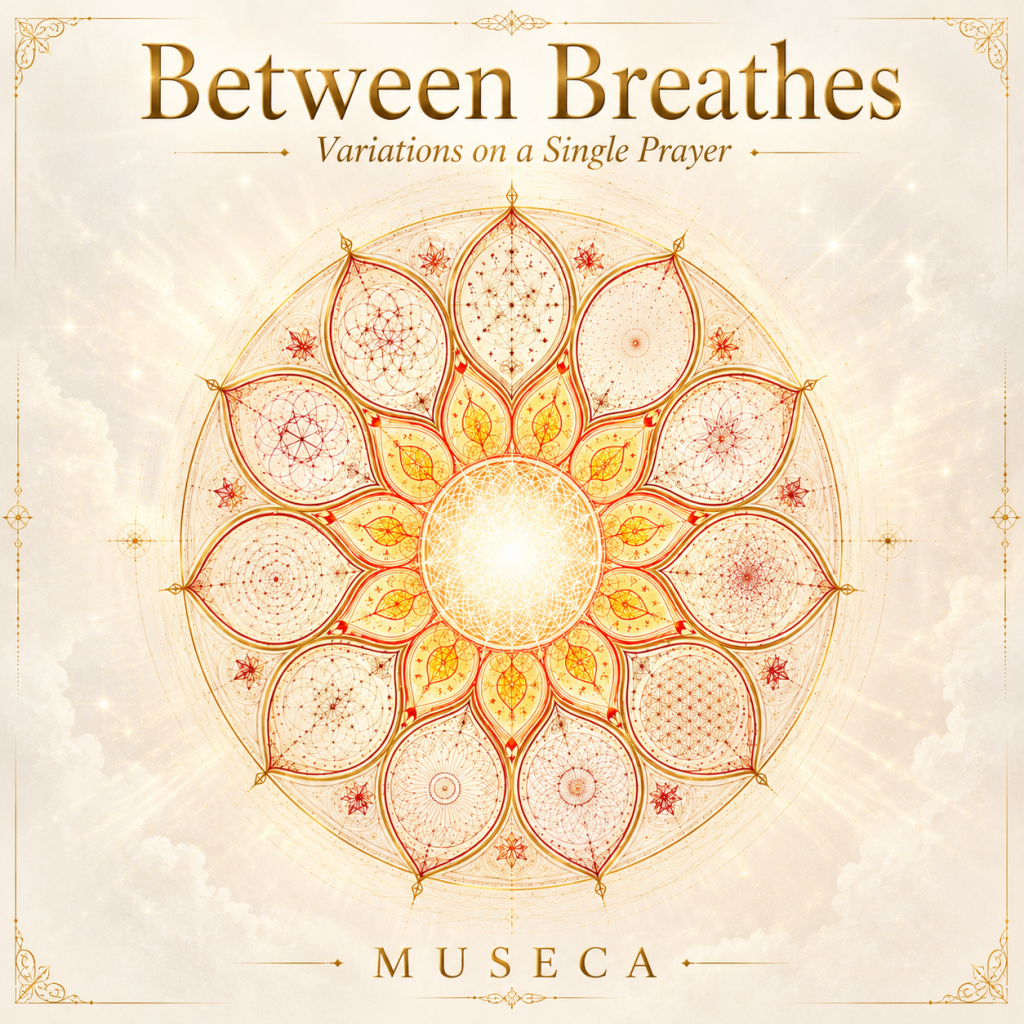
Between Breaths — Introduction
For more than five hundred years, Western composers have returned again and again to a deceptively simple compositional principle: theme and variations. State a musical idea, then transform it. The earliest examples — written for lute and keyboard in the sixteenth century — took popular tunes and dressed them in increasingly elaborate ornamentation. By the eighteenth century the form had grown into an architecture of extraordinary depth: Bach’s Goldberg Variations, his Chaconne in D minor, Handel’s keyboard variation suites. The nineteenth century gave us Beethoven’s Diabelli Variations, Brahms’s variations on Handel and Haydn and Paganini, Tchaikovsky’s Rococo Variations, Elgar’s Enigma. The twentieth century carried the tradition forward with Britten, Copland, Rachmaninoff’s Paganini Rhapsody, Shostakovich’s passacaglias, and dozens of others.
The principle has endured because it satisfies two opposing instincts at once: the pleasure of recognition (the theme returns; we know it) and the pleasure of surprise (the theme is new; we do not). What survives the transformation is what the listener can hold onto. What changes is what the composer wants to reveal.
In nearly all of this history, what persists is some combination of three musical elements: the harmonic skeleton (the chord progression beneath the melody), the phrase structure (the proportions and lengths of musical sentences), and the melodic contour (the recognizable shape of the tune itself). These are the threads. Around them, composers have varied rhythm through faster or slower figuration, texture through fuller or sparser arrangement, mode through a turn from major to minor and back, tempo, occasionally instrumentation, and most rarely affect itself — the underlying emotional character of the music. The melody, the chords, the form: these typically stay. Almost everything else can move.
I wanted to invert this formula.
What if the persistent element were not the melody, not the harmony, not the musical structure at all — but the lyrics? And what if the variable element were the mode itself, the harmonic-emotional grammar through which the same words must pass?
This is the principle of Between Breaths. Eleven tracks, each carrying identical lyrics — a meditation on the triune nature of time and breath, where past, present, and future are revealed as one moment, the still pause between inhalation and exhalation. The words never change from track to track. What changes is the modal world they inhabit.
The eleven modes I chose form a spectrum of emotional and spiritual atmospheres available to Western music. The seven church modes give us Ionian’s bright declaration, Dorian’s wistful longing, Phrygian’s mystical descent, Lydian’s transcendent wonder, Mixolydian’s bardic wisdom, Aeolian’s contemplative sorrow, and Locrian’s unstable threshold. To these I added four synthetic and exotic modes that take the listener further still: whole-tone for weightless suspension, octatonic for visionary otherworldliness, Phrygian dominant for devotional fire, and Hungarian minor for surging dramatic intensity.
Each mode carries its own emotional truth. The same prayer sung in Ionian feels like joyful affirmation; sung in Aeolian, contemplative grief; sung in Lydian, awestruck wonder; sung in Phrygian, mystical descent into sacred darkness. None of these readings is more accurate than another. They are eleven facets of one underlying truth, and the lyrics — written from sensory archetypes of light, breath, hands, sky, water, hush — are flexible enough to live in every one of them.
The album’s structural form mirrors its philosophical content. The triune-reality framework anchoring the lyrics — the idea that every apparent pair of opposites is completed by a unifying third — is enacted by the music itself. One prayer. Eleven manifestations. The listener’s movement through them is the third point that holds the unity and the multiplicity together.
The album opens with Ionian’s clear declaration and proceeds through Mixolydian’s earthy wisdom and Dorian’s longing into Aeolian’s quieter sorrow. It lifts into Lydian’s transcendent wonder before turning inward through Phrygian’s mystical darkness. From there it climbs through Phrygian dominant’s devotional fire to Hungarian minor’s dramatic peak, then begins its slow descent into dissolution: Locrian’s instability, Octatonic’s vision beyond known forms, and finally Whole-tone’s weightless transcendent dissolve into atmosphere and silence.
What persists across all eleven tracks: the lyrics, the soprano voice carrying them, the sacred-minimalism and art-song frame, the felt rather than heard pulse, the contemplative tempo range. What varies: the mode, the harmonic atmosphere it brings, the specific instrumental colors each mode invites, the emotional register the music asks the listener to inhabit.
This is theme and variations turned inside out. Where Bach varied the surface of his Goldberg theme over a fixed harmonic-melodic frame, Between Breaths keeps the words still and lets the harmonic ground beneath them transform. Where the Romantic tradition kept tunes recognizable and reframed them with new ornament, here the tune is reborn in each track and only the prayer remains.
Eleven breaths. One pause between them. The same words, eleven lights through a single window.
Liner Notes
All eleven tracks on this album share the same lyrics — each variation reimagines the song through a different musical mode while keeping the words unchanged.
Lyrics
[Intro]
[Verse 1]
What was given, I am drawing in
Light from old stars in my breath again
Voices remembered, hands I have known
Returning home through this slow inhale
[Chorus]
Between breaths, between breaths
Where time falls still and silence speaks
Between breaths, between breaths
This is where eternity meets
[Verse 2]
What I am holding, I am letting go
Breath becoming wind, becoming sky
Tomorrow released in this gentle flow
A prayer offered up, a quiet sigh
[Chorus]
Between breaths, between breaths
Where time falls still and silence speaks
Between breaths, between breaths
This is where eternity meets
[Bridge]
Here in the pause, here in the hush
Past breath has ended, next breath waits unborn
What was, what is, what will be —
Three faces of one, one moment held
[Final Chorus]
Between breaths, between breaths
Where past and future are one
Between breaths, between breaths
This is where I have always been
Ah-ah-ah, ah-ah-ah
Between breaths
[Outro]
Between Breaths (Ionian — Bright Affirmation)
The prayer in its clearest light: major harmony, settled and luminous, the words sung as though the truth needed no defense. This is the album’s opening declaration — a ground from which all other readings depart, and to which they all return in spirit.
Between Breaths (Mixolydian — Bardic Wisdom)
A folk-rooted reading where the prayer feels ancient, ancestral, carried as though by an elder around a quiet fire. The flatted seventh tilts the harmony toward something earthier, less polished, more human — wisdom that has been spoken for a long time before reaching this voice.
Between Breaths (Dorian — Hopeful Longing)
The minor that does not surrender to sadness. Here the prayer leans into tenderness — a wistful reaching toward what is not yet held — but the raised sixth keeps the harmony alive with possibility. The cello sings beside the voice as though answering it.
Between Breaths (Aeolian — Quiet Sorrow)
Natural minor at its most Górecki-like: the prayer offered through grief, slow and held, the words coming from a place deeper than joy can reach. This is the album’s first descent — sorrow not as despair, but as a form of presence, a way of being awake to loss.
Between Breaths (Lydian — Transcendent Wonder)
The raised fourth opens the harmony toward a sky no other mode can reach. Here the prayer becomes astonishment — the recognition, mid-breath, that what one was looking for has been here all along. Harp and bells move like light across water.
Between Breaths (Phrygian — Mystical Descent)
The flatted second draws the prayer downward into sacred mystery. This reading lives in the territory of Tavener, of Byzantine icon, of cathedrals where the dark is welcome and not feared. The organ drone holds the floor; the voice carries a candle into the depth.
Between Breaths (Phrygian Dominant — Devotional Fire)
Phrygian made passionate. The same descent, now lit from within. A nylon guitar haunts the edges; the rhythm sways more openly. The prayer becomes flame — devotion not as restraint, but as the body’s own ignition into love.
Between Breaths (Hungarian Minor — Surging Contemplation)
The most dramatic reading on the album. Two augmented seconds in the scale give the harmony nowhere to rest, and the prayer surges with them — the violin straining toward height, the soprano answering. This is the emotional peak before the long descent into dissolve.
Between Breaths (Locrian — Edge of Transformation)
The mode of the unsettled tonic. The harmony cannot resolve; the prayer hangs in mid-air, waiting. This is the dark threshold — the moment before transformation, where the ground is still falling away. Brief, necessary, sacred in its instability.
Between Breaths (Octatonic — Vision Beyond)
A scale of alternating whole and half steps gives the music a non-Western, visionary quality. The prayer crosses out of the familiar and enters something dreamlike — Stravinsky’s supernatural color rendered as contemplation. Soft bells suggest an interior light moving through the dark.
Between Breaths (Whole-tone — Transcendent Dissolve)
Six pure whole steps, no resolution available. The harmony floats; nothing pulls toward home, because everything has become home. The prayer dissolves into atmosphere, the voice releasing the words back into breath. The album ends not with declaration but with absorption — the listener released into silence.
Playlist
- Track 1 — Between Breaths (Ionian / Bright Affirmation) Museca 4:13
- Track 2 — Between Breaths (Mixolydian / Bardic Wisdom) Museca 3:10
- Track 3 — Between Breaths (Dorian / Hopeful Longing) Museca 3:30
- Track 4 — Between Breaths (Aeolian / Quiet Sorrow) Museca 3:00
- Track 5 — Between Breaths (Lydian / Transcendent Wonder) Museca 3:45
- Track 6 — Between Breaths (Phrygian / Mystical Descent) Museca 3:40
- Track 7 — Between Breaths (Phrygian Dominant / Devotional Fire) Museca 3:00
- Track 8 — Between Breaths (Hungarian Minor / Surging Contemplation) Museca 4:00
- Track 9 — Between Breaths (Locrian / Edge of Transformation) Museca 3:45
- Track 10 — Between Breaths (Octatonic / Vision Beyond) Museca 3:49
- Track 11 — Between Breaths (Whole-tone / Transcendent Dissolve) Museca 3:36