
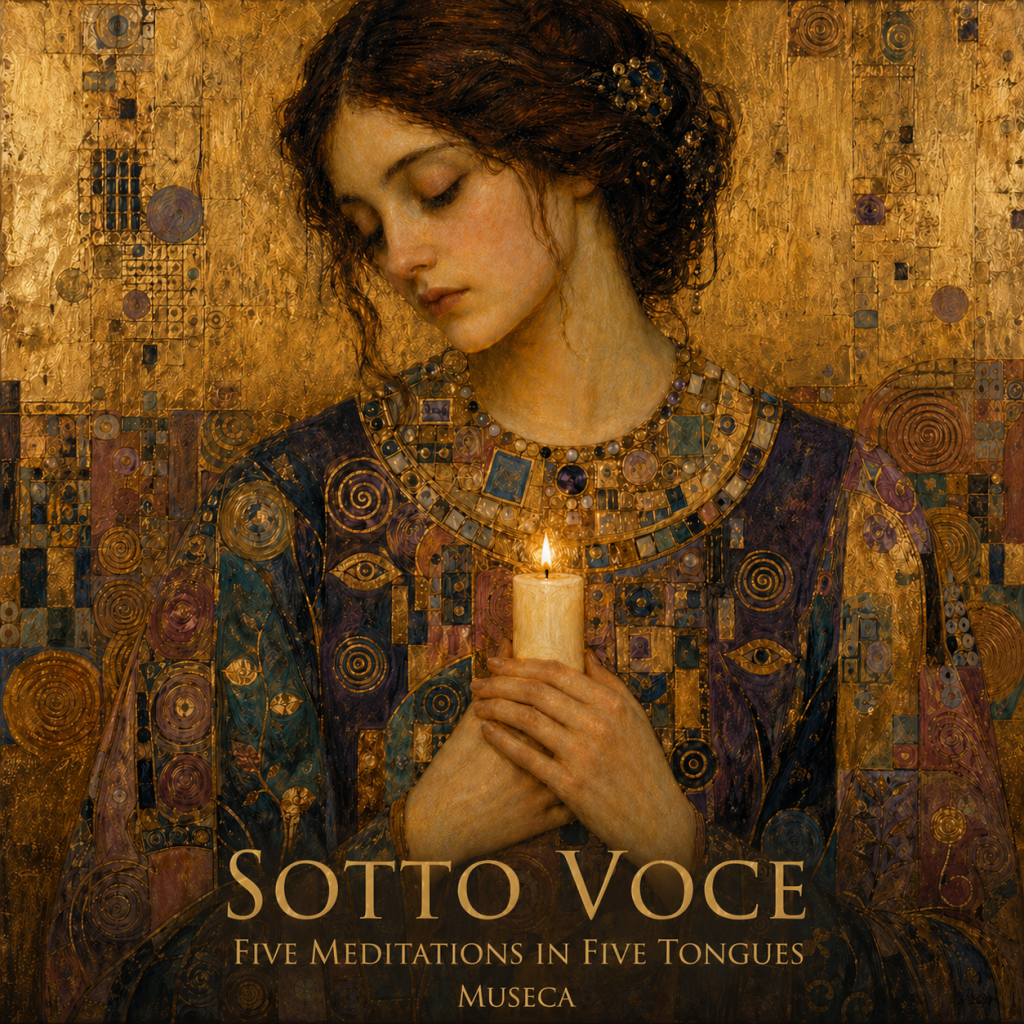
Sotto Voce: Five Meditations in Five Tongues
Sotto Voce is a classical-crossover album of original songs in the lineage of Paul Schwartz’s Aria series and Emma Shapplin’s Carmine Meo — operatic soprano, live-feeling orchestral textures, and Café del Mar–inflected downtempo grooves. But where Schwartz adapted the great operatic arias and Shapplin sang in pseudo-classical Italian, Sotto Voce takes a different path. Every melody, every lyric, every emotional arc is original. The album traces the journey of a single soul through five spiritual states, each rendered in a different European language.
Five meditations. Five languages. Five different stations of the inner life:
Il Silenzio dentro (Italian / Longing) — the soul reaches inward and discovers the Divine Presence she has been seeking far away has always been within her own interior dwelling.
Émerveillement (French / Wonder) — she opens her eyes in a twilight garden and recognizes that same Presence now in the world outside.
Smireniye (Russian / Surrender) — she yields everything she has been holding to time itself, in the Vocalise tradition of Rachmaninoff and the late Tchaikovsky symphonies.
Freude (German / Joy) — first light returns, and she rises into earned celebration in the warmly radiant register of late Strauss’s Vier letzte Lieder.
Peace (English / Homecoming) — she comes home and speaks plainly in the listener’s tongue, in the English art-song tradition of Vaughan Williams and Samuel Barber.
Three instrumental interludes shape the arc between vocal tracks. Aurora lifts the album into morning after the opening Italian meditation. Psyche descends into the soul-figure herself at the album’s deepening point. Umbra is the held breath at the very bottom — the threshold between surrender and the return of light.
The Sound
Across all eight tracks, Sotto Voce honors the same sonic DNA: a light lyric soprano floating sotto voce over real-feeling string textures, with each track shaped by the classical tradition of its language — Respighi and Casella for the Italian; Debussy, Ravel, and Fauré for the French; Rachmaninoff and Tchaikovsky for the Russian; Strauss and Brahms for the German; Vaughan Williams and Barber for the English.
Beneath the orchestra, a Café del Mar–style downtempo pulse breathes warmly, never propulsive — a heartbeat continuing under contemplative music. Tempos sit in the meditative zone (60–78 BPM); harmonies favor modal inflections, plagal cadences, and slow harmonic rhythm. Production includes subtle analog tape warmth, divisi string shimmer, harp arpeggios, distant bell chimes at moments of luminosity, and wordless choirs that bloom only at specific climactic moments — once in Italian (high female voices ascending in Track 1), once in Russian (low male Orthodox voices descending in Track 5), once in German (mixed voices integrating in Track 7).
The Architecture
Each vocal track is anchored on a single recurring word in its native language — Silenzio, Merveille, Vremya, Wunder, Here — that returns at the end of each verse, creating a meditative axis. Across the album, these anchor words are in conversation: each track’s recognition echoes through the others. The Italian “You are here” in Track 1 becomes the French “You are here too” in Track 3, the Russian surrender of even one’s own silence in Track 5, the German “I and You find each other” in Track 7, and the English “And it is enough” in Track 8.
Liner Notes
Il Silenzio dentro
(The Silence Within — Italian, Longing)
I open the album with the soul reaching far away, seeking what she did not yet know was inside her. The setting is Italian Post-Romantic and Impressionist — the harmonic world of Respighi and Casella — floated over a warm Café del Mar groove. A light lyric soprano sings sotto voce, accompanied by solo cello as her intimate companion, divisi string shimmer, harp, and small touches of celesta. The text draws on the Italian mystical tradition of Saint Teresa’s interior dwelling and Saint John of the Cross’s hidden flame, written in contemporary poetic Italian with archaic flourishes. The word Silenzio anchors each verse and returns at the album’s first climax as a wordless soprano choir blooms beneath the soloist — the anima mundi answering the human voice. The song closes on a final whispered silenzio, dissolving into the album’s first dawn.
Lyrics (Italian/English)
Verse 1
Ti cercavo lontano,
I was seeking You far away,
oltre il mare, oltre il cielo,
beyond the sea, beyond the sky,
in ogni luce accesa,
in every kindled light,
in ogni voce che passa.
in every passing voice.
Ma la soglia era qui,
But the threshold was here,
dentro la mia dimora —
within my own dwelling —
una stanza di neve,
a room of snow,
una fiamma che attende.
a flame that waits.
Anchor
E nel cuore profondo,
And in the deep heart,
tu rispondi in…
You answer in…
Silenzio.
Silence.
Verse 2
Chiudo gli occhi al rumore
I close my eyes to the noise
del mondo che mi chiama,
of the world that calls me,
e discendo pian piano
and I descend slowly
nella mia casa antica.
into my ancient house.
Lì rifulge una luce
There, a light shines forth
che non viene dal giorno,
that does not come from day,
una candela accesa
a candle kindled
dalle mani dell’eterno.
by the hands of the eternal.
Anchor
E t’udivo, o Presenza,
And I was hearing You, O Presence,
mi parlavi in…
You were speaking to me in…
Silenzio.
Silence.
Climax
Sei qui, sei qui,
You are here, You are here,
nell’intimo segreto,
in the intimate secret,
fiamma che non consuma,
flame that does not consume,
voce che non si spegne.
voice that does not extinguish.
Coda
Ti cercavo lontano…
I was seeking You far away…
eri dentro di me.
You were within me.
— silenzio —
— silence —
Prelude: Aurora
Between the inward recognition of the first track and the outward marveling of the third, Aurora opens the album’s daylight. Solo harp leads, playing a rising Lydian-mode dawn figure answered by silvery solo flute, with solo cello entering late as warm grounding. Divisi string shimmer hangs as hazy background; celesta places two or three sparkles like dew-drops; a distant bell sounds at the moment of peak luminosity. The interlude is sacred-quiet, Respighi-pale, slowly unfolding — pale gold light spreading through an interior room.
Émerveillement
(Marveling — French, Wonder)
A French meditation on outward wonder. A woman stands alone in a twilight garden as the light fades; jasmine perfumes the air, violet descends from the sky, silver rises from the foliage, and the first stars appear one by one. Musically, the track blends Debussy and Ravel’s Impressionist orchestral language with the intimate art-song tradition of Fauré, scored over a Café del Mar twilight variant — cooler than the album’s opening, more evening-blue than sunset-gold. Solo English horn is the soprano’s aching companion; solo violin appears at two glassy moments, playing harmonics that shimmer like first silver. The text is contemporary poetic French shaded with Verlaine and Baudelaire’s tristesse. The anchor word Merveille returns at the end of each verse; at the climax, the soprano sings the album’s first true cross-track recognition: “Tu es ici aussi” — You are here too. The Divine she found within in the first track is also in the world.
Lyrics (French/English)
Verse 1
Le jour s’en va, la rose pâlit,
The day is leaving, the rose grows pale,
l’air se parfume de jasmin.
the air perfumes itself with jasmine.
Je reste seule au bord du soir,
I remain alone at the edge of evening,
les mains ouvertes, sans dessein.
hands open, without plan.
Un violet descend du ciel,
A violet descends from the sky,
un argent monte des feuillages.
a silver rises from the foliage.
Je respire ce qui s’efface,
I breathe in what is fading,
la beauté qui passe, qui nage.
the beauty that passes, that swims.
Anchor
Et mon cœur s’arrête, muet
And my heart stops, silent
devant cette…
before this…
Merveille.
Marvel.
Verse 2
Une étoile, puis deux, puis trois,
One star, then two, then three,
comme si le ciel se souvenait.
as if the sky were remembering.
Le jasmin tremble, le silence chante,
The jasmine trembles, the silence sings,
la terre tiède se tait.
the warm earth falls quiet.
Tout ce qui passe est infini
All that passes is infinite
un instant, avant de mourir.
for an instant, before dying.
Et je comprends, sans le comprendre,
And I understand, without understanding,
pourquoi les anges doivent venir.
why the angels must come.
Anchor
Et mon âme s’incline, muette
And my soul bows down, silent
devant cette…
before this…
Merveille.
Marvel.
Climax
Tu es ici aussi,
You are here too,
dans le parfum, dans le silence,
in the perfume, in the silence,
dans l’étoile qui s’allume,
in the star that lights itself,
dans ce cœur qui reconnaît.
in this heart that recognizes.
Coda
Le soir tombe… tu demeures.
Evening falls… You remain.
Je ne savais pas, je sais.
I did not know, I know.
Interlude: Psyche
Named for the Greek mortal who became the goddess of the soul, Psyche turns the album inward and downward at its deepening point. Solo cello — the soul instrument given the soul’s name — plays a slow descending Phrygian theme in its lowest register; harp anchors with low sustained chords; restrained upper-string shimmer hangs as distant fog. At the deepening center, a single distant wordless soprano vocalise enters from far away, sustaining one vowel like the soul-figure herself appearing in the music. There is no celesta, no bell, no sparkle anywhere — Psyche is the album’s one un-twinkling track. The interlude dissolves downward into silence, arriving at the depth where surrender becomes possible.
Smireniye (Смирение)
(Surrender / Humility — Russian, Surrender to Time)
The album’s emotional bottom and longest track, drawing on Late Romantic Russian tradition with Rachmaninoff’s Vocalise as the single most important reference point. Surrender here is not Orthodox-mystical but romantic-fatalistic: the Tchaikovsky Pathétique and Akhmatova-and-Pasternak emotional register — the soul yielding to time itself, to mortality, to the universal facts she cannot fight. The Russian-adapted soprano sings in the warmer middle voice of Hibla Gerzmava and the early Anna Netrebko, full of the famous taska color (soulful melancholy that weeps on every note). Solo French horn carries the Russian horn-call tradition, joined by solo violin in a high lonely weeping register, with the brief return of the English horn from Émerveillement as a thread between tracks.
At the climax, a single low tam-tam stroke is followed by Russian Orthodox-style wordless male choir entering underneath the soloist — basses and baritones in deep open chords, the descending counter-architecture to the first track’s ascending female choir. The text, in literary Russian shaded with Akhmatova-precise body imagery, builds toward the climax word Tishinu — silence — the soul surrendering even her own interior silence to time. The track ends not in fade but in plagal Amen-cadence resolution at the lowest register: “Ya znayu. Ya molchu.” — I know. I am silent.
Lyrics (Russian/English)
Verse 1
Ya bol’she ne derzhu
I no longer hold
ni leta, ni rassveta,
neither summer, nor the dawn,
ni golosa togo,
nor that voice
chto otzvuchal kogda-to.
which once sounded.
Raskrylis’ dve ruki,
Two hands opened,
i tishina legla mne
and silence laid itself upon me
ladonyami na grud’ —
palms on my breast —
prozrachnaya, kak plamya.
transparent, like a flame.
Anchor
I vsyo, chto bylo, stalo
And all that was became
vsego lish’…
only…
Vremya.
Time.
Verse 2
Reka nesyot listy,
The river carries leaves,
ya bol’she ne schitayu
I no longer count
ni tekh, chto unesla,
neither those it has carried away,
ni tekh, chto prinimayu.
nor those I receive.
Ya vizhu: vsyo techyot
I see: everything flows
k odnoj i toj zhe taine.
toward one and the same mystery.
Ya vizhu — i sklonyayus’,
I see — and I bow down,
kak travy na zakate.
like grasses at sunset.
Anchor
I vsyo, chto budet, stanet
And all that will be will become
vsego lish’…
only…
Vremya.
Time.
Settling
Aaaah…
(wordless vocalise)
Climax
Ya otdayu, ya otdayu —
I give over, I give over —
dykhanie, i leto, i zaryu.
breath, and summer, and the dawn.
Beri zhe vsyo, beri i etu
Take it all, take even this
poslednyuyu moyu…
my last…
Tishinu.
Silence.
Coda
Ya bol’she ne derzhu.
I no longer hold.
Ya slyshu, kak ty dyshish’…
I hear You breathing…
I eto vsyo. Ya znayu.
And this is everything. I know.
Ya znayu. Ya molchu.
I know. I am silent.
Interlude: Umbra
Latin for shadow, Umbra is the held breath at the album’s structural pivot — the moment between descent and ascent. Where Aurora lifted and Psyche descended, Umbra holds still. Solo viola leads — the album’s untouched string-family voice, occupying the middle register that embodies the threshold itself — playing a slow gathered Aeolian phrase that returns to its starting note rather than opening outward. A sustained quiet organ pad provides atmospheric ground. At the pivot moment in the center of the track, a brief whole-tone shimmer creates a moment of timeless suspension. There is no kick drum, only sub-bass pulse felt more than heard. The track is the album’s most stripped-down, most genuinely suspended moment.
Freude
(Joy — German, Earned Celebration)
After surrender and the held breath, first light returns. The German tradition, rendered in the warmly radiant register of late Strauss’s Vier letzte Lieder — particularly Im Abendrot — with Brahms’s late period as secondary influence. Joy here is earned: it has passed through suffering and surrender, and rises anyway. The light lyric soprano draws on Lucia Popp and Elisabeth Schwarzkopf in their Strauss repertoire, singing with German innigkeit — heartfelt-inwardness — over a Café del Mar dawn-variant chillout bed. Solo oboe is the bright-aching German companion; solo cello returns in its mid-to-high singing-tenor register in the Brahms chamber-music color.
The text integrates the album’s prior recognitions: “I knew you from within, I knew you from the day, I gave you over to time.” The anchor word Ja — yes — closes each verse; the soul’s complete affirmative answer to all that has been. At the climax, a brief upward modulation lifts the harmony, a distant bell sounds, and a mixed wordless choir enters underneath the soloist — both male and female voices, full register integrated. The soprano executes the album’s only true vocal flourish on the climax word Wunder: “Ein einziges Wunder durch alle Welt gedacht — das Ich und Du sich finden am Ende dieser Nacht.” — One single wonder thought through all the world — that I and You find each other at the end of this night.
Lyrics (German/English)
Verse 1
Das Licht kehrt wieder,
The light returns,
ganz leise, ohne Wort.
very softly, without word.
Ich öffne meine Augen —
I open my eyes —
es war die ganze Nacht schon dort.
it was there all night.
Ich kannte dich von innen,
I knew You from within,
ich kannte dich vom Tag,
I knew You from the day,
ich gab dich hin der Zeit —
I gave You over to time —
und du bleibst, wie du magst.
and You remain, as You wish.
Anchor
Und alles, was ich war,
And all that I was
spricht endlich nur noch…
finally speaks only…
Ja.
Yes.
Verse 2
Ich danke dir das Schweigen,
I thank You for the silence,
ich danke dir den Schmerz,
I thank You for the pain,
ich danke dir das Warten,
I thank You for the waiting,
das Wachsen meines Herz’.
for the growing of my heart.
Du warst in jeder Stille,
You were in every silence,
du warst in jeder Träne,
You were in every tear,
du bist in diesem Morgen,
You are in this morning,
in dieser klaren Szene.
in this clear scene.
Anchor
Und alles, was ich werde,
And all that I will be
spricht weiter nur noch…
continues only…
Ja.
Yes.
Climax
Ein einziges Wunder
One single wonder
durch alle Welt gedacht —
thought through all the world —
das Ich und Du sich finden
that I and You find each other
am Ende dieser Nacht.
at the end of this night.
Coda
Das Licht ist hier.
The light is here.
Ich danke dir. Ich bin.
I thank You. I am.
Ich bin. Das ist genug.
I am. That is enough.
Peace
(English, Homecoming)
After seven tracks of foreign-language elaboration, the soul speaks plainly in the listener’s tongue. Peace is the album’s homecoming and its simplest setting. The English Pastoral tradition (Vaughan Williams, Howells) blended with American art-song (Samuel Barber’s Sure on this shining night as the single most apt reference). Solo piano is essentially the only instrument — Schubert-lieder accompaniment style, simple and chordal, never showy. The reverb is intimate and close-to-dry rather than cathedral; the voice sits forward and vulnerable, returning to a small warm room after the larger spaces of the prior tracks. The brief late return of the solo cello in the coda — the cello that grieved as lead in Psyche — appears now as a warm grounding presence, completing the album’s instrumental arc.
The text states the album’s recognition in plain English, beginning with: “I have come a long way to arrive where I began. The door I was looking for was the one I was standing in.” The anchor word Here closes each verse — the deepest single English word, the simplest possible statement of the here-ness the album has been about. The bridge reaches the album’s central thesis: “There is a peace that is not the absence of anything. It is the presence of what was always here.” The closing four lines summarize all eight tracks: “The light is here. The light has always been here. And I am here. And you are here.” The album ends with the threefold repetition “And it is enough. It is enough. It is enough.” — sustained final piano chord held in plagal Amen-cadence resolution, landing rather than fading away.
Lyrics
Verse 1
I have come a long way
to arrive where I began.
The door I was looking for
was the one I was standing in.
Nothing has been added.
Nothing has been taken away.
The light I wanted is the light
I have been seeing all day.
Anchor
And I lay down what I carried.
I let everything be…
Here.
Verse 2
I was looking for a country
in every face I knew.
I was asking for a country
of every word I drew.
The country was the asking.
The country was the eyes.
The country was the long way home
through every bright disguise.
Anchor
And I open both my hands now.
I let it all be…
Here.
Bridge
There is a peace
that is not the absence of anything.
It is the presence
of what was always here.
You were the seeker.
You were the sought.
You were the silence
the song was teaching.
Coda
I have nothing to give You
but what You have given me.
I have nothing to say to You
but what the silence said.
The light is here.
The light has always been here.
And I am here.
And You are here.
And it is enough.
It is enough.
It is enough.
Playlist
- Il Silenzio dentro (The Silence Within) Museca 4:09
- Prelude: Aurora Museca 3:43
- Émerveillement (Marveling) Museca 4:40
- Interlude: Psyche Museca 3:50
- Track 5: Smireniye Museca 4:52
- Interlude: Umbra Museca 4:29
- Freude (Joy) Museca 4:24
- Peace Museca 4:59